The USDA is now accepting applications for grants to help agricultural producers maximize the value of their products and venture into new and better markets.
The USDA is making the grants available under the Value-Added Producer Grants program. (Click that link to go to the USDA webpage about the grant) The grants help farmers and ranchers generate new products, create marketing opportunities, and increase their incomes through value-added activities.
Eligible applicants include independent producers, agricultural producer groups, farmer or rancher cooperatives, and majority-controlled producer-based business ventures.
The USDA may award up to $75,000 for planning activities or up to $250,000 for working capital expenses related to producing and marketing a value-added agricultural product.
Planning activities may include conducting feasibility studies and developing business plans. Working capital expenses may include costs associated with processing, marketing, advertising, inventory and salaries.
The USDA is particularly interested in applications that will advance Biden-Harris Administration priorities to:
• Reduce climate pollution and increase resilience to the impacts of climate change through economic support to rural communities.
• Ensure all rural residents have equitable access to Rural Development (RD) programs and benefits from RD-funded projects;
• Help rural communities recover economically through more and better market opportunities and through improved infrastructure.
Here is great information on the grant program sent out after the webinar. It explains a lot about the program and helps know better how to apply. Just click this link. (Value Added Producer Grant Info).
Paper applications must be postmarked and delivered by mail, email or in person to the state office where the project is proposed by close of business on April 16, 2024. Electronic applications will be accepted via Grants.gov until 11:59 p.m. Eastern Time on April 11, 2024.
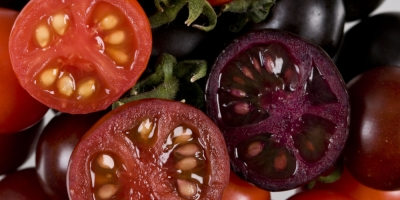
This is a picture of the “Purple Tomato” developed and sold by Norfolk Healthy Produce. According to the press release from the John Innes Centre it is a high-anthocyanin purple tomato developed nearly 2 decades ago. Here are a couple of paragraphs from the article below.
Nathan Pumplin, CEO of Norfolk Healthy Produce, said: “We are thrilled to offer these first-of-a-kind seeds to home gardeners. Our tomato is just a tomato – you can grow it in your garden next to your Sun Golds and Purple Cherokees, and other favorite varieties. We share our gratitude to the thousands of fans who have expressed their interest and encouragement through our website.”
The company says that surveys with American consumers showed that 80% are interested to eat, purchase and grow the purple tomato, knowing that it is bioengineered (as a genetically modified organism, or GMO). Only 5% of consumers were not interested. I seriously doubt this last sentence and wonder how accurately they surveyed customers!
These pictures are of the YOOM tomato. This purple tomato was introduced last year and as you can see also has the purple color and because of that color it has high anthocyanins like other purple vegetables and fruit.
The Yoom tomato is not developed using GMO technology like the “Purple Tomato.” Instead, Yoom tomatoes are the result of conventional breeding techniques. These techniques involve selecting parent plants with desirable traits and crossbreeding them over multiple generations to produce offspring that express those traits. The Yoom tomato, known for its distinctive purple color and high levels of antioxidants, particularly anthocyanins, was developed through this traditional method of plant breeding.(Article in Vegetable Grower News)
The purple color is a natural trait that some tomato varieties exhibit, enhanced through the selection process to appeal to consumers looking for novel and potentially healthier options in their diets. The development of such varieties focuses on enhancing flavor, nutritional content, and visual appeal without the need for genetic modification techniques like CRISPR-Cas9 or GMO.
Conventional breeding remains a powerful tool in developing new plant varieties, allowing for the gradual improvement of crops with respect to taste, yield, disease resistance, and nutritional content. While CRISPR technology offers precise gene editing capabilities, it’s important to distinguish between crops developed through genetic modification and those, like the Yoom tomato, that are the result of selective breeding practices.
Organic growers need to be aware of this powerful difference and don’t be fooled by others who want you to grow the Purple Tomato without realizing the difference. Recently I was asked about organic farmers growing the Purple Tomato. I was caught completely unaware because I knew about YOOM and so thought this was the tomato they were referring to. It was not the YOOM, and you need to know it is not legal or ethical for you to grow the “Purple Tomato” unless you grow the YOOM Purple Tomato.
Lastly, YOOM is not a certified organic seedvariety (YET), at least that I can find. There may be some organic seed offered soon but you will need to talk to your certifier about using conventional YOOM seed based on the fact that it is from conventional breeding and is the only tomato variety with these traits.
News Updates below: Click links for a new twist to this story!
Plant breeders and seed retailers are increasingly living in fear of legal threats from GMO developer companies. Report: Claire Robinson
The company that is commercializing the GM purple so-called “anti-cancer” tomato has targeted a non-GMO heirloom seed company over alleged patent infringement.
(Click the heading above for a link to this article)
Finding a corn variety adapted to Texas extremes can be very difficult. At this time, I just don’t know of too many certified organic corn varieties that can make it through the difficult hot nights in most of Texas except maybe the northern panhandle area of Texas. Even in those area many growers have tried to bring in corn varieties popular in the Midwest and they just don’t yield well.
That said, I have tried to list varieties that Texas organic growers have grown and continue to grow. The companies listed may or may not have varieties adapted to Texas, but you have their contact information to check. If you see anything I need to add, change or delete please let me know. This is an ongoing project and one that will continually be updated and changed.
This list does not necessarily mean that these companies have corn varieties adapted for Texas. Companies continue to develop varieties that work in areas they have not traditionally grown in and so some testing helps know and use new materials.
Pioneer
I am in contact with Pioneer to get contact information soon. Till then check with your local rep if you have one?
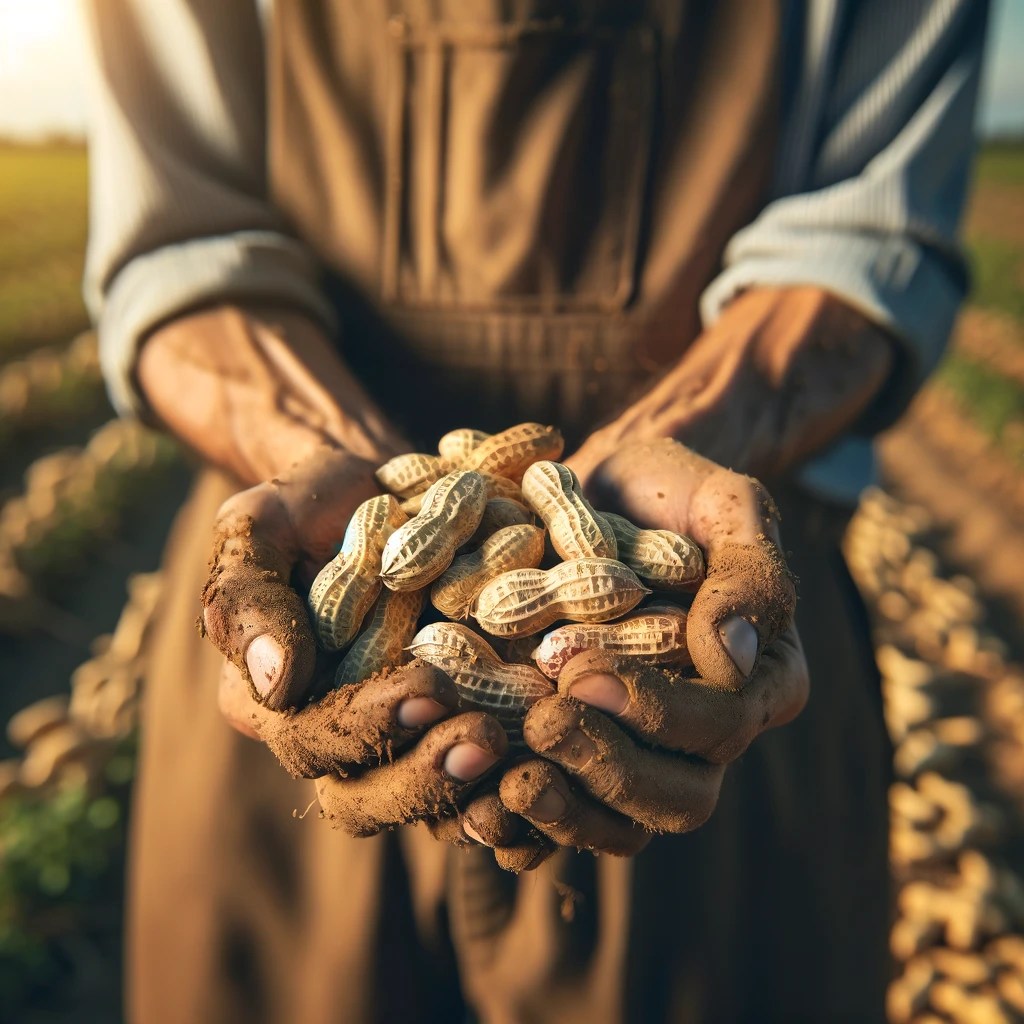
If you are interested in growing organic peanuts, they are a great crop and an excellent rotation to other non-legume crops. Fortunately, peanut varieties have never been developed with genetic engineering and so there is no worry about that issue. The potential is there for breeders, but the industry has stayed away from that type of breeding because of consumer preferences. Be sure that any seed treatments applied are OMRI approved and okayed by your certifier.
Here are few things you might find interesting or helpful as you think about organic cotton planting in a few months (weeks). I will update this as I get new information, but it will be “here” to help anytime you need it.
If there is anything I need to add or change, please let me know. I want to keep this as up to date as possible. Click link in this Table of Contents below to scroll down.
Commercial Varieties Developed without Genetic Engineering Methods. Be sure that any seed treatments applied are OMRI approved and okayed by your certifier.
Upland Varieties
Americot – UA48 (talked to Dr. Robert Lemon with NexGen and they hope to have some commercial varieties good for organic in a few growing seasons.)
Brownfield Seed & Delinting – Varieties: BSD 224, BSD 4X, BSD 598, BSD 9X, Ton Buster Magnum. Currently, one new Tamcot variety is being reviewed for future commercialization and BSD has 2 new varieties being reviewed for future commercialization.
ExCeed Genetics – 6447 or 4344 (May Seed from Turkey where they do not grow GE cotton.)
International Seed Technology (IST) – BRS 286, BRS 293, BRS 335, BRS 2353. Varieties from Brazil and certified in Texas.
Pima or Pima hybrids
Gowan – 1432
Cottonseed Quality – It Matters!
Cottonseed is sold in 50lb. bags as you all know but the number of seed in a bag can be drastically different depending on the variety. Typically, we see 220,000 – 230,000 seed or about 4,500 seed per pound but over the years we have seen cottonseed size go down such that we can have varieties approaching 6,000 seed per pound.
Seed germination for cotton is determined using two methods. A warm seed germination test would be to put the seed through 16 hours of 68 degrees then 8 hours of 86 degrees and do this for 4 days. Calculate the % germination which is the germinated seed number divided by the number of seed tested. 80 germinated seed/100 beginning seed tested * 100 = 80%
A cool seed germination test is simply keeping the seed at a constant 64.5 degrees for 24 hours for 7 days. Calculate the % germination.
If you want to read more about cotton seed testing this is a very recent article that is very helpful. Cotton Seed Quality Program Update
No organic producer should ever begin planning for a crop without first organizing with a buyer to buy the crop. Cotton is not a crop to grow without a buyer since even storage can be difficult unless arranged in advance.
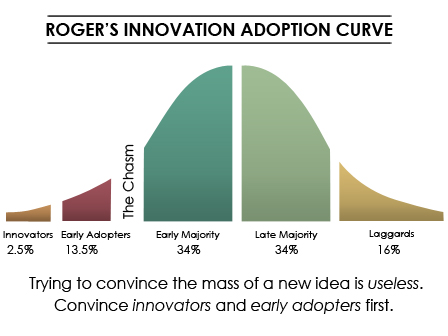
In my career as an Extension professional (extension agent, researcher, specialist) I have had a lot of agriculture training, but I have also had a lot of training for training agriculturists which includes just about every group in agriculture today. One of the early lessons we learned was a simple theory about learning called the Rogers’ Adoption Curve.
I couldn’t begin to tell you much about Rogers or his overall work as an educator, but I do know about this curve and in my career this “curve” has proven to be true over and over again. What you see in this picture is the classic “bell curve” representing the concept of knowledge or technology. People who adopt new knowledge or technologies are represented along the bottom axis and the progression is from left to right, i.e. the first to adopt are on the left and over time the others adopt the technology. So, looking at this we see that the first group to adopt the technology are innovators followed by early adopters and so on. This picture shows a break called “The Chasm” between early adopters and early majority. This chasm is difficult to cross and can represent a lot of time or even failure for the technology.
Organic farmers are mostly in the innovator/early adopter category. Organic agriculture is not easy and in general requires a good knowledge of agriculture systems before getting into the details of growing organic. As an extension educator I tend to try and find innovators and early adopters to work on demonstration or research projects because I know they are just as anxious to explore new technologies as I am.
That said, let me ask you where you are today? Occasionally we need to take a break and get away from it all because we are falling into the late majority or laggard category doing the same thing we always did. Don’t lag too far behind because as you can tell from the “curve” there are a lot of people already on the downhill slide!
Using the Curve!
Rogers’ Adoption Curve is a model that outlines the adoption process of new technologies or ideas through different segments of a population. Developed by Everett Rogers in 1962, it’s widely used in the fields of social science, marketing, and innovation management but is very useful in organic agriculture too.
Rogers’ Adoption Curve is an effective tool for understanding how new practices, like organic agriculture, are adopted within a community. Extension professionals can use this model to tailor their educational and promotional strategies for organic agriculture to different segments of the agricultural community.
Innovators (2.5% of the Population)
Characteristics: These are the first individuals to adopt an innovation. They are risk-takers, have financial liquidity, are social networkers, have closer contact with scientific sources and interaction with other innovators.
Role in Adoption: Their acceptance of an innovation is a key step in the process. Being a small segment, they serve as a testing ground and are crucial in initial debugging or refinement of the product or idea.
Targeting Innovators
Approach: Provide detailed, technical information on organic agriculture, focusing on innovation and environmental benefits.
Why: Innovators are keen to experiment with new techniques and can provide valuable feedback.
Example: Conducting pilot projects with innovators to demonstrate the efficacy of organic practices.
2. Early Adopters (13.5% of the Population)
Characteristics: This group has the highest degree of opinion leadership among the other adopter categories. They are typically younger, more socially forward, and have a higher social status and more financial lucidity.
Role in Adoption: Early adopters are crucial for the validation and initial dissemination of the innovation. Their acceptance acts as an endorsement, influencing the next wave of adopters.
Engaging Early Adopters
Approach: Emphasize the social and economic benefits of organic agriculture. Use early adopters as role models.
Why: Early adopters have strong influence over their peers. Their success stories can inspire others.
Example: Showcasing successful organic farms managed by early adopters in workshops and field days.
3. Early Majority (34% of the Population)
Characteristics: They adopt an innovation after a varying degree of time. This period is significantly longer than the innovators and early adopters. They are typically more deliberate before adopting a new idea, often influenced by interactions with peers.
Role in Adoption: Their adoption is a pivotal point in the lifecycle of an innovation, marking the moment when an innovation reaches a critical mass of users.
Convincing the Early Majority
Approach: Focus on practicality and the mainstream benefits of organic farming. Provide evidence of success from early adopters.
Why: The early majority are cautious and need proof of effectiveness.
Example: Organizing farm tours to successful organic farms and creating user-friendly guides.
4. Late Majority (34% of the Population)
Characteristics: This group is skeptical about change and will only adopt an innovation after the majority of society has embraced it. They typically have below-average social status and financial liquidity.
Role in Adoption: Their adoption signifies the innovation has become mainstream. They usually require external pressures from peers or societal changes for adoption.
Addressing the Late Majority
Approach: Use peer pressure and economic incentives. Highlight the risks of not adopting organic practices.
Why: Late Majority are skeptical and influenced by the norms established by the majority.
Example: Offering financial assistance or subsidies for transitioning to organic farming.
5. Laggards (16% of the Population)
Characteristics: They are the last to adopt an innovation. Unlike some of the previous categories, they aren’t looking for information on new ideas and are focused on traditions. They tend to be of an older age, lower in social status, and less financially fluid.
Role in Adoption: Their adoption is usually not vital for the overall success of an innovation but signifies complete market saturation.
Reaching Laggards
Approach: Use personal relationships and focus on tradition and security aspects of organic farming.
Why: Laggards are resistant to change and trust familiar faces and traditional methods.
Example: One-on-one meetings, focusing on how organic farming aligns with traditional farming values.
Importance in Agriculture Extensionand Teaching Organic
In the context of agriculture extension, understanding Rogers’ Adoption Curve is vital. It helps in identifying the right strategies to promote new agricultural practices or technologies. By recognizing the characteristics and motivations of each group, extension professionals can tailor their approach, ensuring that innovations are adopted effectively across different segments of the farming community.
For example, introducing organic farming techniques or new sustainable practices can follow this curve. Innovators might experiment with these techniques first, followed by early adopters who validate and popularize them. As these practices gain credibility, they gradually become adopted by the majority.
Tailored Communication: Develop different communication strategies for each group. Innovators and early adopters might prefer digital communication, whereas late majority and laggards may respond better to traditional methods like community meetings.
Feedback Loops: Establish feedback mechanisms with each group. Innovators can provide technical feedback, whereas the majority can give insights into mainstream acceptance.
Continual Education: Offer ongoing support and education, adapting to the changing needs and responses of each group.
Conclusion
Rogers’ Adoption Curve provides a framework to understand how innovations like organic agriculture spread within a community. This understanding is crucial for professionals in fields like agriculture extension, where the goal is to implement new, often more sustainable, practices and technologies. By catering to the unique characteristics and needs of each adopter category, the adoption process can be more efficient and widespread.
By understanding and applying Rogers’ Adoption Curve, we can more effectively promote organic agriculture. Tailoring strategies to each segment of the adoption curve ensures that communication and education are relevant and engaging, increasing the likelihood of widespread adoption of organic practices. This approach not only aids in the dissemination of organic farming methods but also ensures a supportive community (the organic family) is built around these practices.






 Texas A&M AgriLife Organic