
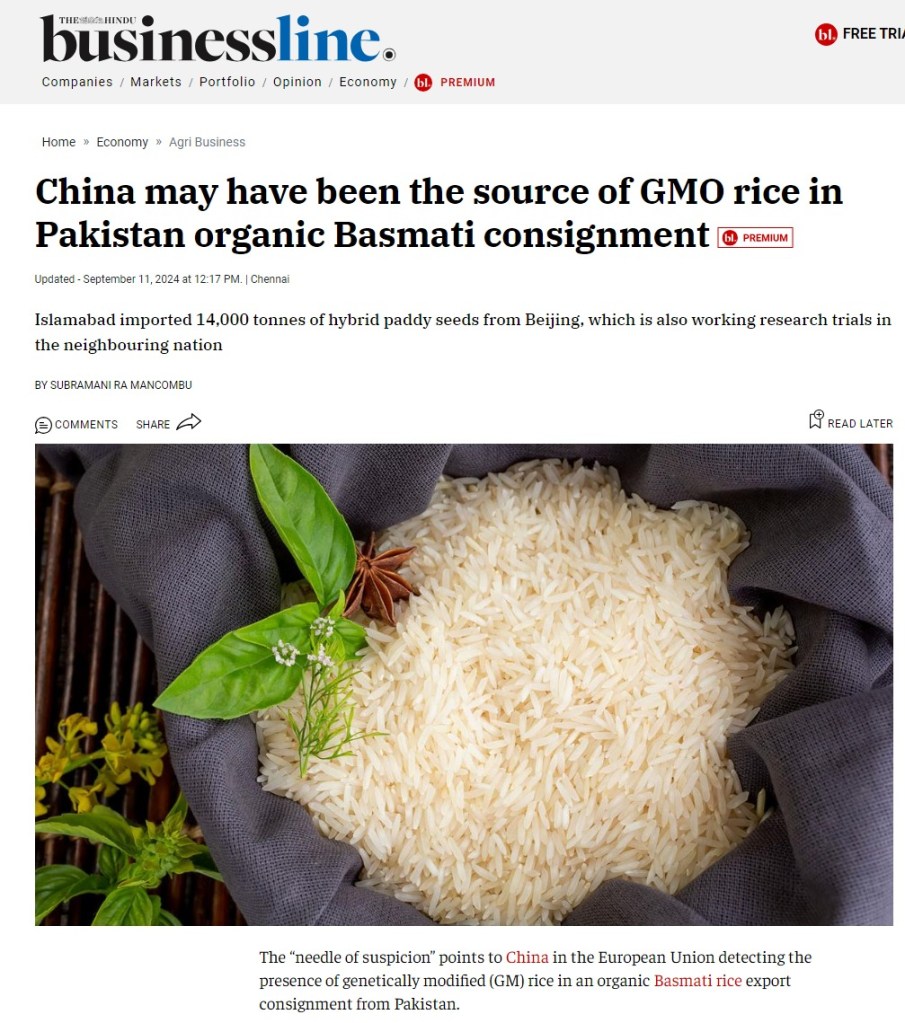
Organic cotton farmers work hard to maintain their certification, ensuring that their crops are grown without synthetic chemicals, genetically modified organisms (GMOs), or prohibited inputs. Even when farmers follow organic practices to the letter, GMO contamination can still occur!
Let’s take a closer look at how GMO testing works, what the results mean, and why the final decision on certification can sometimes feel arbitrary.
How is GMO Contamination Measured?
GMO testing in Seed Cotton (raw cotton including fibers and seeds) is performed using real-time PCR analysis, a widely used method to detect genetic modification markers in cotton DNA. The gin will take samples of your seed cotton and submit those samples to their Global Organic Textile Standard (GOTS) Certifier. The GOTS Certifier will submit those samples to a lab, usually OMIC which will then run them for GMO presence. The results are then submitted back to the GOTS Certifier. Here are some things that are being investigated.
- Standard Limit of Quantification (LOQ): 0.1% GMO content – This is the most commonly used threshold for accurately measuring contamination.
- More Sensitive Tests: Some advanced labs claim they can detect levels as low as 0.01%, but I have not seen this as an industry-standard threshold for Seed Cotton testing. But you could see this from European labs!
- Anything above a 0.1% is detectable and reported as such as you can tell from this test sheet with all the names removed!

Here is another test with some different results.

What the Test Results Mean
- This sample contains GMO markers including Bt toxin (Cry1Ab/Ac) and herbicide resistance (otp/mepsps).
- p35S, pFMV, and tNOS confirm genetic modification.
- Organic certifiers would likely reject this cotton since GMO elements were clearly detected.
- If contamination was unintentional, an investigation might be needed to determine if the cotton can still qualify for certain supply chains.
| Marker | Detected? | GMO Trait Significance |
|---|---|---|
| SAH7 (Cotton Gene) | ✔ Yes | Confirms valid cotton DNA |
| Cry1Ab/Ac (Bt Toxin) | ✔ 1.44% | Indicates Bt Cotton (Insect Resistance) |
| otp/mepsps (Glyphosate Resistance) | ✔ 0.47% | Possible Roundup Ready Cotton (Herbicide Resistance) |
| p35S (CaMV Promoter) | ✔ 1.93% | Common GMO activation switch |
| PAT (Glufosinate Resistance) | ❌ Not Detected | No Liberty Link herbicide resistance |
| pFMV (FMV Promoter) | ✔ 1.91% | Used for GMO gene activation |
| tNOS (Terminator) | ✔ 3.27% | Common GMO terminator sequence |
| GM Elements (General GMO Presence) | ✔ Yes | Confirms GMO modification detected |
Now What Happens?
What happens when an organic cotton sample tests positive for GMOs? That really depends on a lot of different things, and this is where farmers can get frustrated. I have provided you with some sample test results but usually you won’t even see these results. At this point the GOTS Certifier for the Gin has your test results. This is a small list of what they do:
The Global Organic Textile Standard (GOTS) Says:
- No intentional use of GMOs is allowed.
- If contamination is detected, the GOTS certifier launches an investigation instead of outright rejection.
- If the farmer can prove they used verified non-GMO seed and followed organic practices, then there is a strong possibility that they may still be approved.
GOTS Certifier Reaches Out
The next step is for the GOTS Certifier to reach out to your Organic Certifier at the farm level. Because a “red flag” is now waving, your certifier is going to be looking at your Organic System Plan (OSP) with a fine-toothed comb! They will be looking at your cottonseed information, at your field and field locations, at every record you submitted to determine if there is anything that might have caused a “voluntary” versus “involuntary” contamination. You will probably know that something is up either by just a notice of an investigation or possibly a full-blown visit. Either way, they (your certifier) are trying to find out why the raw seed cotton is showing up with detectable levels of GMO.
Most of the time there is absolutely nothing you did to cause a detectable limit of GMO in your seed cotton. We might call this an “Act of God” because no one knows why it happens. The planting seed tested good, the field was good and there is no drift. No one knows what happened or why and so you get a clean bill of health. The system is designed with some flexibility because there can be an “Act of God” and to be honest I am glad to recognize that God is Sovereign even over cotton fields and cotton farmers!
On the other hand, it can sometimes be identified as a wrong bag of planting seed picked up, a wrong module or bale marking, or some other contamination issue along the way. Elevated levels of GMO in your raw seed cotton will throw up all kinds of red flags and could lead to a non-compliance, rejected organic cotton and a microscopic look at all other aspects of your organic operation! Let’s hope we don’t go there……
What Can Farmers Do?
- Test early and often. If you suspect contamination, conduct your own tests before sending cotton to market. Newsletter Article Page 2
- Maintain strong records. Prove that you sourced verified non-GMO seed and followed organic protocols.
- Work with a certifier who understands the realities of farming. Some certifiers are more flexible in their investigations than others or ask the right questions instead of just assuming you are wrong.
- Improve segregation. Make sure that cotton stays separate at every stage, from harvesting to ginning.
Final Thoughts
Organic farmers face an uphill battle when it comes to avoiding GMO contamination. Even with perfect compliance, your cotton test results can find GMOs, and certification decisions often depend on factors beyond the farmer’s control. Don’t panic and be willing to go the extra mile to find out why. Your organic certifier has their neck on the line too as does your ginner and we all want you to succeed. As we are at the very start of a new crop year do all you can now to stay out of this “mess” later!












 Texas A&M AgriLife Organic