Smart Sensing in Organic Systems: How Drones, Satellites, and Sensors Help Detect Crop Stress Before It Happens

Smart sensing is transforming how we understand plant health in organic systems. By integrating satellite and drone imagery, in-field sensors, and artificial intelligence, we can now detect stress in crops long before symptoms appear. This technology doesn’t replace the farmer’s eye—it strengthens it, helping us protect soil biology, use resources more wisely, and make better management decisions.

Learning from Students and Staying Curious

This past Saturday (October 18), a group of high school students invited me to speak about their project on smart plant monitoring. They were designing a device to track plant health in real time. Their questions—about soil, light, and water—were sharp and curious. It reminded me why I love this field: whether we’re students or seasoned farmers, we’re all learning how to listen to plants a little better.

Their project also made me reflect on how far we’ve come. When I started in Extension, plant monitoring meant walking fields, taking notes, and maybe digging a soil sample. Now, we’re using satellites orbiting hundreds of miles above the earth and sensors no bigger than a pencil eraser to understand how crops respond to their environment.
From Satellites to Soil: The New Eyes of Agriculture

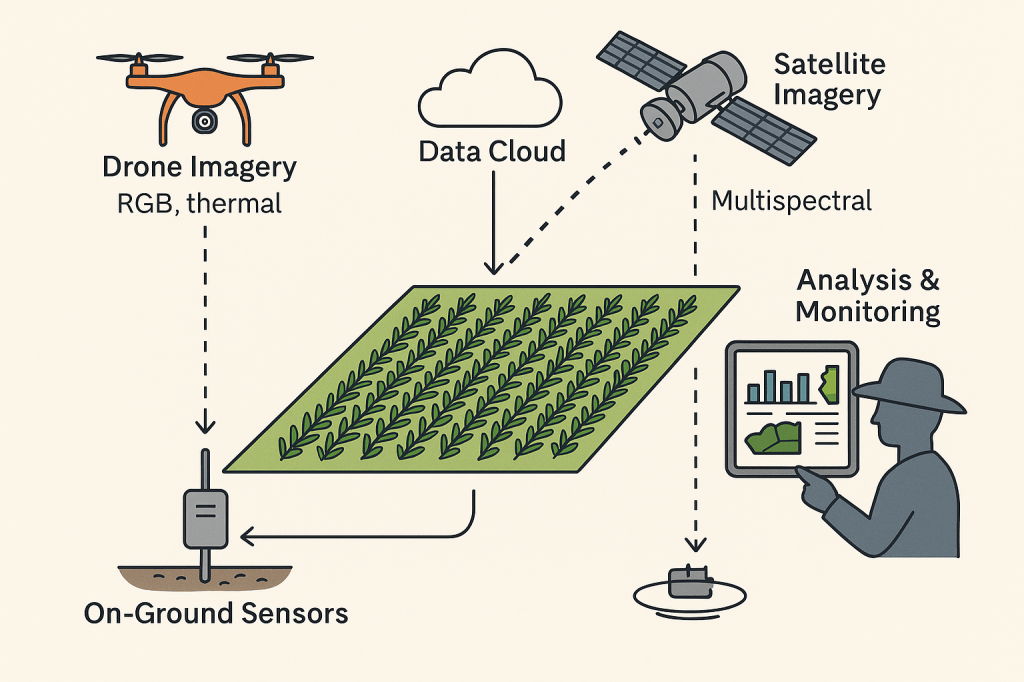
In organic production, timing is everything. A crop under stress can lose days of growth before we even notice it. But RGB drone and satellite imaging now allow us to spot stress early by detecting subtle changes in leaf color, canopy density, or reflectance.

Even more advanced are multispectral and hyperspectral sensors, which measure how plants reflect light across visible and infrared wavelengths. These patterns can reveal water stress, nitrogen deficiency, or disease pressure—well before a plant wilts or yellows.1

Thermal cameras add another layer. Drought-stressed plants reduce transpiration, causing leaf temperature to rise—a change that infrared sensors can detect long before visible damage occurs.2

Once the imagery is captured, we still rely on ground-truthing—walking to the coordinates, checking the crop, soil, and often pulling tissue samples. This blend of technology and touch keeps data meaningful.

Predictive Systems: Seeing Stress Before It Starts

The most exciting progress in recent years has been predictive capability. AI-powered analytics now integrate drone imagery, IoT soil data, and weather patterns to learn what “normal” looks like for a crop. When the system detects deviations—like a drop in chlorophyll fluorescence or a rise in leaf temperature—it flags them early.3

One powerful method is solar-induced chlorophyll fluorescence (SIF), which measures photosynthetic efficiency. Subtle declines in fluorescence intensity can indicate stress from drought, salinity, or nutrient imbalance days before the plant shows visible symptoms.4

Meanwhile, IoT sensor networks are spreading across fields. These small devices monitor soil moisture, pH, canopy temperature, and even sap flow, sending real-time data to cloud dashboards that can automatically adjust irrigation schedules.5

This isn’t just smart—it’s proactive agriculture.

Image acquisition setups using different sensors (i) DJI Matrice 600 Pro with a Sony Alpha 7R II, 42.4-megapixel RGB camera mounted on it(Sapkota, 2021), (ii) A close-range laboratory imaging system with a Micro-Hyperspec VNIR sensor in controlled lighting condition (Dao et al., 2021a), (iii) HyperCam on the tripod, Fluke TiR1, Lci leaf porometer, Infragold as well as dry and wet references targets (Gerhards et al., 2016) (iv) Chamber equipped with two Raspberry Pi 3B + and an ArduCam Noir Camera with a motorized IR-CUT filter and two infrared LEDs (Sakeef et al., 2023).6

Why This Matters for Organic Systems

Organic farming depends on living systems—soil microbes, organic matter, and ecological balance. Unlike conventional systems, we can’t rely on quick chemical fixes. We need to detect stress early enough to respond biologically—through irrigation management, microbial inoculants, or balanced foliar nutrition.

Smart sensing tools help us manage that complexity. When we combine spectral imagery, soil data, and climate information, we begin to see the farm as an interconnected ecosystem rather than a collection of separate fields.

Monitoring also supports stewardship. Water-quality sensors can now detect salinity and bicarbonate buildup that harm roots over time. Linking those readings with AI-derived stress maps helps producers align soil chemistry, water quality, and plant physiology in one continuous feedback system.7

The Human Element Still Matters

Even with all this technology, the farmer’s experience is irreplaceable. Data can tell us something changed, but it takes experience to know why. Was that NDVI dip caused by poor drainage, pests, or a timing issue in irrigation?

Technology should not distance us from the field—it should bring better insight to our decisions. As I often tell growers, just as computers need rebooting, we occasionally need to “reboot” our interpretation—to align the data with what we know from hands-on experience.

A Partnership Between Grower, Plant, and Sensor

When those students asked how technology fits into farming, I told them this: smart monitoring doesn’t make agriculture less human—it makes it more informed.

The future of organic production is a partnership between the grower, the plant, and the sensor. When all three communicate clearly, we grow more than crops—we grow understanding. And in that understanding lies the future of any sustainable agriculture.

Further Reading

References

  1. Dutta, D. et al. (2025). “Hyperspectral Imaging in Agriculture: A Review of Advances and Applications.” Precision Agriculture, 26(3): 445–463. ↩︎
  2. Cendrero-Mateo, M.P. et al. (2025). “Thermal and Spectral Signatures of Plant Stress.” Frontiers in Plant Science, 16:31928. https://doi.org/10.3389/fpls.2025.1631928 ↩︎
  3. Chlingaryan, A. et al. (2025). “Machine Learning for Predictive Stress Detection in Crops.” Computers and Electronics in Agriculture, 218:107546. https://www.sciencedirect.com/science/article/pii/S0168169924011256 ↩︎
  4. Guanter, L. et al. (2024). “Solar-Induced Fluorescence for Assessing Vegetation Photosynthesis.” NASA Earthdata Training Series. https://www.earthdata.nasa.gov/learn/trainings/solar-induced-fluorescence-sif-observations-assessing-vegetation-changes-related ↩︎
  5. Ahmad, L. & Nabi, F. (2024). Agriculture 5.0: Integrating AI, IoT, and Machine Learning in Precision Farming. CRC Press. ↩︎
  6. Chlingaryan, A. et al. (2025). “Machine Learning for Predictive Stress Detection in Crops.” Computers and Electronics in Agriculture, 218:107546. https://www.sciencedirect.com/science/article/pii/S0168169924011256 ↩︎
  7. Gómez-Candón, D. et al. (2025). “Integrating Water Quality Sensors and Remote Sensing for Sustainable Irrigation.” Agricultural Water Management, 298:108072. ↩︎

Organic Grain Marketing Webinar Set

Please mark your calendar for an Online Microsoft TEAMS Webinar discussing Organic Grain Markets in Texas, Oklahoma and New Mexico.  The meeting will be held on Monday, November 18 at 1:00 pm (CST) on TEAMS.  To register, just click the link below and you will be directed to a registration page and be sure to include the invite on your reminder calendar. Need help with getting on a TEAMS Webinar just click this link to learn how: TEAMS Webinar Made Simple

Texas A&M AgriLife Extension is pleased to present this Organic Grain Marketing Webinar, bringing together both organic grain farmers and buyers (mills, processors, feedlots, dairy) to discuss key criteria for producing high-quality grains and meeting market demands. The event will feature special presentations from Argus Media Group, offering insights into organic grain market trends and reporting. Also included will be engaging discussion from selected growers and buyers on what it takes to produce and purchase organic grains that meet organic industry standards. There is no cost to participate, just be sure to register so you can get information to sign onto the program webinar.

The State of Organic Grain Markets: Why Take Action?

You may be wondering why this meeting is crucial, or why you should participate. Frankly, I’ve been hesitant to host such events because these discussions often bring tension from both growers and buyers. Yet, the current state of organic grain markets leaves me no choice but to step in. Here are some pressing issues that have been affecting the market, creating inefficiencies and frustrations that this webinar aims to address:

  1. Price Transparency Issues
    Many organic farmers feel they are operating in the dark. Unlike conventional markets with established price discovery systems, organic grain pricing remains inconsistent and opaque. Farmers struggle to find reliable data on market prices, making it difficult to plan their production effectively. Buyers, on the other hand, are uncertain whether they are paying a fair price, which can lead to friction in negotiations. This meeting aims to shed light on the data gaps and discuss ways to make the market more transparent.
  2. Limited Market Information
    A lack of comprehensive market data on organic grains affects both supply and demand. Farmers don’t have access to real-time demand forecasts or historical data, which leads to overproduction or underproduction. This not only results in wasted resources but also impacts profitability. Buyers are equally frustrated by the lack of a consistent supply, as farmers cannot adequately meet demand when production planning is based on incomplete information. By bringing buyers and sellers together, we aim to establish better communication and data sharing practices to bridge this gap.
  3. Reluctance to Share Information
    Another issue is the reluctance among industry players to share market information. Some participants prefer to keep their cards close to the chest, fearing that sharing too much data might give their competitors an advantage. However, this creates a fragmented market, where both buyers and sellers are unable to make fully informed decisions. This webinar will serve as a platform to address the hesitations and work toward more collaborative market practices.
  4. Fragmented Market Systems
    The organic grain market is fragmented, with different regions operating under different pricing and demand systems. What sells for a premium in one region might be undervalued in another, and there is no easy way for farmers to tap into broader markets. This disconnect limits opportunities for growth and scalability. One goal of this meeting is to identify ways to standardize market systems, making it easier for farmers to access new markets and for buyers to secure consistent supplies.
  5. Incentives to Engage in Market Information Systems
    Smaller organic grain producers often see little incentive to participate in formal market reporting. The perceived complexity and lack of immediate benefits discourage farmers from engaging in platforms that could, over time, benefit the entire market. Through discussions with both buyers and sellers, we hope to explore solutions that could offer better incentives for engagement, such as direct market access or premiums for those who participate.

By addressing these issues head-on, this webinar offers a unique opportunity for both growers and buyers to not only learn from each other but to actively shape the future of the organic grain market.

I got this information below which also highlights the need for more information.

USDA Organic: You are automatically part of a huge family!

The organic label is more than just a marketing term; it is a rigorous standard of quality that reflects sustainable and environmentally friendly practices across the agricultural sector. The USDA’s National Organic Program (NOP) is at the heart of this movement, ensuring that products labeled as organic meet stringent, federally regulated guidelines. This unified regulatory framework is crucial not just for maintaining the integrity of the organic label but also for investing in and supporting a diverse array of stakeholders involved in the organic supply chain—from farmers and researchers to retailers and consumers. Tools such as the USDA Organic Consumer Outreach Toolkit play a vital role in promoting these standards, ensuring that the value of organic products is clearly communicated and understood by the consumer but also by those outside looking in and examining the organic program family!

  1. The Unified Regulatory Framework of Organic Agriculture
  2. Collaborative Efforts Across Stakeholders
  3. Education and Outreach: Tools for Sustaining Organic Integrity
  4. Support Systems and Knowledge Exchange
  5. Traceability and Transparency: Building Consumer Trust
  6. Conclusion
  7. Some real-world examples of building consumer trust

Organic agriculture operates under a comprehensive framework established by the NOP, which enforces consistency across the entire supply chain. This uniformity ensures that whether one is dealing with an organic dairy farm in Texas or a producer of organic vegetables in California, or a feed manufacturer in Illinois, all parties are held to the same high standards. This regulation not only supports the integrity of organic products but also helps streamline processes for stakeholders at all levels, including brokers, wholesalers, manufacturers, and retailers. The ability to trust in the label “organic” comes from this rigorous oversight and the commitment to upholding these standards universally.

One of the most remarkable aspects of the NOP’s structure is its collaborative nature, which fosters engagement across a broad spectrum of stakeholders. This collaboration includes:

  • Educational institutions and specialists: As an organic specialist with a land grant university, my role involves educating and guiding future and current farmers on best organic practices. Even specialists without organic in their title like agronomists, entomologists or plant pathologists contribute to organic knowledge and expertise. More and more these folks are finding ways to work with our natural plant and animal systems advancing organic agriculture.
  • University researchers are doing tremendous work and through their efforts organic ag is advancing faster and faster. I know, because of the many current organic grant projects just in Texas. Other research bodies, both public and private research, also are a part of this huge collaboration to advance organic agriculture from the farm all the way to the table.
  • Organizations and associations like the Organic Trade Association (OTA), The Organic Center (TOC), Organic Farm Research Foundation (OFRF) and many other non-profits work tirelessly to promote organic production practices and products, help foster collaborations, and advocate within the halls of government.
  • Certification entities and even certification inspectors all work together with growers and handlers to ensure that the system is protected from simple mistakes to outright fraud protecting a consumer based and backed program. They are not doing this just for themselves but for the grower and handler who needs the consumer to buy their products because they are certified organic.

The USDA Organic Consumer Outreach Toolkit exemplifies the educational tools that are crucial for sustaining the integrity of the organic label. This toolkit is designed to educate stakeholders along the supply chain and inform consumers about what the organic label represents. Clear, consistent messaging helps to ensure that the organic label retains its value and significance in the marketplace. For instance, retail employees can use the toolkit to better explain the benefits of organic products to customers, reinforcing trust and understanding.

I will admit this is a tough one! We do not have the support systems and advisory services we need within the organic community. Extension organic specialists and county extension agents and even private advisors and consultants to provide ongoing support and guidance, have been in short supply – but it is improving. This continual knowledge exchange is vital for keeping up with the fast-changing organic systems research, the new and innovative products for organic production, the regulatory environment we work within and of course, any and all emerging trends in organic agriculture.

A cornerstone of the NOP’s approach is the emphasis on traceability and transparency. From farm to retail store, every step of the organic product’s journey is documented (and includes a certified entity), ensuring that the products consumers buy are genuinely organic. This traceability not only helps in enforcing compliance with organic standards but also builds consumer confidence in the organic label. According to a recent consumer survey conducted by the Organic Trade Association 88% of all consumers know about the organic label and are willing to pay more because of their trust in the label.

The USDA National Organic Program’s structured approach to regulating and promoting organic agriculture underpins the integrity and trust in the organic label. By fostering a unified and collaborative framework, the NOP ensures that organic standards are not just ideals but practical realities that benefit the environment, producers, and consumers alike. As we look to the future, your continued support and participation in this program will be crucial for advancing sustainable agricultural practices and increasing organic farming, manufacturing, retailing and consumption. How? By realizing you are part of an “organic family” that promotes you and your business along with every other part of the value chain (traceability means you get promoted) all the way to the consumer who picks up your product and knows you are part of that product.

I know that all these rules and regulations and the piles of paperwork get overwhelming but know that this helps the consumer to feel a part of your production and ultimately your farm. Here are a few examples or Case Studies of what things may look like in the future as we try to invite the consumer to be part of this value chain known as Organic Farming.

Case Study 1: Carrefour and Blockchain

Overview:
Carrefour, (big in Europe and the Middle East) a global retail giant, launched a blockchain-based traceability system for several products, including organic fruits and vegetables. The system allows consumers to scan a QR code on the product packaging to access detailed information about the production process.

Key Features:

  • Farm to Fork Information: Consumers can see details about where and how the organic produce was grown, including the farm’s location, the farming practices used, and the harvest date.
  • Transparency and Trust: By providing a clear view of the supply chain, Carrefour enhances consumer trust in their organic label.

Case Study 2: IBM Food Trust and Walmart

Overview:
Walmart joined the IBM Food Trust, a blockchain-based system, to improve the traceability of its food products. The initiative initially focused on conventional products but has extended to organic products to ensure their integrity.

Key Features:

  • Enhanced Traceability: The system tracks every transaction from the supplier to the store, ensuring that organic standards are maintained at every step.
  • Rapid Response to Issues: If an issue arises, such as a contamination risk, Walmart can quickly trace the product back to its source and manage the situation effectively.

Case Study 3: Ripe.io and Tomato Traceability

Overview:
Ripe.io uses blockchain technology to provide transparency in the tomato supply chain. Although not exclusively organic, the principles applied can directly benefit organic markets by detailing each step of a tomato’s journey from seed to supermarket.

Key Features:

  • Detailed Product Insights: Information on when and how tomatoes were planted, cared for, harvested, and transported are all recorded.
  • Consumer Feedback Integration: Consumers can provide feedback on the quality of the product, which can be used to improve farming practices.

Water-Seeded Rice

Dr. Ronnie Levy, Extension Rice Specialist at LSU wrote this article for the April 2022 issue of Rice Farming Magazine. I clipped it out and thought, “this will come in handy someday!” I am putting this out there again because our organic rice producers are facing some real problems with weeds in rice including weedy rice, hemp sesbania, jointvetch and certainly weedy grasses.

Last year I was at Joe Broussard’s farm near Nome, looking at a rice field that was headed out and looking great. On the other side of the levy was a field choked with weeds – what was the difference? One was water-seeded rice, and the other was not. Joe had used water seeding and his flood to control weeds “the old-fashioned way!” So, read this article by Dr. Levy and think about it……

Rice Farming, April 2022. Dr. Ron Levy. “Most rice is drill-seeded in Louisiana — about 80% — but there is a renewed interest in water-seeding rice for weedy rice suppression (or many other weeds in organic systems).

The most common water-seeding method in Louisiana is the pinpoint flood system. After seeding, the field is drained briefly. The initial drain period is only long enough to allow the radicle to penetrate the soil (peg down) and anchor the seedling. A three- to five-day drain period is sufficient under normal conditions.

The field then is permanently flooded until rice nears maturity (an exception is midseason drainage to alleviate straighthead (physiological problem of rice) under certain conditions).

In this system, rice seedlings emerge through the floodwater. Seedlings must be above the water surface by at least the 3 to 4-leaf rice stage. Before this stage, seedlings normally have sufficient stored food and available oxygen to survive. Atmospheric oxygen and other gases are then necessary for the plant to grow and develop.

The pinpoint flood system is an excellent means of suppressing weedy rice emerging from seeds in the soil because oxygen necessary for weedy rice germination is not available as long as the field is maintained in a flooded (or saturated) condition. A continuous flood system, another water-seed system, is limited in Louisiana. Although similar to the pinpoint flood system, the field is never drained after seeding.

Regarding the water-seeded systems, a continuous flood system is normally best for red rice suppression, but rice stand establishment is most difficult. Even the most vigorous variety may have problems becoming established under this system. Inadequate stand establishment is a common problem in both systems.

Fertilization timing is the same for both the pinpoint and continuous flood systems. Phosphorus (P), potassium (K), sulfur (S) and zinc (Zn) fertilizers are applied preplant incorporated as in the dry-seeded system. Once the field is flooded, the soil should not be allowed to dry.

If the nitrogen requirement of a particular field is known, all nitrogen fertilizer can be incorporated prior to flooding and seeding or applied during the brief drain period in a pinpoint flood system. Additional N fertilizer can be applied at the beginning of reproductive growth between panicle initiation and panicle differentiation (2-millimeter panicle).

Water-seeding has been used in the past for weed control. Will water-seeding make a comeback to help with weedy rice suppression (or possibly for organic rice producers)?”

Another issue water-seeded rice may experience.

Rice Seed Midges – The larvae of these insects (Order Diptera, Family Chironomidae, Genera Tanytarsus and Chironomus) are aquatic and can be very abundant in rice fields. The adults are small, gnat-like flies that typically form inverted pyramidal mating swarms in the spring over stagnant or slow-moving water. Female flies lay eggs in ribbons on the water surface. The larvae hatch and move downward to the flooded substrate where they build protective “tubes” of silk, detritus, and mud. These brown, wavy “tubes” are easily observed on the mud surface of rice paddies. Occasionally, the larvae will exit the tubes and swim to the surface in a whiplike fashion, similar to that of mosquito larvae. Midge larvae can damage water-seeded (pinpoint or continuous flood) rice by feeding on the sprouts of submerged germinating rice seeds. Damage can retard seedling growth or kill seedlings; however, the window of vulnerability to midge attack is rather narrow (from seeding to when seedlings are about 3 inches long).

Control rice seed midge problems by dry seeding, then employing a delayed flood, or by draining water-seeded paddies soon after planting. Thus, a pinpoint flood should reduce the potential for rice seed midge damage relative to a continuous flood. For water-seeded rice, reduce rice seed midge problems by increasing the seeding rate and planting sprouted seed immediately after flooding.

Management of Rice Seed Midge – Insecticide Trial Results

Click on the above link to read a great article from California rice researchers about an experiment they did on Rice Seed Midge control and some of the most effective treatments are organic and soon to be OMRI approved.

Organic Corn Resources

Finding a corn variety adapted to Texas extremes can be very difficult. At this time, I just don’t know of too many certified organic corn varieties that can make it through the difficult hot nights in most of Texas except maybe the northern panhandle area of Texas. Even in those area many growers have tried to bring in corn varieties popular in the Midwest and they just don’t yield well.

That said, I have tried to list varieties that Texas organic growers have grown and continue to grow. The companies listed may or may not have varieties adapted to Texas, but you have their contact information to check. If you see anything I need to add, change or delete please let me know. This is an ongoing project and one that will continually be updated and changed.

Click a link below to scroll down!

Updated 3/12/25

  1. Corn Varieties Used for Organic
  2. Seed Contacts:
  3. Organic Corn Buyers:
  4. Resources (just click to see)
  • Pioneer Yellow – P0075, P0157, P0487, P1185, P1197, P1222, P1359, 6381, 5353, P1608, P1639, P1718, P1870, P17677 (available in 2025), and (not sure about availability – P1751, P33Y74, P1422, 63T1GH, 6589ZZ, P33774)
  • Pioneer White – P1790W, P1306W, P1543W (available in 2025), and (not sure about availability – 1639 and 32B10)
  • Partners Brand – PB 11802 (118 day), CL 860 (116 day), and PB 8580 (115 day)
  • Seitec Genetics – 6345, 6381
  • BH Genetics – 8780, 8700, 8590, 8555, 8420, 8443W, 8121

This list does not necessarily mean that these companies have corn varieties adapted for Texas. Companies continue to develop varieties that work in areas they have not traditionally grown in and so some testing helps know and use new materials.

Pioneer

  • I am in contact with Pioneer to get contact information soon. Till then check with your local rep if you have one?

New Deal Grain

  • 501 E Main St, New Deal, TX 79350
  • Office: (806) 784-2750

Partners Brand

B-H Genetics

  • 5933 Fm 1157, Ganado, TX 77962
  • Office: (361) 771-2755
  • seed corn, sorghum, sorghum-sudangrass

Seitec Genetics

Beck’s Hybrids/Great Harvest Organics

  • 6767 E. 276th Street, Atlanta, IN 46031
  • (800) 937-2325
  • Corn, Corn Silage, Soybeans, Wheat, Alfalfa, Milo/Sorghum, Forage and Cover Crop

Albert Lea Seed/Blue River Organic Seed/Viking Non-GMO

  • 1414 West main Street Albert Lea MN 56007
  • seedhouse@alseed.com
  • Work: (800) 352-5247
  • www.alseed.com
  • corn, soybeans, alfalfa, wheat, oats, cover crops, wildflowers, native grasses, CRP

De Dell Seeds

American Organic Seed

Falk’s Seed Farm

  • 1170 High 9 NE Murdock MN 56271
  • falkseed@westtechwb.com
  • (320) 875-4341
  • www.falkseed.com
  • soybeans, corn, forages, small grains

Foundation Organic

Genetic Enterprises International

Master’s Choice

Welter Seed and Honey Company

Byron Seeds

  • 775 N 350 E Rockville IN 47872
  • duane@byronseeds.us
  • (800) 801-3596
  • http://byronseeds.net/
  • alfalfa, corn, clover, cover crop, grasses, mixes

Enger Farms

McDowell Feed Source

Coyote Creek Organic Feed Mill

Deaf Smith County Grain

Panhandle Milling

Heartland Co-op

Triple Nickel

Pink Rose Organix

Where Do Seedless Watermelons Come From?

One of my first Seedless Watermelon Trials, Comanche County Texas

I have been asked on numerous occasions “Where Do Seedless Watermelons Come From?” or “How do you get seed from a seedless watermelon?” Well, the process is simple but lengthy, taking two generations but the end result is fantastic.

First, you need to understand a little about chromosomes, the threadlike bodies that contain genes for development. A regular watermelon has two sets of chromosomes and is called a diploid (di for two). A plant breeder will take a diploid watermelon seed and treat it with a chemical called colchicine. Colchicine will cause the seed to develop a melon with four sets of chromosomes called a tetraploid (tetra for four). This melon is grown out and the seed harvested for the next growing season. This tetraploid seed is planted and begins to grow but the plant is covered with a spun row cover to prevent any pollination so that the plant breeder can pollinate at the right time with a diploid melon variety. These melons will grow and the seed from them will be harvested. The cross of tetraploid plant with a diploid plant result in triploid seed. This plant has three sets of chromosomes and is the “mule” of the watermelon family. This seed when planted will produce a seedless melon meaning it is sterile. You may see some sort of seed like “carcass” but that is soft and not developed shown in the picture below. They don’t affect the taste or the quality.

Seedless melons are really a favorite of the urban clientele. They don’t buy grapes with seeds, and they don’t like melons with seeds (what do you do with the seeds in a nice restaurant). They are excellent for salad bars and are sold in grocery stores sliced and ready to eat. Seedless watermelons are typically smaller and so fit easily in the refrigerator, another plus for the urban American. One of the first and most popular seedless varieties was Tri-X 313. I was told that the Tri-X meant triploid, the first 3 was 3 months maturity and the 13 was the typical weight of 13 pounds per melon. Sounds good anyway!

Organic Seedless Melons – Florida Fields to Forks

Growing seedless melons are a little different than the typical watermelon. First this seed is very fragile and must be germinated under higher-than-normal germination temperatures. We will germinate seeds in chambers with 90+ degree temperatures. This forces the seed to quickly germinate and begin to grow versus a cold soil in the field which will slow seed germination enough that most seedless plants won’t make it. Because of its temperamental nature a seedless watermelon is grown as a transplant first and then moved into the field later after getting a good root system established. These seeds cost from 17¢ to 50¢ a piece and growing the actual plant in a pot to be transplanted costs another 15¢ for a total of approximately 50¢ per plant. The germination percentage is low for seedless, around 80%, so that cost can go up even more. It takes about 1500 to 1700 plants per acre or about $600.00 per acre of planted seedless melons, a lot of money and still 80 days till harvest.

Seedless has other good traits besides being seedless. They are very productive, generally producing more melons than any other hybrid if grown properly. They are also disease tolerant plants resisting many of the diseases that other melons quickly die from and seedless are good shippers, holding flavor for a long time.

I mentioned that the seedless is the “mule” of melons, well a watermelon produces both male and female flowers so that we can plant one variety in a field and bees can pollinate with no trouble. A seedless melon produces a male flower that cannot pollinate another melon so to get by this we have to plant seeded variety melons in rows next to the seedless rows to insure good pollination. I have seen mix-ups in the field where seedless plants covered 10 solid rows so that the outside two rows were the only ones with melons. Having a pollinator row for seedless is mandatory if you want seedless melons, a fact you should know if you want to try growing seedless melons.

Is a seedless melon organic?  Absolutely. Colchicine is a naturally occurring alkaloid compound found in certain plant species, primarily the Colchicum autumnale plant, also known as autumn crocus or meadow saffron. Colchicum autumnale is native to Europe and Asia. The alkaloid colchicine is extracted from the seeds, corms (underground storage organs), and other parts of this plant. It can be applied to the seeds or plants, and this causes the doubling of the chromosomes. This process seems unnatural but in nature it is not that rare to find naturally occurring tetraploid melons!

Colchicine has been used for centuries in traditional medicine, particularly in the treatment of gout and certain inflammatory conditions. However, it is important to note that colchicine can be toxic in high doses, so it should only be used under medical supervision. In organic production the melons should be treated with the naturally derived colchicine not the synthetic. As always, check with your CERTIFIER first!