
Technical content updated June 2026 to include recommendations for collecting representative hay samples.
Start with a Representative Hay Sample
I wrote this longer article back in October of 2024, but since we are in the midst of cutting hay right now, I thought an update would be a good thing! Before discussing the surprising variability found among individual hay bales from a single field, it is important to remember that a forage analysis is only as good as the sample submitted to the laboratory. Many producers still collect a handful of hay from the outside of a bale and send it for analysis. Unfortunately, this approach often provides misleading results because leaves, stems, and different portions of the bale are not represented equally.
The preferred method is to use a hay probe attached to a cordless drill and collect core samples from a minimum of 20 representative bales within a hay lot. A hay lot should consist of hay from the same field, cutting, forage type, and harvest period. I carry a bucket with me and put each core in the bucket as I sample a bale. The core sampler is a 24″ model since almost everyone has round bales today. The individual cores are combined into a single composite sample (the bucket), mixed thoroughly, and submitted to a forage testing laboratory.
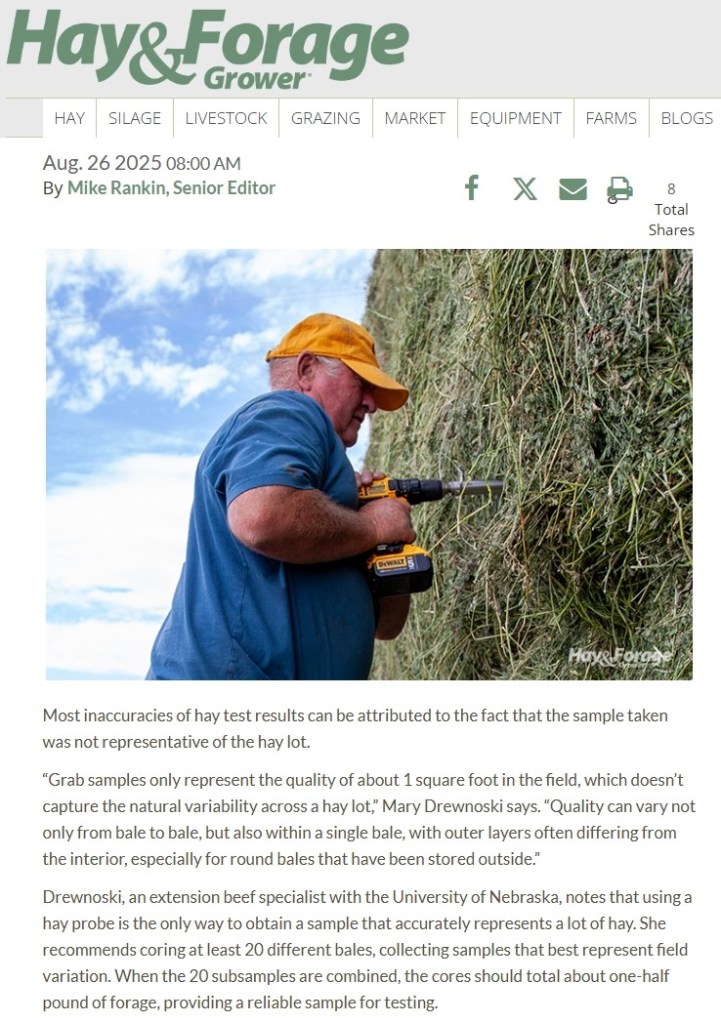
The picture above is a clip I copied from a longer article in Hay and Forage Magazine, April 2025 edition. The article is just a good reminder of proper sampling, but the best part of the article is a list of all the places to order a hay probe. Just click on the picture or here Hay Probes to see the list!
How Much Can Hay Vary Within One Field?
When it comes to hay production, many farmers assume that bales harvested from the same field will contain similar nutrient levels. The differences across fields was evident in a recent article by Michael Reuter in Progressive Forage1. His article and data show us all, the significant differences even among bales from the same field. Understanding and managing these differences can make a big impact, especially for organic farmers who want to optimize livestock nutrition and maintain a consistent quality of forage.

The following table from the article1 presents the nutrient composition and analysis of 20 individual bales randomly sampled from an 86-acre hay field, which was managed as a unit and harvested all at the same time:

What the Bale Data Showed
The analysis of the 20 hay bales showed surprising variability in key nutrients such as Crude Protein (%CP), fiber content (measured as %ADF and %NDF), and essential minerals like Calcium (%CA) and Phosphorus (%P). Summary statistics of the nutrient composition are presented below:

Crude protein, for example, varied from 9.7% to 15.9%. This 6.2 percentage point difference could significantly influence the nutritional value of hay fed to livestock.
Fiber levels also differed substantially. The ranges in Acid Detergent Fiber (%ADF) and Neutral Detergent Fiber (%NDF) directly affect how digestible the hay is and how much livestock will eat. Calcium and phosphorus levels, which are critical for bone health and metabolic functions, also showed noteworthy differences between bales.
Why Does Hay Quality Vary?
Even within a field managed and harvested as one unit, soil fertility, plant maturity, species composition, moisture, weeds, topography and microclimate can vary enough to influence forage quality. In organic fields, uneven manure or compost distribution can add another potential source of spatial variability:
- Soil Fertility Differences: Organic amendments like compost or manure may not be evenly spread across the field. Variability in soil nutrients can cause different areas of the field to produce hay with varying nutrient levels.
- Crop Rotation and Plant Diversity: Rotating different crops or allowing natural diversity in the field is beneficial for soil health, but it can also lead to differences in how well each crop absorbs nutrients.
- Pest, Weed, and Microclimate Effects: Organic fields often have more variability in pest pressure, weed growth, and microclimates. These differences can lead to uneven growth, which in turn affects nutrient content.
Managing Hay Variability
To minimize these differences and provide more consistent forage quality, farmers can take several practical steps:
- Soil Testing: Regularly test soil across different sections of the field. This helps identify nutrient deficiencies or hotspots, allowing targeted amendment application.
- Even Amendment Application: When applying compost, manure, or other organic fertilizers, try to ensure even distribution across the field. Variability in amendment application is a key factor in nutrient inconsistency.
- Use Cover Crops: Cover cropping can help improve soil structure and increase nutrient cycling, which leads to more uniform plant growth.
- Monitor Harvest Stages: Harvesting at a consistent plant maturity stage across the field can help reduce variability. Plants harvested at different growth stages can differ significantly in nutrient content.
- Matching Regular Soil and Forage Testing: Applying soil nutrients based on soil tests and then testing multiple hay bales gives a clearer picture of the overall nutrient profile from start to finish. Testing hay allows adjustments in livestock feeding to meet nutritional needs effectively and maybe even save money!
Why This Matters for Organic Livestock
In organic livestock systems, purchased feed supplements must meet USDA organic requirements, and compliant organic feed ingredients can be expensive. Maximizing the nutritional value and consistency of farm-produced forage can therefore reduce purchased-feed needs and improve ration management. Variable hay quality can significantly impact livestock health, as inconsistencies in nutrition may lead to reduced growth rates, lower milk production, or other health issues. Moreover, optimizing the quality of on-farm forage can reduce the need for expensive purchased supplements and any organic supplements are not cheap.
Maintaining consistent forage quality also supports animal welfare, which is a core value of organic and sustainable farming. Healthy, well-fed animals are more resistant to disease, aligning with the organic principle of promoting natural immunity and reducing intervention.
The Take-Home Message
Variability is a natural part of farming, but with informed management, we can turn that variability into an opportunity for learning and improvement—ultimately providing better feed for our livestock and keeping our farms resilient.
Sources and Further Reading
1.Data Source: October 1, 2024 issue of Progressive Forage written by Michael Reuter, Analytical Services Technical Manager at Dairy One Cooperative Inc. and Equi-Analytical Labs.


