Turning Oilfield Wastewater into Agricultural Opportunity

As farmers in the Texas know all too well, water is the lifeblood of our land—and it’s in short supply. But what if one of the most abundant waste streams in our region could be cleaned up and used to grow crops? That’s the question being tested right now in several pilot projects across Texas, where treated oilfield wastewater, called produced water, is being evaluated for agricultural use.

WaterTectonics at a site in Midland treating Produced Water for reuse in a fracking operation. Similar to what might be done in agriculture. Picture from https://www.watertectonics.com/project/texas-produced-water-reuse-treatment/

What is Produced Water?

Produced water is the salty, chemical-laden byproduct that comes up with oil and gas during drilling operations. The Permian Basin alone generates around 24 million barrels of this water every day—that’s equivalent to roughly 1 billion gallons, about 37,196 acre-inches, or over 3,100 acre-feet daily. Historically, this water has been disposed of underground, but with growing water needs and improving treatment technologies, many are asking: can we make this water safe and useful for agriculture??

New Pilot Projects in Texas Agriculture

Thanks to recent legislation (notably SB 1145, effective Sept. 1, 2025), Texas is laying the groundwork for farmers to eventually use treated produced water. But for now, only pilot projects are permitted—and here are some of the most important ones:

OrganizationPilot ScopeLocationCrops or Focus
Texas Pacific Water Resources (TPWR)Treating water with reverse osmosis; testing 400+ contaminantsMidland and Pecos River areaAlfalfa, native grasses (greenhouse & outdoor)
Deep Blue OperatingIrrigation pilot using up to 27,300 gal/dayMidland CountyCotton, bermuda grass, alfalfa, wheat
Texas Produced Water ConsortiumResearch coordination, data analysisMultiple West Texas sitesSupports 5 pilot sites with varying treatment systems
TETRA & EOG ResourcesDesalination pilot with high recovery ratesPermian BasinRangeland grasses (greenhouse testing)
Aris Water Solutions & GarverMembrane & thermal treatment systemsPermian BasinSystem design; seeking TCEQ irrigation permits
General Land Office & EOG Resources1-acre soil/crop health trialReeves CountyMonitoring nutrient uptake and plant health

These pilot projects are being carefully watched—not only by state regulators but by farmers, environmental scientists, and rural water managers. If successful, they could help shift produced water from being a liability to a resource.

Opportunities for High-Value Ag

For Texas (particularly West Texas) growers, the implications are huge. While piping treated produced water to distant farms is one possible use, its greatest potential may lie right at the source—near oilfields. These areas often have access to electricity, trucking infrastructure, and available land. That makes them ideal for developing high-value production systems where water and logistics are already in place. In this context, treated produced water could potentially support:

  • Alfalfa for hay export or dairy feed
  • Hydroponic cotton in controlled environments—growing cotton without soil in greenhouses using treated produced water. This approach, pioneered in Spain by Magtech and now being explored by researchers in Texas, can increase cotton yield up to 60 times per plant while reducing water use by as much as 70%. With greenhouse infrastructure, electricity, and logistics already in place at oilfield sites, hydroponic cotton may offer a promising high-value use for treated produced water.
  • Small grains for forage or cover crop use—including some hydroponic or germinated forage systems grown in controlled buildings, which allow rapid biomass production using minimal land and continuous water supply
  • New specialty crops on reclaimed or marginal land—such as tomatoes, cut flowers, ornamentals, and guayule—offering high-value returns in controlled or niche markets
  • Controlled Environment Agriculture (CEA) in Containers/Buildings — Treating produced water and using it in hydroponic or aeroponic systems within shipping containers or retrofitted buildings.

However, it’s not without concern. Produced water contains salts, heavy metals, even traces of radioactive materials and PFAS (so-called “forever chemicals”). These pilot projects are focused on whether new treatment technologies can remove or neutralize those contaminants. No broad use is permitted yet—only tightly monitored experiments.

What Happens Next?

Texas regulators (RRC and TCEQ) are developing rules for future land application. Meanwhile, the Texas Produced Water Consortium at Texas Tech is coordinating research and setting potential standards. Full-scale use in agriculture will depend on:

  • Successful pilot results
  • Clear treatment and monitoring rules
  • Economic viability for farmers
  • Long-term environmental and crop safety

Bottom Line for Farmers

This is not ready for prime time—but it’s getting closer. If you’re farming in Texas near where there is Produced Water and facing water stress, this is an idea worth watching. You may soon have access to a new, local water source that was once just oilfield waste.

GMO Testing in Organic Cotton: What Farmers Need to Know

Organic cotton farmers work hard to maintain their certification, ensuring that their crops are grown without synthetic chemicals, genetically modified organisms (GMOs), or prohibited inputs. Even when farmers follow organic practices to the letter, GMO contamination can still occur!

Let’s take a closer look at how GMO testing works, what the results mean, and why the final decision on certification can sometimes feel arbitrary.

GMO testing in Seed Cotton (raw cotton including fibers and seeds) is performed using real-time PCR analysis, a widely used method to detect genetic modification markers in cotton DNA. The gin will take samples of your seed cotton and submit those samples to their Global Organic Textile Standard (GOTS) Certifier. The GOTS Certifier will submit those samples to a lab, usually OMIC which will then run them for GMO presence. The results are then submitted back to the GOTS Certifier. Here are some things that are being investigated.

  • Standard Limit of Quantification (LOQ): 0.1% GMO content – This is the most commonly used threshold for accurately measuring contamination.
  • More Sensitive Tests: Some advanced labs claim they can detect levels as low as 0.01%, but I have not seen this as an industry-standard threshold for Seed Cotton testing. But you could see this from European labs!
  • Anything above a 0.1% is detectable and reported as such as you can tell from this test sheet with all the names removed!
  • This sample contains GMO markers including Bt toxin (Cry1Ab/Ac) and herbicide resistance (otp/mepsps).
  • p35S, pFMV, and tNOS confirm genetic modification.
  • Organic certifiers would likely reject this cotton since GMO elements were clearly detected.
  • If contamination was unintentional, an investigation might be needed to determine if the cotton can still qualify for certain supply chains.
MarkerDetected?GMO Trait Significance
SAH7 (Cotton Gene)✔ YesConfirms valid cotton DNA
Cry1Ab/Ac (Bt Toxin)1.44%Indicates Bt Cotton (Insect Resistance)
otp/mepsps (Glyphosate Resistance)0.47%Possible Roundup Ready Cotton (Herbicide Resistance)
p35S (CaMV Promoter)1.93%Common GMO activation switch
PAT (Glufosinate Resistance)Not DetectedNo Liberty Link herbicide resistance
pFMV (FMV Promoter)1.91%Used for GMO gene activation
tNOS (Terminator)3.27%Common GMO terminator sequence
GM Elements (General GMO Presence)✔ YesConfirms GMO modification detected

What happens when an organic cotton sample tests positive for GMOs? That really depends on a lot of different things, and this is where farmers can get frustrated. I have provided you with some sample test results but usually you won’t even see these results. At this point the GOTS Certifier for the Gin has your test results. This is a small list of what they do:

  • No intentional use of GMOs is allowed.
  • If contamination is detected, the GOTS certifier launches an investigation instead of outright rejection.
  • If the farmer can prove they used verified non-GMO seed and followed organic practices, then there is a strong possibility that they may still be approved.

The next step is for the GOTS Certifier to reach out to your Organic Certifier at the farm level. Because a “red flag” is now waving, your certifier is going to be looking at your Organic System Plan (OSP) with a fine-toothed comb! They will be looking at your cottonseed information, at your field and field locations, at every record you submitted to determine if there is anything that might have caused a “voluntary” versus “involuntary” contamination. You will probably know that something is up either by just a notice of an investigation or possibly a full-blown visit. Either way, they (your certifier) are trying to find out why the raw seed cotton is showing up with detectable levels of GMO.

Most of the time there is absolutely nothing you did to cause a detectable limit of GMO in your seed cotton. We might call this an “Act of God” because no one knows why it happens. The planting seed tested good, the field was good and there is no drift. No one knows what happened or why and so you get a clean bill of health. The system is designed with some flexibility because there can be an “Act of God” and to be honest I am glad to recognize that God is Sovereign even over cotton fields and cotton farmers!

On the other hand, it can sometimes be identified as a wrong bag of planting seed picked up, a wrong module or bale marking, or some other contamination issue along the way. Elevated levels of GMO in your raw seed cotton will throw up all kinds of red flags and could lead to a non-compliance, rejected organic cotton and a microscopic look at all other aspects of your organic operation! Let’s hope we don’t go there……

  • Test early and often. If you suspect contamination, conduct your own tests before sending cotton to market. Newsletter Article Page 2
  • Maintain strong records. Prove that you sourced verified non-GMO seed and followed organic protocols.
  • Work with a certifier who understands the realities of farming. Some certifiers are more flexible in their investigations than others or ask the right questions instead of just assuming you are wrong.
  • Improve segregation. Make sure that cotton stays separate at every stage, from harvesting to ginning.

Organic farmers face an uphill battle when it comes to avoiding GMO contamination. Even with perfect compliance, your cotton test results can find GMOs, and certification decisions often depend on factors beyond the farmer’s control. Don’t panic and be willing to go the extra mile to find out why. Your organic certifier has their neck on the line too as does your ginner and we all want you to succeed. As we are at the very start of a new crop year do all you can now to stay out of this “mess” later!

Understanding the Proper Use of Organic and Biological Products in Pest Control

I am asked all the time about organic and biological products. I have over 130 OMRI approved products on a list for controlling pests (weeds, disease and insects) in organic crops. As more growers turn to organic and biological products for pest control, it’s important to understand the nuances of their application. Unlike synthetic chemicals, these products require careful consideration of environmental conditions, mixing procedures, and application timing to be effective. People assume that the Extension Organic Specialist will know every product on the list and how they work – Wrong! I do know about many, but I am also very dependent on growers who use the products telling me about their experiences. I include a lot of that information in the list below.

To view the 5 Excel Sheets or to Download just click on the picture above.

Why Choose Biological Control Products?

Biological control products, while sometimes slower to act than botanical oils or mineral oils, offer several advantages. These products, often derived from beneficial fungi or bacteria, work by stopping insect feeding almost immediately. Over several hours, they gradually degrade the exoskeleton of pests and can also target eggs and larvae, preventing their development.

While oils can provide a quick knockdown effect, they can be harsh on crops, especially in regions like Texas where intense heat and light can exacerbate their impact. This makes biological products generally a safer option for maintaining crop health.

The Importance of Water pH and Quality

One of the most overlooked aspects of using organic and biological sprays is the pH and quality of the water used for mixing. In Texas, our hard water is notorious for high mineral content, which can bind with the active ingredients in sprays, reducing their effectiveness.

For most biological products, it’s crucial to buffer your water to a pH of 5.5-6.5. This range helps to ensure that the organisms remain stable and active in the solution. An exception is Pyganic, a natural pyrethroid, which is highly sensitive to pH. For Pyganic, water buffered to a pH of 4.0-5.0 is ideal for maximizing its efficacy.

Additionally, always use warm water, not cold, when mixing your sprays. Warm water helps the biologicals to remain active and mix more evenly, preventing the clumping that can occur with cold water.

Timing Your Application

Timing is everything when it comes to applying organic and biological products. Unlike synthetic chemicals, these products are sensitive to environmental conditions, particularly UV radiation. Applying them in the evening or at dusk is ideal for several reasons:

  • Reduced UV Exposure: UV radiation can degrade biological products quickly. Applying in the evening allows the product to remain effective longer.1
  • Insect Activity: Many insects are more active when it’s cooler and there’s less light, making it easier to target them effectively.
  • Improved Residual Effect: Spraying in the evening allows the droplets to stay moist longer, thanks to slightly higher humidity. This moisture helps the product adhere better to the plant surfaces and provides residual protection overnight.2

Click on this picture above to read about adjuvants

The Role of Organic Adjuvants in Biological Spray Applications

Organic adjuvants play a critical role in enhancing the performance of biological and organic spray products. By reducing the surface tension of the spray solution, adjuvants help the product spread more evenly across plant surfaces, ensuring better coverage of leaves, stems, and other target areas.

In addition to improving coverage, adjuvants help prevent biological products from drying out too quickly. Many beneficial organisms, such as fungi and bacteria, require time to adhere to the plant surface and begin their activity. Rapid drying can reduce their effectiveness. By maintaining moisture on the surface longer, adjuvants enhance the opportunity for these organisms to establish and do their job effectively.

When selecting an organic adjuvant, ensure it is compatible with the biological product you are using. Always follow label recommendations for application rates and test compatibility in a small jar test if you’re mixing multiple products. Proper use of surfactants can make a significant difference in achieving the desired results from your pest control program.

Common Pitfalls and How to Avoid Them

Many growers who experience issues with organic products often trace the problem back to a few common mistakes:

  1. Improper Mixing: Failing to buffer water or using cold water can lead to reduced efficacy. Always mix according to the product’s instructions and monitor the pH closely.
  2. Environmental Conditions: Applying products during the heat of the day or in bright sunlight can degrade their effectiveness. Always aim for cooler, less bright times of the day.3
  3. Timing: Don’t rush your application. Ensure that you’re applying at the right time to maximize the product’s impact.

Conclusion

By understanding and addressing these factors, you can significantly improve the effectiveness of your organic and biological pest control efforts. Remember, the success of these products often hinges on the details—proper mixing, the right environmental conditions, and timely application.

I encourage you to share your experiences and any questions you might have in the comments below. Together, we can continue to refine our practices and improve the outcomes of organic farming.

  1. The timing of pesticide application can significantly affect the level and persistence of pesticide residues. Evening applications generally lead to higher pesticide residue levels over a longer period compared to morning applications.
    Key Findings
    Effect of Application Timing: Evening applications of pesticides tend to result in higher residue levels that persist longer. This is because the conditions in the evening, such as lower temperatures and reduced sunlight, slow down the degradation of pesticides, allowing residues to remain on plants for extended periods (Norida et al., 2023; Moraes et al., 2021; Makram. et al., 2020).
    Degradation Factors: Sunlight and UV exposure are critical in the degradation of pesticides. Pesticides degrade more effectively when exposed to direct sunlight in the morning compared to the evening, as seen in studies where morning sunlight led to more significant degradation of certain pesticides (Makram. et al., 2020).
    Impact on Efficacy: The effectiveness of pesticides can also vary with the time of application. For instance, some studies have shown that morning applications can be more effective in controlling certain pests due to better environmental conditions for pesticide action (Skuterud et al., 1998; Moraes et al., 2021).
    Environmental Considerations: Applying pesticides in the evening can reduce the immediate impact on non-target organisms, such as bees, as residues have more time to dissipate before these organisms become active again in the morning (Swanson et al., 2023).
    Conclusion
    Evening applications of pesticides generally result in higher and more persistent residue levels compared to morning applications. This is due to slower degradation rates in the absence of sunlight and cooler temperatures. While this can enhance the persistence of pesticide effects, it also raises concerns about prolonged exposure to residues. Therefore, the timing of pesticide application should be carefully considered to balance efficacy and environmental impact.

    References
    Skuterud, R., Bjugstad, N., Tyldum, A., & Tørresen, K. (1998). Effect of herbicides applied at different times of the day. Crop Protection, 17, 41-46. https://doi.org/10.1016/S0261-2194(98)80020-3
    Norida, M., Yahya, S., & Ghazali, F. (2023). Effectiveness of Homemade Repellents and Spray Timing in Controlling Insect Pest in Okra (Abelmoschus esculentus) and Chinese Mustard (Brassica rapa var. Parachinensis). IOP Conference Series: Earth and Environmental Science, 1208. https://doi.org/10.1088/1755-1315/1208/1/012021
    Swanson, L., Melathopoulos, A., & Bucy, M. (2023). Systematic review of residual toxicity studies of pesticides to bees and comparison to language on pesticide labels using data from studies and the Environmental Protection Agency. bioRxiv. https://doi.org/10.1101/2023.06.05.543089
    Moraes, H., Ferreira, L., De Souza, W., Faria, R., De Freitas, M., & Cecon, P. (2021). Spray volume, dose and time of day of glyphosate application in the control of Urochloa brizantha. Bioagro. https://doi.org/10.51372/bioagro333.1
    Makram., S., Ibrahim, H., & Mohammed., M. (2020). EFFECT OF DIRECT SUNLIGHT AND UV-RAYS ON DEGRADATION OF BUPIRIMATE, PENCONAZOLE AND PROFENOFOS. **. https://doi.org/10.21608/fjard.2020.189675 ↩︎
  2. Ibid ↩︎
  3. Ibid ↩︎

Guayule! A West Texas Rubber Tree?

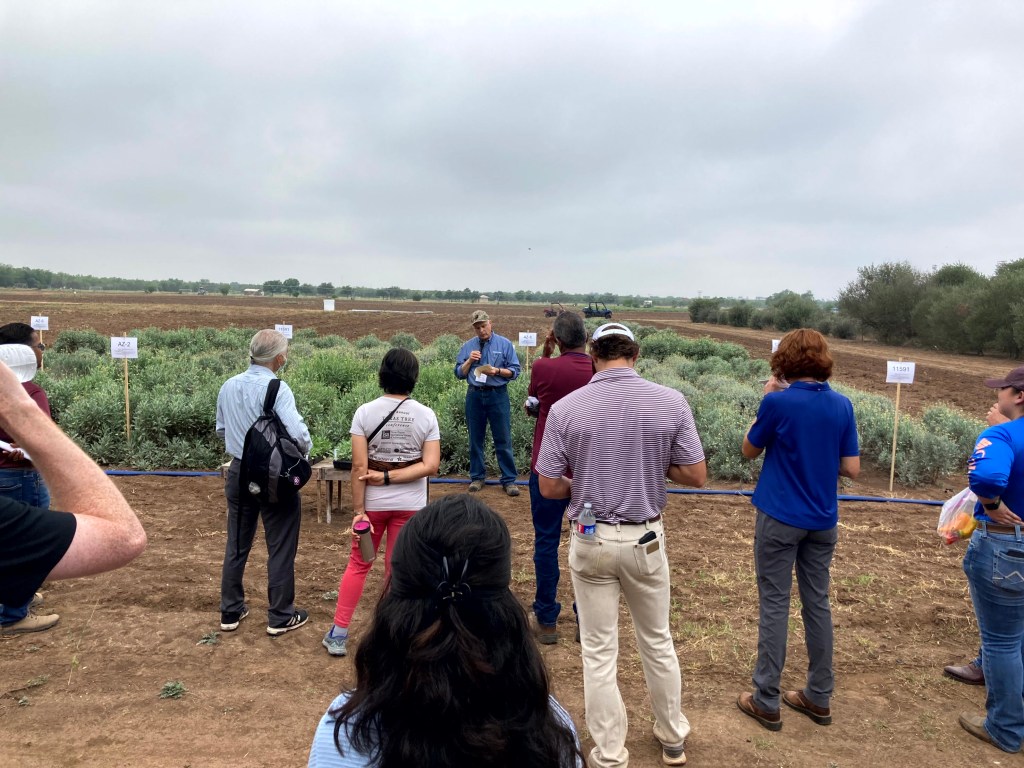
On May 2, 2024, I had the privilege of attending and speaking at the Texas A&M AgriLife Research and Extension Center in Uvalde – Vegetable Spring Field Day. The field day featured a morning walking tour of all the research going on at the center and one of the stops was extremely interesting and informative especially since it covered an area of agriculture I had never heard about. Del Craig with Bridgestone Company (maker of many brands of tires) was on hand to talk about their continued research into a plant called “Guayule,” and it was a fascinating introduction!

Guayule is a shrub native to the southwestern United States and northern Mexico. The correct spelling is Parthenium argentatum, and it’s indeed a source of natural rubber. Guayule is particularly interesting because it offers an alternative to the traditional rubber source, the Hevea brasiliensis tree, which is grown primarily in Southeast Asia.

Characteristics of Guayule

  • Habitat: Guayule thrives in semi-arid climates, making it well-suited for regions where few other economic crops can grow.
  • Appearance: It’s a woody perennial that can reach up to 3 feet in height. It has a silver-gray appearance due to its hairy leaves, which help minimize water loss.
  • Rubber Production: Unlike the rubber tree, guayule produces rubber biopolymers in its bark and roots rather than in its sap. This rubber is harvested by grinding the whole plant and using a solvent-extraction process. Del Craig explained that the whole plant is harvested like you would harvest hay and then taken to processing.

Environmental and Economic Benefits

  • Sustainability: Since guayule grows in semi-arid regions, it requires less water than traditional rubber crops, making it an environmentally friendly alternative.
  • Hypoallergenic Properties: The rubber from guayule does not contain the proteins responsible for latex allergies, making it safe for use in medical supplies like gloves and catheters.
  • Economic Potential: It offers economic benefits for arid and semi-arid regions, providing a viable crop option that can support local economies without the extensive use of irrigation.

Research and Applications

  • Research is ongoing into optimizing the cultivation and processing of guayule for rubber extraction. This includes genetic breeding for traits such as increased rubber yield and disease resistance.
  • Current applications of guayule rubber include tires, medical products, and even consumer goods like footwear and adhesives.
  • The Uvalde Center has been a good test site but Del explained on the tour that they are also establishing a project in the Rio Grande Valley and at the Lubbock Research and Extension Center. These multiple sites allow for lots of experimentation on varieties in different eco-zones.

Could it grow in the South Plains?

In the pursuit for sustainable agricultural solutions in regions like the South Plains of Texas with limited water resources, guayule could be a great alternative to consider. Native to arid environments and native to Texas, this drought-resistant shrub is ideally suited to the South Plains of Texas, where traditional water-intensive crops struggle. Mr. Craig told me personally that they are looking into the possibility of the Plains to Brownfield to Seminole area being ideal for production.

One of the most compelling attributes of guayule is its water efficiency. This plant thrives in semi-arid climates, utilizing very deep root systems that tap into lower soil moisture levels and leaves adapted to minimize water loss. These features allow guayule to sustain itself and produce economically valuable rubber with minimal irrigation, aligning perfectly with the water conservation needs of the South Plains.

Moreover, guayule is adaptable to various soil types, increasing its viability across different landscapes within the region. Its introduction could diversify agricultural practices, reduce economic risks from crop failures, and provide farmers with a new revenue stream through the production of biodegradable rubber products.

The environmental benefits of cultivating guayule are also noteworthy. By stabilizing soil and reducing erosion on marginal lands, it enhances soil health and supports the local ecosystem. Del Craig also commented that they have looked at the carbon sequestration ability of the plant and its deep and extensive root system makes it a winner. To fully integrate guayule into the South Plains, initiatives such as pilot projects to tailor cultivation techniques, local agronomic support, and the establishment of processing facilities are essential.

Resources