
Most of us grew up hearing that “soil takes hundreds or thousands of years to form.” That is a useful reminder that mature soil profiles and distinct soil horizons develop slowly. But it can also leave the impression that meaningful soil development cannot occur within a farmer’s lifetime.
That is not necessarily true.
Research on young soils and soil chronosequences shows that biological activity, organic matter accumulation, aggregation, mineral weathering, and other measurable soil properties can begin changing within years to decades. A mature soil profile may take centuries or longer to develop, but the processes that build a functioning soil begin much sooner.1 2
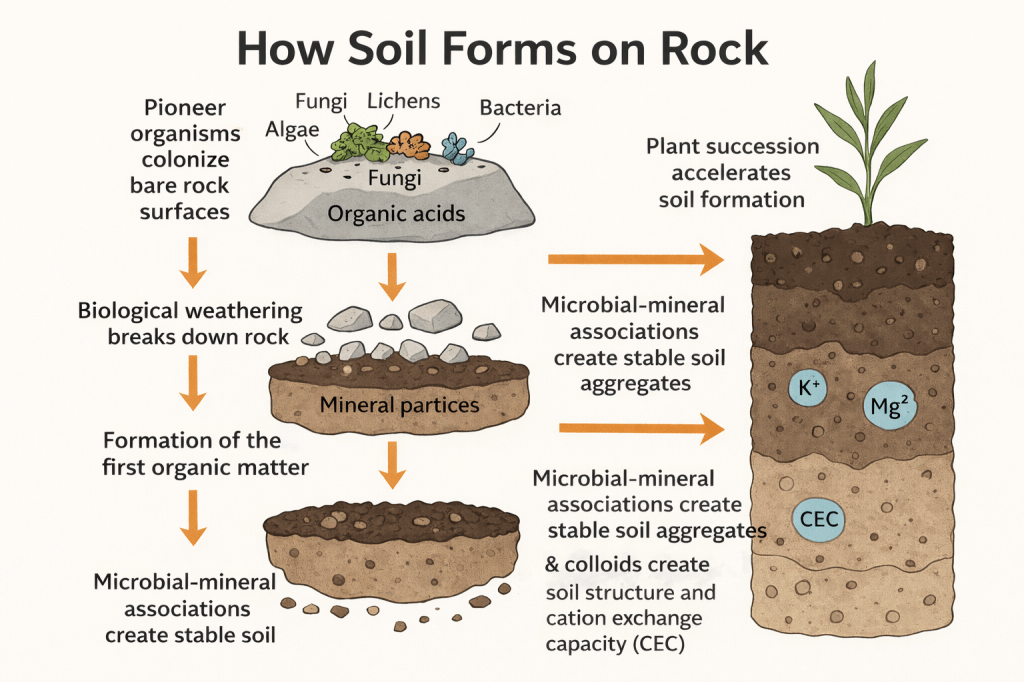
Under favorable conditions, measurable changes in soil biology, organic matter, aggregation, nutrient cycling, and other soil properties can occur within years to decades.
By “soil development,” I am not suggesting that a mature soil profile forms in 20 or 30 years. I am referring to measurable changes in soil structure, biological activity, organic matter, nutrient retention, weathering, and other properties associated with pedogenesis.3 4
Soil Formation Starts When Life Colonizes Minerals
Biological colonization is one of the most important accelerators of early pedogenesis. On newly exposed rock, ash, sediment, or other parent material, organisms such as lichens, algae, cyanobacteria, fungi, bacteria, and eventually plants begin interacting with mineral surfaces.
- Lichens (symbiotic associations between fungi and algae and/or cyanobacteria)
- Cyanobacteria and algae
- Fungi
- Mineral-weathering bacteria
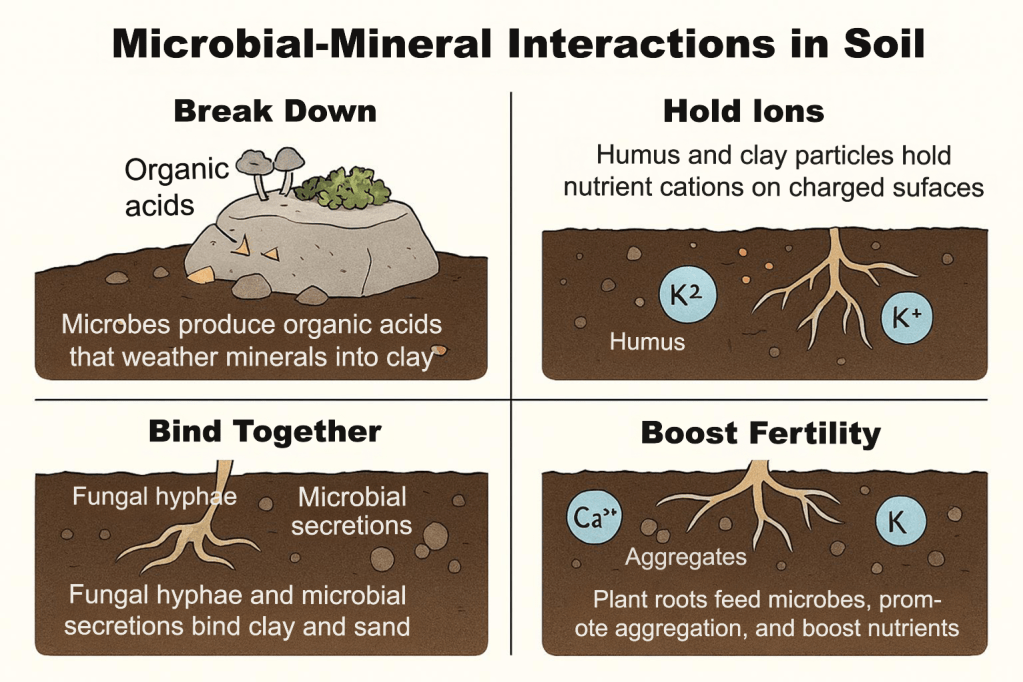
These organisms don’t just “live on rock.” They actively change it. They attach to mineral surfaces, grow into microcracks, and begin chemically and physically transforming the material into something more soil-like.
Biology Accelerates Mineral Weathering
Once microbes and fungi are present, weathering becomes a biological–geochemical process.
Chemical weathering
Organisms produce compounds such as organic acids and chelators that dissolve minerals and release nutrients like:
- calcium (Ca²⁺)
- magnesium (Mg²⁺)
- potassium (K⁺)
- phosphorus (PO₄³⁻)
Carbon dioxide from respiration also forms carbonic acid in water, which further increases mineral dissolution. These reactions can increase mineral dissolution and release plant nutrients from susceptible minerals.
Physical weathering
Fungal hyphae and plant roots widen cracks. Wet–dry cycles and freeze–thaw cycles fracture material. Windblown dust can add fine mineral particles. The result is more surface area and faster breakdown.
In short, biology makes the parent material more reactive and easier to transform.
Organic Matter and Clay Create Nutrient-Holding Capacity
As the pioneer organisms mentioned above die and recycle, organic residues accumulate. Even small organic inputs matter (adding compost/grow cover crop) because they start forming organo-mineral associations—the foundation of stable soil.
At the same time, primary minerals weather into secondary minerals (including clays and short-range-order minerals, depending on parent material). Organic compounds associated with mineral surfaces can also contribute to nutrient retention and carbon stabilization.
CEC (cation exchange capacity) — the soil’s ability to hold and supply nutrient cations like Ca²⁺, Mg²⁺, K⁺, and NH₄⁺. This increasing exchange capacity matters because it gives the developing soil more ability to retain positively charged nutrients such as calcium, magnesium, potassium, and ammonium rather than allowing them to move readily with water.
This is a major transition point: the developing soil gains greater capacity to retain and cycle nutrients.
A good example of rapid stabilization and soil development occurs in volcanic ash materials, which are highly reactive and can form strong mineral–organic associations relatively quickly.5
Aggregation: The “Soil Structure” Breakthrough
One of the clearest signs that soil is forming rapidly is the development of aggregation—stable crumbs and clods that resist slaking and erosion.
Biology contributes strongly to aggregation through:
- fungal hyphae physically binding particles
- microbial extracellular polymers (EPS) acting as glue
- root exudates stimulating microbial activity
As aggregation increases, the soil improves in:
- water infiltration
- pore space and aeration
- erosion resistance
- root penetration
- drought resilience
This is one reason growers may notice a soil becoming easier to work, infiltrating water better, or forming more stable crumbs within only a few seasons—even though the underlying soil profile is still essentially the same soil.
Why Decadal Soil Development Is Plausible
Traditional statements about soil taking thousands of years usually refer to fully developed soil profiles under slow geologic weathering. But modern evidence supports that early soil formation can proceed rapidly when:
- biological activity is high
- parent material is reactive
- vegetation establishes quickly
- erosion is controlled
- carbon inputs are consistent
Time matters, but the rate and direction of pedogenesis depend on the interaction of biology, climate, parent material, landscape position, and management. In young soils, biological activity can be an especially powerful accelerator.6
Statements such as “an inch of topsoil takes hundreds of years to form” and evidence of soil development within decades refer to different things. The first generally describes long-term development or replacement of soil material. The second describes measurable changes in soil properties and pedogenic processes. Soil can become more structured, biologically active, carbon-rich, and functionally different long before a mature soil profile has formed.
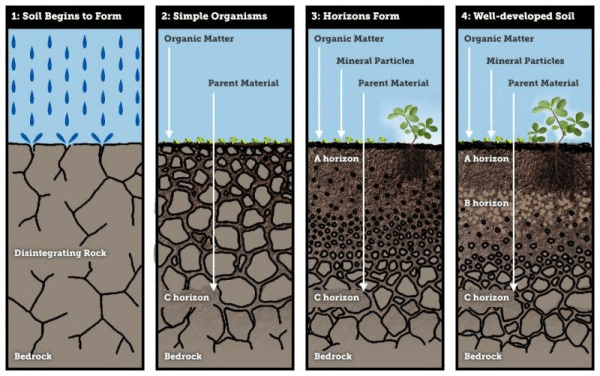
Picture: Manaaki Whenua – Landcare Research 2020. The New Zealand Soils Portal. https://doi.org/10.26060/3nyh-mh28
What This Means for Organic and Regenerative Production
Many practices used in organic and regenerative production can strengthen the same biological and physical processes involved in soil development:
- living roots longer during the year (cover crops, perennials)
- high biomass carbon inputs (residue retention, mulches)
- reduced disturbance where possible
- organic amendments that stimulate microbial activity
When we manage for biology, we aren’t “creating soil out of thin air.” But we are increasing the processes that build soil structure, nutrient retention, and resilience faster than many people expect.
On an established farm, our goal is usually not to “form a new soil.” It is to improve the structure, biological activity, organic matter dynamics, nutrient cycling, and water relations of the soil we already have.
Bottom Line
Soil formation is not just slow geology. It is an active biological process. Under the right conditions, the early stages of pedogenesis—weathering, organic matter accumulation, clay development, and aggregation—can produce measurable improvements in soil function within decades, and sometimes even sooner.
That’s encouraging science for anyone trying to rebuild soil health on real farms in real time.
References
- USDA Natural Resources Conservation Service — Soil Facts / Soil Formation and Classification. ↩︎
- Huggett, R.J. 1998. Soil chronosequences, soil development, and soil evolution: a critical review. CATENA 32:155–172. ↩︎
- Nature of the Belowground Ecosystem and Its Development during Pedogenesis. Advances in Agronomy 127:43–109 (2014). ↩︎
- Spinola et al. 2024. Rapid soil formation and carbon accumulation along a Little Ice Age soil chronosequence in southeast Alaska. CATENA 246:108460. ↩︎
- Volcanic ash soils and rapid stabilization: https://www.mdpi.com/2071-1050/11/11/3072 ↩︎
- Soil formation factors (Landcare Research NZ): https://soils.landcareresearch.co.nz/topics/understanding-soils/how-do-soils-form ↩︎

Discover more from Texas A&M AgriLife Organic
Subscribe to get the latest posts sent to your email.


