Corn Breeding – Not an Easy Process

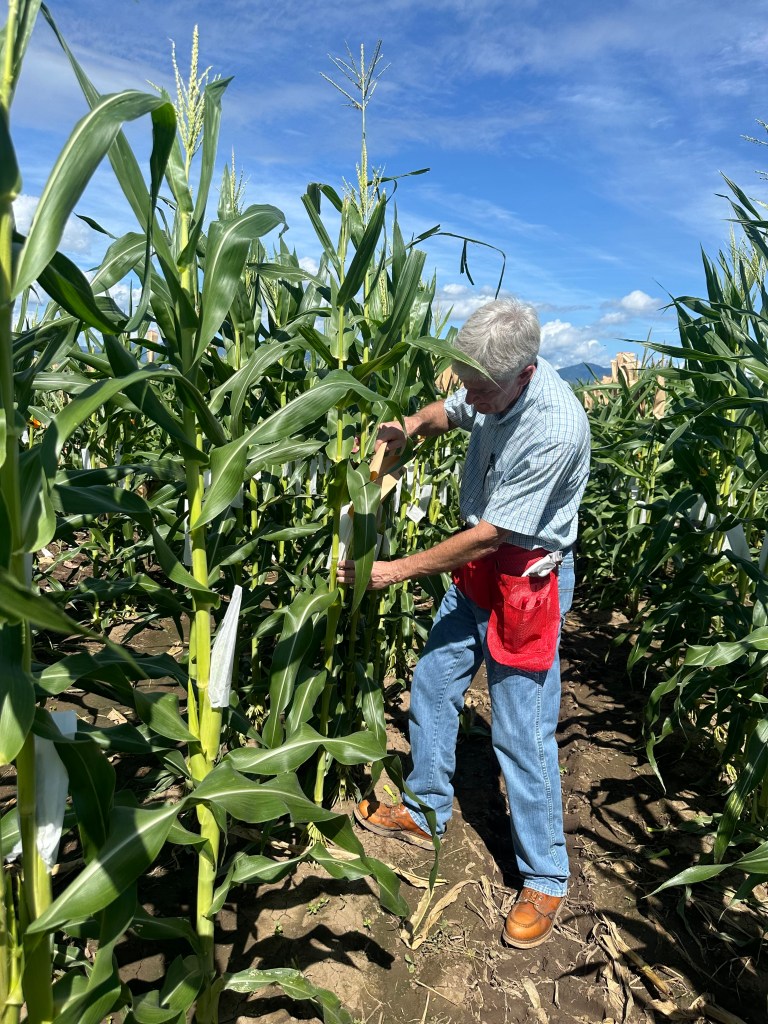
In the world of organic agriculture, the continuous development of improved corn varieties is crucial for addressing the evolving challenges faced by farmers. This November, Dr. Wenwei Xu, a TAMU Research Corn Breeder from Lubbock, and I traveled to work in the Winter Corn Nursery in Ponce, Puerto Rico. Our mission involved carefully collecting pollen from specific corn varieties and crossing them onto the silks of other varieties to produce hybrids for future variety production.

The Winter Corn Nursery plays a vital role in accelerating the breeding process by allowing researchers to conduct additional growing cycles during the off-season. This enables breeders to make faster progress in developing new varieties with desirable traits such as brown mid-rib, improved leaf structure for weed suppression, drought tolerance, high antioxidant production, and enhanced silage production capability. By utilizing winter nurseries, breeders can significantly reduce the time required to bring new, improved varieties to market, ultimately benefiting organic farmers and the agricultural industry as a whole.

The work of corn breeders is essential for advancing organic agriculture and addressing the unique challenges faced by organic farmers. Through careful selection and crossing of varieties with known traits, breeders aim to develop new hybrids that combine multiple desirable characteristics. These efforts result in corn varieties that are better adapted to organic growing conditions, more resilient to pests and diseases, and capable of producing higher yields with improved nutritional profiles. By continually refining and enhancing corn genetics, breeders contribute to the sustainability and productivity of organic farming systems, helping to meet the growing demand for organic products while supporting the long-term viability of organic agriculture.

Organic Corn Resources

Finding a corn variety adapted to Texas extremes can be very difficult. At this time, I just don’t know of too many certified organic corn varieties that can make it through the difficult hot nights in most of Texas except maybe the northern panhandle area of Texas. Even in those area many growers have tried to bring in corn varieties popular in the Midwest and they just don’t yield well.

That said, I have tried to list varieties that Texas organic growers have grown and continue to grow. The companies listed may or may not have varieties adapted to Texas, but you have their contact information to check. If you see anything I need to add, change or delete please let me know. This is an ongoing project and one that will continually be updated and changed.

Click a link below to scroll down!

Updated 3/12/25

  1. Corn Varieties Used for Organic
  2. Seed Contacts:
  3. Organic Corn Buyers:
  4. Resources (just click to see)
  • Pioneer Yellow – P0075, P0157, P0487, P1185, P1197, P1222, P1359, 6381, 5353, P1608, P1639, P1718, P1870, P17677 (available in 2025), and (not sure about availability – P1751, P33Y74, P1422, 63T1GH, 6589ZZ, P33774)
  • Pioneer White – P1790W, P1306W, P1543W (available in 2025), and (not sure about availability – 1639 and 32B10)
  • Partners Brand – PB 11802 (118 day), CL 860 (116 day), and PB 8580 (115 day)
  • Seitec Genetics – 6345, 6381
  • BH Genetics – 8780, 8700, 8590, 8555, 8420, 8443W, 8121

This list does not necessarily mean that these companies have corn varieties adapted for Texas. Companies continue to develop varieties that work in areas they have not traditionally grown in and so some testing helps know and use new materials.

Pioneer

  • I am in contact with Pioneer to get contact information soon. Till then check with your local rep if you have one?

New Deal Grain

  • 501 E Main St, New Deal, TX 79350
  • Office: (806) 784-2750

Partners Brand

B-H Genetics

  • 5933 Fm 1157, Ganado, TX 77962
  • Office: (361) 771-2755
  • seed corn, sorghum, sorghum-sudangrass

Seitec Genetics

Beck’s Hybrids/Great Harvest Organics

  • 6767 E. 276th Street, Atlanta, IN 46031
  • (800) 937-2325
  • Corn, Corn Silage, Soybeans, Wheat, Alfalfa, Milo/Sorghum, Forage and Cover Crop

Albert Lea Seed/Blue River Organic Seed/Viking Non-GMO

  • 1414 West main Street Albert Lea MN 56007
  • seedhouse@alseed.com
  • Work: (800) 352-5247
  • www.alseed.com
  • corn, soybeans, alfalfa, wheat, oats, cover crops, wildflowers, native grasses, CRP

De Dell Seeds

American Organic Seed

Falk’s Seed Farm

  • 1170 High 9 NE Murdock MN 56271
  • falkseed@westtechwb.com
  • (320) 875-4341
  • www.falkseed.com
  • soybeans, corn, forages, small grains

Foundation Organic

Genetic Enterprises International

Master’s Choice

Welter Seed and Honey Company

Byron Seeds

  • 775 N 350 E Rockville IN 47872
  • duane@byronseeds.us
  • (800) 801-3596
  • http://byronseeds.net/
  • alfalfa, corn, clover, cover crop, grasses, mixes

Enger Farms

McDowell Feed Source

Coyote Creek Organic Feed Mill

Deaf Smith County Grain

Panhandle Milling

Heartland Co-op

Triple Nickel

Pink Rose Organix