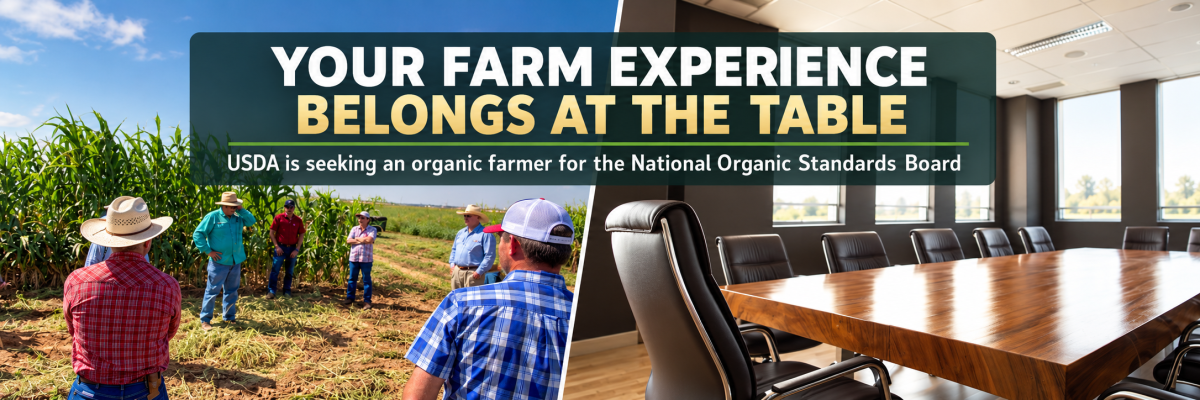
USDA is seeking applicants for three upcoming vacancies on the National Organic Standards Board (NOSB), including one position specifically reserved for an individual who owns or operates an organic farming operation or is employed by an organic farmer.
Applications must be received or postmarked by December 28, 2026, and those appointed will serve through January 2032.
For an organic farmer who has ever wondered who helps decide which materials can be used in organic production, how the National List changes, or how organic regulations develop over time, the NOSB is one of the most important places where those discussions occur.
What Is the National Organic Standards Board?
The NOSB is a 15-member federal advisory board created under the Organic Foods Production Act. Its members represent different parts of the organic community, including organic farmers, handlers, consumers, environmental and resource conservation interests, retailers, scientists and certifiers.
Four of the 15 seats are specifically designated for organic farmers or employees of organic farming operations.
The Board advises USDA on organic production, handling and processing issues and has a particularly important responsibility for the National List of Allowed and Prohibited Substances.
When a new substance is proposed for organic use, NOSB members review the petition, scientific and technical information, possible alternatives, effects on human health and the environment, and whether the material is compatible with organic production. After receiving public comment, the Board discusses and votes on whether to recommend the substance to USDA. Under the Organic Foods Production Act, USDA cannot add a substance to the National List without a recommendation from the NOSB.
The NOSB has made more than 600 recommendations since it was established in 1992, covering organic production practices, materials and other organic policy issues.
This Is More Than Two Meetings a Year
The full NOSB normally meets twice each year in public meetings where members discuss proposals, consider public comments and vote on recommendations to USDA.
Much of the Board’s work, however, occurs between those meetings.
The NOSB has six subcommittees covering:
- Crops
- Livestock
- Handling
- Materials
- Compliance, Accreditation and Certification
- Policy Development
Members participate in regular subcommittee conference calls, review petitions and technical reports, evaluate materials undergoing sunset review, analyze public comments, and help prepare discussion documents and formal proposals.
USDA estimates that monthly subcommittee calls require approximately three to six hours per month, in addition to preparation time. Members also spend significant time preparing for the two full Board meetings each year.
USDA covers lodging, airfare and a daily per diem for required in-person NOSB meetings.
In other words, this is a working board rather than an honorary appointment.
Why the Farmer Seat Matters
Organic regulations ultimately have to work on farms.
A material that sounds reasonable in a technical report may be difficult to use under actual field conditions. An alternative that appears available on paper may not be economically or practically available to farmers in every region. Production challenges in Texas may look very different from those encountered in California, the Midwest or the Northeast.
That is why farmer representation on the NOSB is important.
A farmer member brings experience with soil, weather, pests, crop rotations, livestock, labor, markets, certification and the hundreds of practical decisions involved in operating an organic farm.
The farmer representative brings the perspective of organic farmers to the Board, while considering how recommendations may affect organic agriculture across crops, regions and production systems.
Texas Already Has a Voice on the Board
Texas organic agriculture recently gained additional representation when Texas organic grower and produce-industry leader Jed Murray was appointed to the NOSB.
Jed’s background illustrates the type of practical experience that can be valuable on the Board. His experience includes organic vegetable production, packing and marketing, working with retailers and advocating for growers.
His appointment also demonstrates that knowledge gained through farming, marketing and working directly with producers can be valuable at the national policy level.
For Texas readers, you can also read our earlier article, “Texas Organic Experience Comes to the National Organic Standards Board,” about Jed Murray’s appointment.
Who Should Consider Applying?
USDA is not simply looking for someone who spends every day working on organic policy.
A strong farmer candidate might be someone who:
- understands certified organic production from practical experience;
- is willing to study technical and regulatory issues;
- can listen carefully to perspectives from different parts of the organic community;
- can evaluate how proposed changes may affect farmers in different production systems and regions; and
- is willing to devote the time required to participate actively in Board and subcommittee work.
The current opening is available to an individual who owns or operates an organic farming operation or is an employee of such an individual.
USDA is also seeking applicants for one public or consumer-interest seat and one seat for an individual with expertise in toxicology, ecology or biochemistry.
How to Apply
Applications must include:
- a resume;
- the USDA AD-755 Advisory Committee Background Information Form; and
- identification of the NOSB position for which the applicant is applying.
A cover letter and letters of reference are optional, although USDA encourages reference letters.
Applications must be received or postmarked by December 28, 2026.
Electronic submissions are preferred and should be emailed to Andrew Malone, Associate Deputy Administrator, National Organic Program, Andrew.Malone@usda.gov.
Anyone considering applying should review USDA’s NOSB nomination information carefully for the current application instructions, eligibility requirements and contact information.
Learn More
- USDA National Organic Standards Board
- USDA NOSB Nomination Process
- USDA NOSB Meetings
- USDA NOSB Subcommittees
- Organic Trade Association NOSB Resources
- Recommendation on Criteria for Board Membership (pdf)
- Nominations page. – Information about the Board, time commitments, workload, and how to apply
- About the Board – Current Members, Activities, Policy & Procedures Manual, Resources