Nitrogen is one of the most important nutrients in crop production, but it is also one of the hardest to manage well. In organic agriculture, that challenge is even greater because we do not use synthetic nitrogen fertilizers. We depend on legumes, manure, compost, crop rotations, soil organic matter, and biological activity to supply nitrogen over time.
That makes nitrogen efficiency extremely important. Every pound of nitrogen released from manure, compost, legumes, or soil organic matter needs to be captured by the crop as effectively as possible. When nitrogen is lost, the farmer may lose yield potential, grain protein, forage value, and money. The environment can also lose because nitrogen may move into water or escape from the soil as nitrogen gases. This is why a concept called Biological Nitrification Inhibition, or BNI, has great potential and why we are looking at it in our wheat breeding programs.
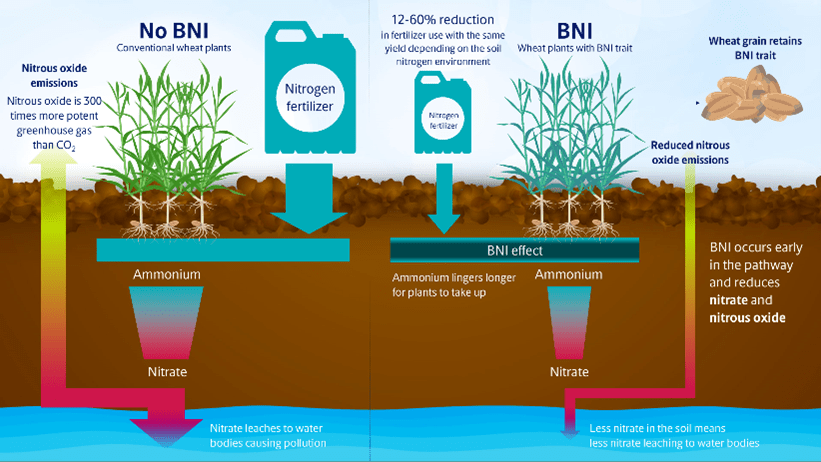
Figure description: BNI wheat slows the conversion of ammonium to nitrate in the soil. This keeps nitrogen in a form that is less prone to leaching, can reduce nitrous oxide emissions, and may allow the crop to use fertilizer nitrogen more efficiently.
Table of Contents
What Is BNI?
BNI is a natural plant trait where roots release compounds that slow down nitrification, the microbial process that converts ammonium nitrogen into nitrate nitrogen.
That matters because ammonium nitrogen, written as NH₄⁺, tends to stay attached to soil particles. Nitrate nitrogen, written as NO₃⁻, is much more mobile and can move with water below the root zone. Nitrate can also be involved in soil processes that produce nitrous oxide, a greenhouse gas.
In simple terms, BNI may help the crop slow the leak in the nitrogen bucket.
BNI does not stop nitrogen cycling. It does not sterilize the soil. It simply slows one part of the nitrogen cycle near the root so more nitrogen may remain available to the crop longer. Researchers describe BNI as root exudates suppressing ammonia-oxidizing bacteria and archaea, which are microbes involved in the first major step of nitrification (Coskun et al., 2017; Subbarao et al., 2013; Subbarao et al., 2021).
Why This Matters in Organic Farming
Organic farmers already work hard to build nitrogen through biology. Legume cover crops, compost, manure, crop residues, and soil organic matter all release nitrogen through natural processes. The challenge is timing. The crop needs nitrogen at certain growth stages, but the soil releases nitrogen according to moisture, temperature, microbial activity, and residue quality.
If nitrogen becomes nitrate too early, it may be lost before the crop can use it. BNI wheat may help by keeping more nitrogen in the ammonium form near the root system.
That does not replace good organic management. BNI wheat would still need good rotations, fertility planning, soil health, weed control, and adapted varieties. But if the crop can help hold nitrogen in the root zone longer, it may improve nitrogen-use efficiency in systems where nitrogen is often expensive, limited, or difficult to time correctly.
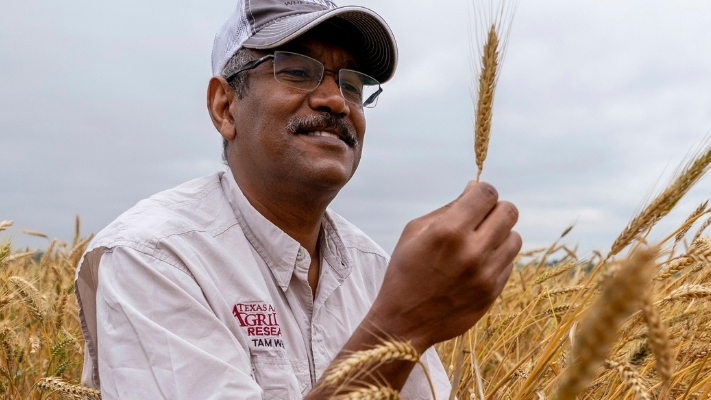
Wheat research conducted by Texas A&M AgriLife Research. Photo courtesy of Dr. Amir Ibrahim, Texas A&M AgriLife Research.
Why Wheat?
Wheat is one of the most flexible crops in American agriculture. It can be harvested for grain, cut for silage, grazed as forage, used in dual-purpose systems, or grown as a cover crop. That makes wheat especially important in organic systems. In Texas, wheat is often part of livestock systems and row-crop rotations. For organic dairy, beef, grain, and cover crop systems, a more nitrogen-efficient wheat could have value across the whole farm.
Is BNI Wheat Genetically Engineered?
No! The BNI wheat being discussed in current research is developed through conventional plant breeding methods, not genetic engineering. Researchers identified a strong BNI capacity in a wild relative of wheat called Leymus racemosus. The BNI-associated chromosome segment from that wild relative was transferred into wheat, and researchers have since developed BNI-enabled wheat lines such as MUNAL-BNI and ROELFS-BNI (Subbarao et al., 2021; Bozal-Leorri et al., 2022).
This work uses crossing, backcrossing, marker-assisted selection, root exudate testing, and field evaluation. These are conventional breeding tools, even though some are advanced. Marker-assisted selection simply helps breeders identify which plants inherited the desired chromosome segment. It does not create a genetically engineered plant. That distinction matters for organic agriculture because BNI wheat fits within the conventional plant breeding pathway.
What Do We Know So Far?
The science is still developing, but the early evidence is encouraging. Research has shown that BNI capacity exists in wild relatives of wheat and in some wheat landraces. One study found significant BNI activity in several wheat landraces, showing that BNI is not limited only to wild species (O’Sullivan et al., 2016). More recent work shows that wheat genotypes vary in root exudate chemistry and BNI activity, which means breeders may have useful natural variation to work with (Ghatak et al., 2025).
Studies with BNI-enabled wheat lines have reported reduced ammonia-oxidizing bacteria, lower nitrification potential, lower nitrate levels, greater ammonium retention, improved nitrogen uptake, and no yield penalty in many cases (Subbarao et al., 2021; Bozal-Leorri et al., 2022; Karwat et al., 2025).
That does not mean every question is answered. Soil type, pH, temperature, nitrogen source, crop stage, and variety background can all affect how well BNI works. But the evidence is strong enough to justify serious breeding, field testing, and organic systems research.
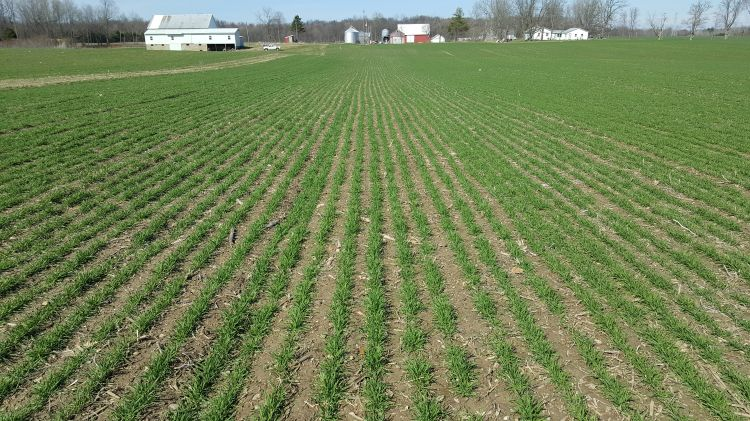
Wheat field representing commercial wheat production. Photo: Adobe Stock.
What Could BNI Wheat Mean for Farmers?
For organic grain farmers, better nitrogen-use efficiency could help with both yield and grain protein. Protein is especially important in bread wheat markets, and nitrogen availability is one of the major drivers of protein.
For organic dairy and livestock producers, BNI wheat could have value as forage, silage, grazing, or feed grain. If wheat can use nitrogen more efficiently, it may improve the economics of growing organic feed locally.
For organic crop rotations, BNI wheat could become another tool to help stabilize fertility. It will not replace legumes, compost, manure, or cover crops, but it may help the crop use those biological nitrogen sources more efficiently.
For the environment, BNI wheat may reduce nitrate leaching and nitrous oxide emissions. Reviews of BNI research suggest that BNI crops can improve nitrogen-use efficiency and reduce nitrogen losses, although field performance will depend on soil, climate, crop genetics, and management (Coskun et al., 2017; Subbarao et al., 2013; Saud et al., 2022; Wang et al., 2021).
References and Further Reading
Bozal-Leorri, A., Subbarao, G., Kishii, M., Urmeneta, L., Kommerell, V., Karwat, H., Braun, H., Aparicio-Tejo, P., Ortiz-Monasterio, I., González-Murua, C., & González-Moro, M. (2022). Biological nitrification inhibitor-trait enhances nitrogen uptake by suppressing nitrifier activity and improves ammonium assimilation in two elite wheat varieties. Frontiers in Plant Science, 13. https://doi.org/10.3389/fpls.2022.1034219
Coskun, D., Britto, D., Shi, W., & Kronzucker, H. (2017). Nitrogen transformations in modern agriculture and the role of biological nitrification inhibition. Nature Plants, 3. https://doi.org/10.1038/nplants.2017.74
Ghatak, A., et al. (2025). Natural variation of the wheat root exudate metabolome and its influence on biological nitrification inhibition activity. Plant Biotechnology Journal, 23, 4755–4772. https://doi.org/10.1111/pbi.70248
Karwat, H., et al. (2025). Nitrogen dynamics and yield performance of an elite bread wheat line with BNI capacity expressed in an alkaline soil. bioRxiv. https://doi.org/10.1101/2025.07.29.667244
O’Sullivan, C., Fillery, I., Roper, M., & Richards, R. (2016). Identification of several wheat landraces with biological nitrification inhibition capacity. Plant and Soil, 404, 61–74. https://doi.org/10.1007/s11104-016-2822-4
Subbarao, G. V., et al. (2021). Enlisting wild grass genes to combat nitrification in wheat farming: A nature-based solution. Proceedings of the National Academy of Sciences, 118. https://doi.org/10.1073/pnas.2106595118
Subbarao, G. V., et al. (2013). A paradigm shift towards low-nitrifying production systems: The role of biological nitrification inhibition (BNI). Annals of Botany, 112(2), 297–316. https://doi.org/10.1093/aob/mcs230
Wang, X., et al. (2021). Effects of biological nitrification inhibitors on nitrogen use efficiency and greenhouse gas emissions in agricultural soils: A review. Ecotoxicology and Environmental Safety, 220, 112338. https://doi.org/10.1016/j.ecoenv.2021.112338

Discover more from Texas A&M AgriLife Organic
Subscribe to get the latest posts sent to your email.


