
Planning Organic Production with a Practical Price Index

In Extension, we’re often asked to help farmers and food businesses plan for the future—whether it’s transitioning acreage to organic, developing budgets, or evaluating the economics of new practices. One of the most common challenges we face is this: how do you plan for prices in an unpredictable market?

While no one can forecast future prices with certainty, that doesn’t mean we’re flying blind. We base our planning on something measurable, reliable, and rooted in history—and in organic agriculture, one of the most useful tools for this is a broad price index or multiplier.

Why Use a Price Multiplier?

Organic markets—like all markets—fluctuate. Prices are affected by everything from weather and input costs to consumer demand and global trade. But when we look at long-term trends, we begin to see patterns that can inform sound decision-making.

When we have access to strong market data—such as for organic corn, cotton, dairy, and many fruits and vegetables—we can use that data to create benchmarks. These help answer practical questions:

  • What kind of price can I reasonably expect if I go organic?
  • How much more can I budget for input costs and still break even?
  • Will this transition pencil out?

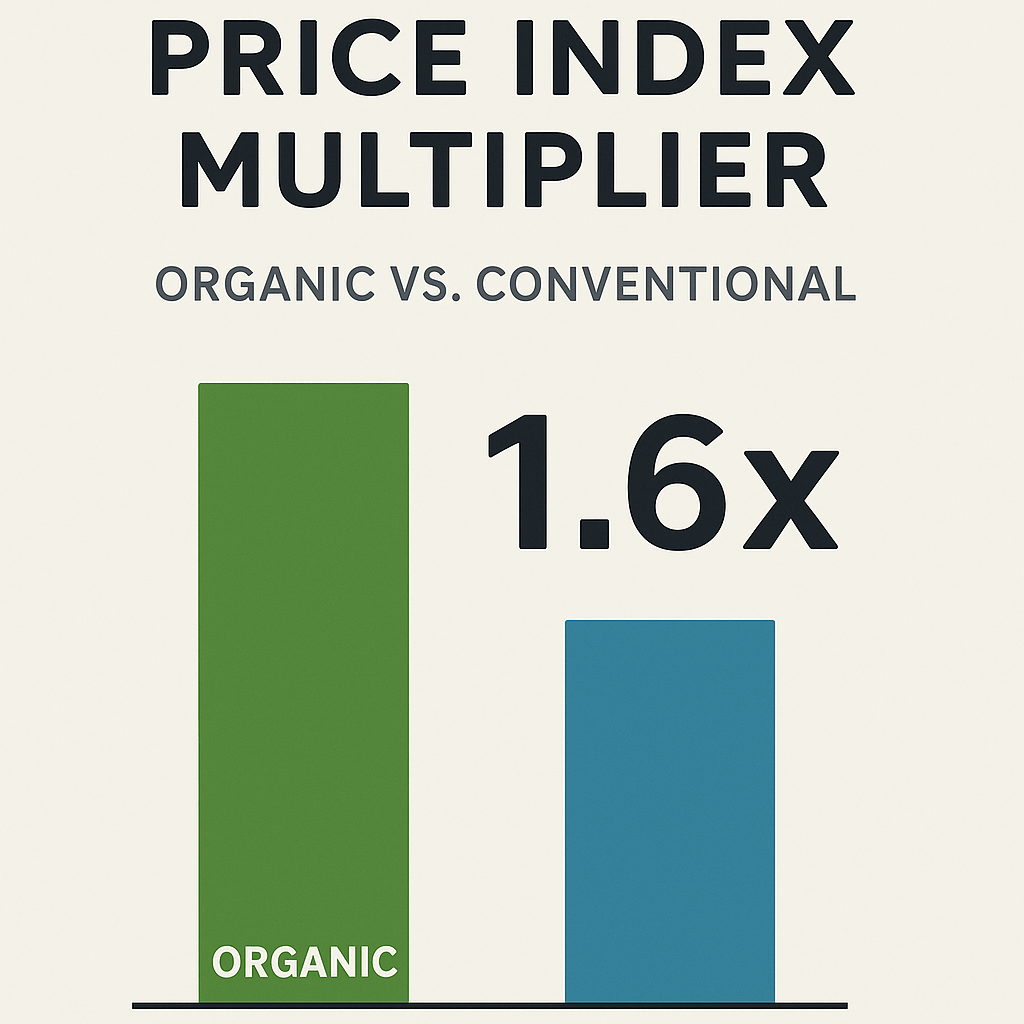
To answer these questions, we need a reference point—and that’s where a 1.6 multiplier comes in.

What Is the 1.6 Organic Multiplier?

The 1.6 multiplier means that organic farmgate prices tend to average about 1.6 times higher than conventional prices for many major commodities over the long run. That’s a 60% premium, based on real market data and USDA price tracking over the past decade or more. I happened to stumble onto this idea when I read an article in Progressive Dairy about conventional milk price forecasts through 2025. (Click to Read) This article made me wonder if I could use historical organic dairy milk prices in relation to conventional dairy milk prices and use this ratio to predict future organic prices. It was amazing to see what I kind of knew, that organic prices do follow with conventional prices for the most part!

So, this is not a guess. It’s backed by:

  • USDA AMS organic market summaries for corn (1.6 is pretty stable for corn) and cotton (less stable as prices have been higher making the index 1.6-2.0 or higher).
  • National organic dairy price reports, which show organic milk regularly selling at 1.5 to 1.65 times the price of conventional.
  • Industry-wide organic vegetable and fruit pricing that shows farmgate premiums in the 1.5 to 1.7 range across categories like tomatoes, lettuce, and apples.

Whether you’re planning production, analyzing risk, or applying for a grant or loan, this index provides a realistic baseline. It is not too optimistic or too pessimistic and is useful for planning purposes.

When This Index Works—and When It Doesn’t

The 1.6 multiplier is a planning tool, not a crystal ball. It works best:

  • When building enterprise budgets for row crops, dairy, and produce.
  • When discussing profitability potential with transitioning farmers.
  • When negotiating contracts or thinking through insurance or risk tools.
  • In extension workshops, to help audiences grasp market potential quickly.

However, this index doesn’t capture every situation. Local sales, direct markets, specialty crops, and extreme weather or supply chain issues can cause premiums to fall below or rise above the average. Sometimes, organic produce in a saturated market may only bring in a 10–20% premium, while other times a rare variety or short supply can push that number above 2x (or higher) the conventional price.

Why It’s Still Useful

Despite those swings, planning requires a number—and the 1.6 index is a solid, evidence-based starting point.

When I help producers set up organic systems, I don’t want to promise the moon. Instead, it is better to offer realistic projections grounded in long-term national trends.

Always I encourage producers to:

  • Adjust their projections up or down depending on crop, region, and market access.
  • Keep checking updated USDA-AMS, Argus Media, or buyer data each year.
  • Use the 1.6x benchmark as a baseline, not a guarantee.

Final Thoughts

As organic agriculture continues to grow, tools like this price index become more and more valuable. They help all of us in organic talk apples to apples with producers, gins, co-ops, lenders, and buyers. They also help demystify what can sometimes feel like a complex or volatile market.

My plan and my job is to keep helping farmers make decisions that are smart, sustainable, and rooted in good data.


Selling Your Organic Grain – Be Prepared!

  1. Why Contracts Are Essential in Organic Grain Sales
  2. Organic Grain Growers Checklist for Selling to Buyers
  3. Pre-Sale Preparation
  4. Before Delivery
  5. Delivery & Inspection
  6. Payment & Dispute Prevention
  7. Additional Protections

Why Contracts Are Essential in Organic Grain Sales

Selling organic grain is not as straightforward as selling conventional grain at an elevator, where pricing and quality adjustments are often standardized. In the organic grain market, unclear contracts, inconsistent pricing adjustments, and slow payments are common challenges that can put YOU at a disadvantage. Many organic buyers have been known to accept deliveries without immediate quality verification, only to later claim that the grain does not meet specifications. This often results in unexpected discounts deducted from the final payment, sometimes with little to no communication until the check arrives. Additionally, delayed payments can create financial strain for farmers who rely on timely income to manage expenses and reinvest in their operations.

These issues are not unique to one buyer but are widespread across the organic grain industry, where transactions are often handled differently than traditional grain sales. Unlike selling to an elevator, where grain is weighed, graded, and priced immediately, organic grain buyers frequently negotiate terms individually, leading to greater risk for the grower if expectations are not clearly defined upfront. Without a well-structured contract that specifies quality standards, pricing, delivery terms, and payment deadlines, farmers may find themselves in disputes over quality, receiving lower payments than expected, or waiting months to be paid.

To protect growers from these risks, formal contracts should be a standard practice in organic grain sales. A well-written contract provides transparency, ensures both parties agree on quality and pricing expectations, and reduces the likelihood of unfair deductions or disputes. Additionally, incorporating steps such as pre-approved grain samples and documented delivery inspections can help establish trust and accountability in transactions. By setting clear terms in writing, organic growers can secure fair payment for their crops and create a more predictable and long-term marketing process.

Organic Grain Growers Checklist for Selling to Buyers

Pre-Sale Preparation

Research the Buyer – Check past experiences, ask other farmers, and ensure the buyer has a good reputation.
Obtain a Written Contract – Do not rely on verbal agreements. Ensure all details are in writing.
Define Quality Specifications – Specify acceptable moisture, test weight, foreign material limits, and any other grading factors.
Determine Discount Schedule – Get in writing how much will be deducted for deviations from specifications.
Set a Payment Schedule – Include clear payment terms (Net 15, Net 30, etc.) and penalties for late payment.
Require a Pre-Approved Sample – Send a sample to the buyer before the deal is finalized and get a written quality approval.

Before Delivery

Keep Records of Grain Quality – Document test weight, moisture content, and any lab results before shipping.
Take Photos of the Grain – Have visual proof of quality before it leaves the farm.
Confirm Delivery Details – Date, time, location, and any special unloading requirements.
Clarify Inspection at Delivery – Require written acceptance of the load upon delivery to avoid later disputes.

Delivery & Inspection

Request a Third-Party Inspection (If Necessary) – If there are concerns, get an independent inspection at delivery.
Obtain a Delivery Receipt – Ensure the buyer acknowledges the grain’s arrival and confirms quality in writing.
Document Any Quality Concerns Immediately – If issues arise, get a signed report at the time of unloading.

Payment & Dispute Prevention

Track Payment Due Dates – Follow up if payment is delayed beyond the agreed timeframe.
Dispute Any Unfair Discounts Promptly – If deductions occur, request documentation and negotiate if necessary.
Consider Partial Upfront Payment – For large transactions, negotiate for partial pre-payment or escrow arrangements.

Additional Protections

Keep a Paper Trail – Maintain emails, contracts, test results, and photos in case of a dispute.
Clarify Liability for Rejections – If the grain is rejected, determine who covers the cost of returning or reselling it.
Work With a Lawyer (For Large Sales) – For significant transactions, having a legal review can prevent future issues.