If you missed getting a copy of the USDA Organic Cotton Market Summary put out by the Agricultural Marketing Service, then let me provide the report here. This report is for the 2024 market year and typically this report comes out in August of the next year or in this case, August 2025.
Production
The 2024 organic Upland and American Pima cotton production in the U.S. totaled 56,717 bales, according to information collected from organic producers, marketing associations, and gins that process organic cotton. Production increased by 17,458 bales from the previous year. An additional 1,201 transitional bales were reported. Texas continues to lead organic cotton plantings and production, with additional acreage in Arizona, California, and New Mexico.
Cottonseed
Organic cottonseed prices ranged from 385 to 620 dollars per ton. This compares to 235 to 385 dollars per ton for conventional cotton. Cottonseed yields ranged from 460 to 775 pounds of seed per bale of ginned lint. With most of the cottonseed being sold to organic dairies, some was saved for oil and livestock feed.
2025 Crop Outlook
Early season storms and a tornado destroyed many acres in Texas and were not replanted in organic American Pima because of a lack of available planting seed. Some fields were replanted with organic Upland. The stands that survived advanced with the above-average April through July rainfall. Abundant rainfall encouraged weed populations to explode, and fields were cultivated to mitigate weeds. Hoe crews manually removed stray weeds hidden in the rows. Stands in Arizona, California and New Mexico progressed and were regularly irrigated. Demand was very light.
My comments
Last year’s organic prices were a rollercoaster, and many dryland producers just didn’t get timely rains to give them a harvest. This year again prices started the year down and have continued to be bearish. Offers of $1.50 on upland were possible but limited.
Yes, if you are certified organic you are special and yes, everybody knows it or can know it! I have many, many opportunities to speak to groups about organic every year. I do my best to tell people that really don’t know about organic, what is involved in being certified organic, and then to describe the people who grow, process and sell organic products. Most of the groups I speak to, have no clue that you as a certified organic entity have your business name, your address, your email, your phone and more in a database for all the world to see – did you as a certified organic farmer or processor know that?
Well, it is true! For instance, do you know about this farm?
This is the Kirov Farm called Peresvet. You are looking at a portion of their organic certificate that I downloaded from the Organic Integrity Database (OID). But there is more:
In this picture you can see that Sun Xun grows Maize (corn), Soybeans and Wheat. I can call Mr. Xun on the phone if I want to make an international call because he lives in the Kirov District of the Russian Federation. Or I can email him and ask a quick question about maybe buying his wheat crop.
Based on this certificate, I now know pretty much everything about this organic operation I need to know to make contact and begin a discussion about his crops and a possible purchase or even a collaboration to expand our markets. This is exactly how I am able to send you a newsletter by email or mail since I can get both off of the OID website!
I asked Chat GPT to give me more information about this place and here is what it said:
The listing you shared is for an organic operation certified in the Russian Federation, specifically in Primorsky Krai within the Kirov District.
Primorsky Krai is a region in the Russian Far East, bordering China and North Korea, and stretching to the Pacific Ocean.
The Kirov District is one of the administrative divisions inside Primorsky Krai.
The crops listed (maize, soybeans, wheat) are fairly typical for the region, which has a mix of fertile plains and a temperate climate suitable for grains and legumes.
So, the only thing I am missing is a physical address so I could look up the farm on Google Earth but we are getting pretty close! I asked Chat GPT to do more searching and here is the result:
In QIMA’s “Supplier Details / Food Certifications Database,” “Peresvet” LLC (Kirov Farm) is listed with registry RU007-1, address in Kirov District, Primorsky Krai, and products: soybean, wheat, maize. ibd.com.br
In IBD’s certified operator list, LLC “Peresvet” (Kirov Farm) is listed under organic certification (CA23319/24), with the same RU007-1 ID. ibd.com.br
In Russian corporate registry data (via “saby.ru”), there is a company ООО Пересвет (Peresvet LLC) registered in Primorsky Krai / Ussuriysk with INN 7720493313, with a general director named Трачук Дарья Сергеевна (Trachuk Darya Sergeevna). Saby
That same registry listing shows that “wholesale grain trade” is its main business (among many activity codes) and that the authorized capital is quite small (50,000 ₽) compared to the vast acreage declared in OID. Saby
The registry also indicates the business was registered on 16 January 2020. Saby
In “spark-interfax.ru” (an information aggregator), ООО Пересвет has 119 (or 106 in other listings) registered types of business activities (OKVED codes), and the head or sole owner is the same Darya Trachuk. spark-interfax.ru
Okay, Okay I know I have proved my point!!
There is a lot that the OID can tell us about organic throughout the world, and you are a part of that world. I like to think that you are part of a large “family” since you all share both the benefits and rules of being in that organic family. We know that Mr. Xun yearly gets inspected and so do you!
Now that you know that information is in the database is there more information out there? Yes, there is a lot of information out there and it can be used a multitude of ways! First, you already know one way and that is for a mailing list like the one I use to send out email or mailed newsletters every month. I just go to the webpage https:// organic.ams.usda.gov/integrity/Home and then I do an advanced search. This allows me to sort the database on several criteria but for me, I want to know all the organic entities in Texas. I simply list Texas as the state and then search. In seconds I see the screen filled with all the Certified Texas Organic Entities, which includes both growers and handlers. I can then download that list to an Excel Spreadsheet (it has a place to click to download) which allows me to look at the data very in-depth.
Above is just a small screenshot of the Excel Spreadsheet I downloaded of all certified organic entities in Texas. If you want a closer look at the information, just click here: OID Certification for Texas
I can also find out if we grow any organic cotton in Texas and who grows it. I can find out who buys organic cotton in Texas and even who is making products from organic cotton in Texas. I can look up organic acres, find phone numbers, locate certifiers, I can see if you have a website, in fact there are many other places for you to tell the world about your business or advertise your business!
So, that leads me to ask why aren’t you using this as a business tool? If you are in the organic world then you can only buy or sell in the organic world and here is a free opportunity to advertise to that world. Unfortunately, I find so many mistakes in the database that I wonder if you are even paying attention! Wrong addresses, no addresses, bad emails, wrong crops, wrong products, misspelled names, no zip code, no company name. One of my pet peeves is to have your consultants name or their phone number and email as the contact person in the database. That just signals to folks that you don’t want to be contacted by anyone!
Here is my Call to Action: Claim Your Space
I have some thoughts – the database already tells the world you’re certified organic. Why not make it work for you?
Look up your entry. It is easy and I hope you now know how!
Make sure your contact information is correct. Call your certifier.
Make sure your products are listed correctly. Call your certifier.
Share the link with buyers: “You can find us in the USDA Organic Integrity Database.” That link can be a link to your Organic information like this:
If you’ve ever traveled to Europe and wondered why the bread, pasta, or croissants taste so much better, you’re not imagining things. Organic wheat products in Europe really do have a different flavor and texture compared to what we’re used to in the United States. The reasons come down to how wheat is grown, milled, and baked—and even what people expect when they buy bread.
I have had opportunities to work all over the world and most of those travels end up going through Europe. One of the truly delightful things to do when in Europe is just to walk the streets looking at shops and many of those are bakeries. The smell is unbelievable, and the taste is beyond compare. I was visiting with a friend of mine who lived in Paris for a number of years. He said they bought bread fresh daily versus maybe once a week here. There the dough would take hours to rise, and you could walk in a shop and watch it. Here, it is never anything to watch and certainly something that happens fast.
How Much Wheat Do We Eat?
The average American eats about 130 pounds (58–60 kg) of wheat each year, while Europeans eat closer to 200 pounds (90 kg). That’s about 50% more! For Europeans, bread and pasta are still part of almost every meal. In the U.S., diet trends like low-carb and gluten-free have pushed wheat down the list.
But, let me ask a question! Which group has more problems with weight – so it is not the consumption of wheat products – is it?
The Wheat Itself
In the U.S., most organic wheat is bred for high yields and disease resistance. That’s great for farmers but not always for flavor. The result can be wheat with really strong gluten—perfect for making bread chewy, but sometimes too tough. In Europe, many organic farms still grow older varieties like spelt, einkorn, and emmer, or modern wheats chosen for taste as much as for yield. That’s why European bread often feels lighter and more flavorful. I have bought organic breads when I can find them and unfortunately, they taste bland and tough!
Milling Matters
How the grain is ground also makes a difference. In the U.S., organic flour is often very “whole”—meaning it keeps lots of bran and germ. That’s healthy, but it can make bread heavier and a bit bitter. In Europe, countries set rules for flour types, like French Type 65 or Italian Type 00, which allow for partial sifting. The flour still has nutrition, but the bread turns out softer, lighter, and often tastier.
The Secret of Fermentation
In American organic bakeries, loaves are often made quickly—mixed, baked, and on the shelf the same day. In Europe, bakers take their time. Long fermentations, sometimes 16 to 24 hours, bring out natural sweetness, make bread easier to digest, and build that classic sourdough flavor.
What People Expect
In the U.S., shoppers often buy organic bread because it’s “healthy.” A dense, hearty loaf feels like you’re getting your money’s worth. In Europe, bread is part of everyday life, so even organic loaves have to win people over with taste and texture first.
A Side-by-Side Example
U.S. Organic Loaf: 100% whole wheat, baked in a few hours, dark, dense, and chewy.
French Organic Baguette: flour sifted just enough, fermented for over 16 hours, crisp crust, airy inside, and nutty flavor.
Both are organic—but they couldn’t be more different.
The Takeaway
So why does bread taste better in Europe? It’s not just nostalgia from your travels. It’s the wheat varieties, the flour standards, and the time bakers are willing to invest. If the U.S. wants organic bread that rivals Europe’s, we might need to rethink what we value most—nutrition on the label, or flavor on the table. I think we have a great product on the farm, and we need it to be a great product at the bakery!
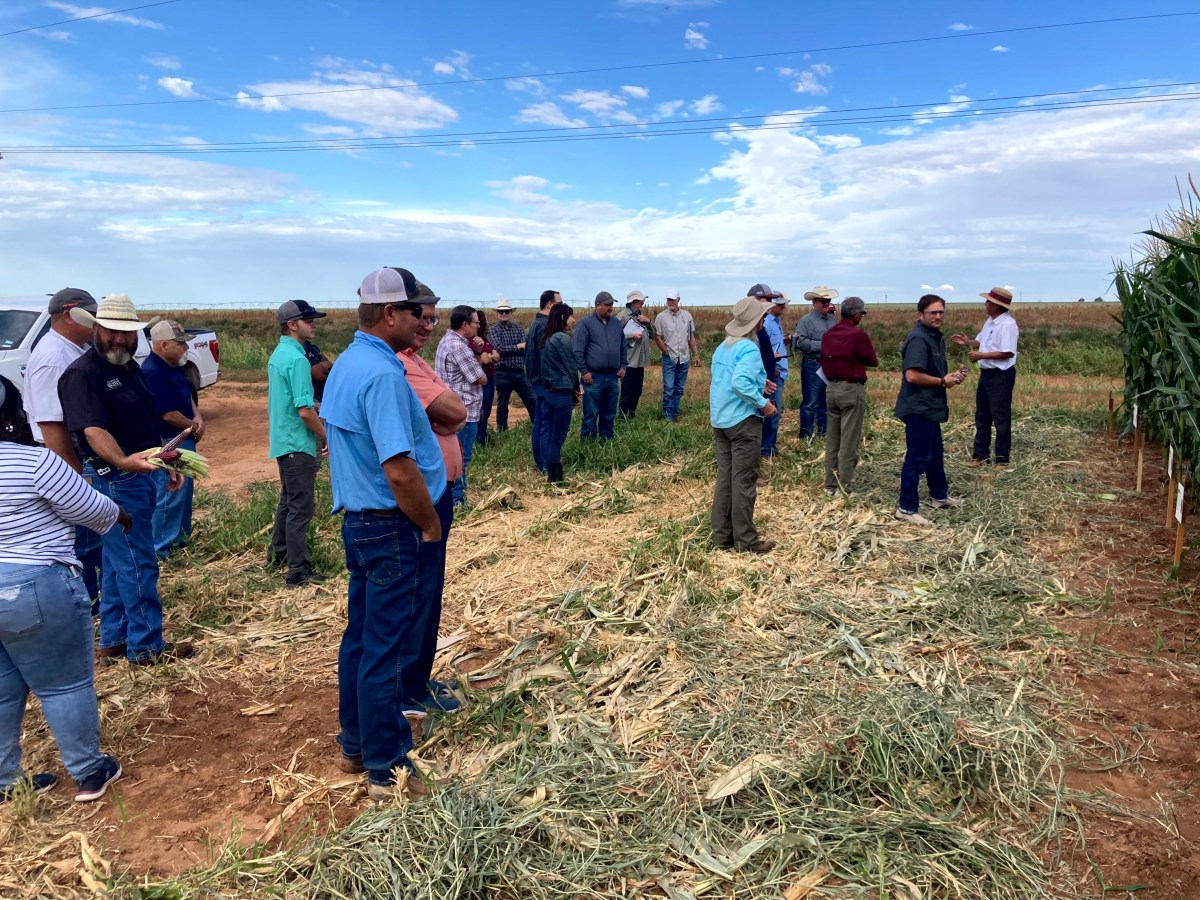
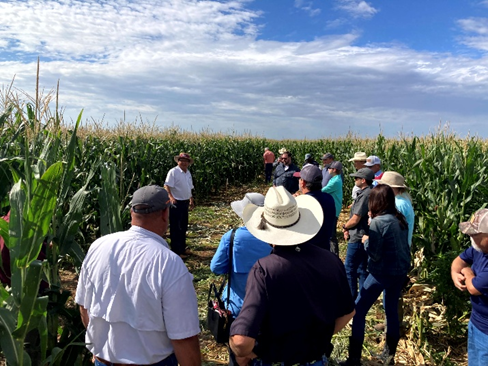
On Thursday, July 31, 2025, the Texas A&M AgriLife Research Halfway Station hosted a Hi-A Corn Breeding and Genetics Field Tour and Research Forum that brought together around 30 participants, including farmers, researchers, seed companies, and agricultural lenders. The event highlighted the exciting potential of Hi-A (high anthocyanin) corn varieties in both production and food markets.
Hi-A Corn Variety Plots at the Halfway Research Station
Field Tours and Research Highlights
The day began with a welcome from Dr. Todd Baughman, followed by an introduction from Dr. Wenwei Xu, Regents Fellow and corn breeder at Texas A&M AgriLife Research in Lubbock.
Dr. Xu has led the development of Hi-A corn varieties, including TAMZ 102, which is known for its deep purple kernels and high anthocyanin content. His work has focused on combining yield performance with enhanced nutritional traits, creating hybrids that perform well in the field while offering health-promoting properties. The Hi-A program under Dr. Xu’s leadership has become a cornerstone of innovation for Texas A&M AgriLife, linking plant breeding with food and health research.
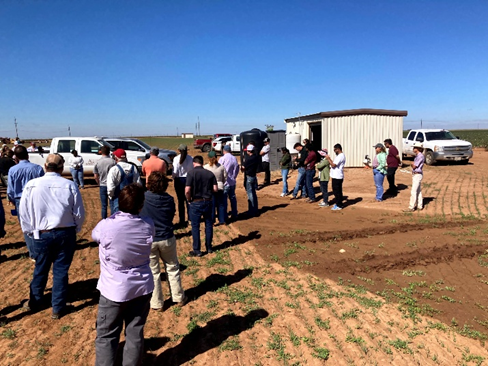
Participants then toured Hi-A corn plots at the Halfway Research Center before traveling to Helms Farms to view large field-scale strip trials. These demonstrations highlighted how Hi-A and short-season hybrids are performing under West Texas growing conditions. Mr. Ken Igo, Halfway Farm Chemicals discussed on-farm performance results at the Edmonson location.
Hi-A Corn Varieties at the Helms Farm. Dr Xu is discussing the variety performance.
The tour then returned to the Halfway Research Center where Dr. Tim Paape (USDA-ARS) provided updates on breeding, genetics, genomics, and metabolism research. Tim Paape is a Research Geneticist with the United States Department of Agriculture (USDA), who works in the areas of plant and crop genetics, genomics, and molecular biology. He is directly employed with the USDA-ARS Responsive Agriculture Food Systems Research Unit (RAFSRU) located on the Texas A&M College Station campus.
After Dr. Paape spoke, I was able to share about the opportunities for organic corn in Texas, focusing on how Hi-A varieties can align with organic markets where consumer demand for nutritionally dense and colorful grains continues to grow.
Dr. Tim Paape introducing Hi-A Corn to HHS Secretary Kennedy when the Secretary visited the TAMU Campus in early July.
Joe Longoria, president of CASA RICA Tortillas in Plainview, shared his experience using this corn in commercial tortilla production, noting its excellent qualities for both flavor and nutrition. Joe is committed to the healthy food movement and talked about his interest in continuing to showcase healthy grains in his products.
From Research to Food
One of the highlights of the day was the luncheon, where participants tasted enchiladas, chips, and tortillas all made with Hi-A corn. The deep color and flavor of these products come from naturally high anthocyanin content in TAMZ 102. A big thanks to Joe Longoria and Casa Rica for providing the Hi-A chips and tortillas. Amazingly there were no chips or tortillas left after lunch!!
This hands-on experience helped bridge the gap between the research plots and the food plate, showing how agricultural innovation can quickly translate into consumer products.
Building Toward the Future
The classroom event did conclude with an informal Research Forum, where scientists, producers, and industry leaders discussed strategies for integrating breeding, production, and commercialization of Hi-A corn. By combining genetics research with market development, this crop has potential not only in specialty food markets but also in animal nutrition.
A Shared Success
The Field Day was a success thanks to the collaboration of researchers, growers, and industry leaders. With Hi-A corn gaining momentum, it’s encouraging to see strong partnerships forming around this crop. The tortillas, chips, and fresh ears we shared at lunch gave everyone a taste of what the future of corn could look like—nutrient-rich, flavorful, and farmer-driven.
Big thanks and a great deal of appreciation to the Texas Corn Producers Board, Southern SARE, High Plains Underground Water Conservation District, and USDA-ARS. These outstanding groups not only helped fund this important work but attended the field day as well!
When organic wheat growers choose a variety, they aren’t just planting seed—they’re planting bread, tortillas, and the reputation of their crop in the marketplace. That’s why milling and baking quality matter as much as yield. Extension Specialists and Wheat Researchers have been digging into an important question for growers: how do milling quality and baking quality fit into variety choice, especially for organic systems? These traits, along with protein and yield, play a direct role in what millers want and what farmers get paid for.
Milling Quality vs. Baking Quality
Milling quality is about how efficiently a kernel turns into flour. Seed size, uniformity, and hardness all affect milling yield.
Baking quality is about what happens in the bakery—how dough handles, rises, and produces bread or tortillas that buyers want.
Testing happens at several levels. The Cereal Quality Lab at College Station does preliminary evaluations, while the USDA and Wheat Quality Council conduct full baking and milling trials with multiple mills and bakeries. Every TAM variety is rated, and those scores directly influence variety release decisions.
Variety Highlights for Organic Wheat Growers
TAM 114
Mid-season hard red winter wheat prized for excellent milling and baking quality, solid yield potential, and strong adaptability.
Strengths: Excellent dough properties, solid straw strength, good grazing ability, drought tolerance, and winterhardiness. Moderately resistant to stripe, leaf, and stem rusts as well as Hessian fly; good acid soil tolerance.
Consistently appears on “Pick” lists for irrigated and limited irrigation systems thanks to its stable performance.
TAM 115
A dual-purpose variety offering both grain yield and grazing potential, with enhanced disease and insect resistance.
Strengths: Excellent milling and baking quality, large seed, high test weight, strong drought tolerance, and resilience against leaf, stripe, and stem rust, greenbug, and wheat curl mite (which contributes to Wheat Streak Mosaic Virus (WSMV) resistance).
Adapted across High Plains, Rolling Plains, Blacklands, and even Western Kansas/Eastern Colorado. Performs well under irrigation and good dryland conditions—but less reliable under severe dryland stress due to lower tillering capacity.
TAM 205
TAM 205 is a newer dual-purpose variety known for its strong milling and baking quality paired with unmatched disease resistance. It is highly adaptable across systems and is a strong option for both grain and forage. Strengths:
Exceptional milling and baking quality
Good forage potential
Broad resistance (leaf, stripe, stem rust; WSMV; Fusarium head blight)
High test weight and large seed
TAM 113
A reliable dryland performer with good grain and forage potential, especially under stress.
Strengths: Solid grain yield, decent milling quality, and forage use. Early maturing with strong emergence and tillering – valuable in challenging environments. Offers resistance to stripe, leaf, and stem rusts.
Remaining a steady Dryland “Pick” in High Plains trials thanks to its adaptability.
Reminder: Organic farmers need to make seed purchase arrangements early (well before planting season) to ensure they have an adequate supply of untreated seed.
Protein Content vs. Protein Functionality
Farmers often watch protein percent, but researchers emphasize that protein functionality—how protein behaves in dough—is more important. While there’s no easy field test for this, variety choice remains a strong predictor.
When evaluating economics, consider total protein yield (bushels × protein percent). Sometimes a lower-yielding but higher-protein field can be more profitable than a high-yield, low-protein one.
Of course, protein levels don’t appear out of thin air. They’re the result of fertility, management, and soil health—areas where organic systems work a little differently than conventional.
Nitrogen and Organic Systems
One point of clarification: organic wheat does not suffer from a “late-season nitrogen challenge” so much as it requires planning ahead for higher yields. Excellent varieties and management can unlock yield potential, but only if soil fertility is built to support them.
Cover crops can provide up to 100 lbs of nitrogen per acre.
Manure composts from chicken or dairy sources can supply around 40 lbs of nitrogen per 1,000 lbs applied.
These are slow-release, biologically active forms of nitrogen. They need to be managed in advance so nutrients are available as the wheat grows.
Liquid organic N sources exist, but they are generally too expensive to justify based on the modest yield increases in wheat.
This means success in organic wheat fertility comes from building the soil and feeding the crop over the long term, not chasing protein with late-season nitrogen shots. The key takeaway is that organic fertility is a long game—cover crops and compost must be planned well in advance to match the yield potential of high-quality varieties like TAM 114 and TAM 205.
TAM Varieties and Seed Saving
Beyond fertility, seed access and seed-saving rights also matter to organic growers when planning for the future. All TAM varieties are public releases and not under Plant Variety Protection. Farmers can legally save and replant TAM seed for their own use. This is especially valuable in organic systems where untreated seed availability can be limited.
Why This Matters
In conventional systems, buyers reward bushels. In organic systems, millers and bakers want quality along with yield. Understanding both milling and baking traits—and managing fertility to match variety potential—helps organic growers capture more value.
As we look ahead, TAM 114 remains a cornerstone for organic production, but TAM 205 is quickly emerging as a variety that combines yield, quality, and resilience. With the right fertility planning and variety choice, Texas organic wheat can continue to meet both market demand and farmer profitability.
By combining resilient TAM varieties with thoughtful organic fertility planning, Texas wheat growers can continue to deliver grain that is profitable on the farm and dependable in the marketplace.
I am constantly asked about organic herbicides. I am tempted to shout back, “there are no organic herbicides!” Unfortunately, I would be wrong since the rules do allow for some “organic herbicide” use but overall, I AM RIGHT! The restrictions on using organic herbicides in a certified organic operation should and pretty much do eliminate their use. Here are some guidelines to consider.
Regulatory Framework (7 CFR §205)
The National Organic Program (NOP) requires that organic producers rely primarily on cultural, mechanical, and biological practices for weed control—not routine chemical herbicides. Synthetic substances are prohibited unless explicitly listed on the National List (7 CFR §205.600–607), and nonsynthetic (natural) materials are permitted only if they are not specifically prohibited in §205.602 and are included in guidance like NOP 5034‑1.
What Constitutes Allowed “Herbicides”
Soap-based herbicides, which are naturally derived, are allowed—but only for limited situations such as farmstead maintenance, roadways, ditches, building perimeters, and ornamental plantings—not for use in food crop production Legal Information.
Other natural herbicidal ingredients—acetic acid (vinegar), essential oils such as garlic or clove, corn gluten meal—may be formulated into commercial products (often OMRI-listed), but their use is still optional and must comply with producer’s approved Organic System Plan (OSP).
Why Use of Organic Herbicides Is Limited by the OSP
The Organic System Plan (OSP) is mandatory and must list all substances used in operation. Certifiers evaluate this list, and only substances compliant with 7 CFR §205—including NOP guidance and National List—may be approved National List .
Even when a natural herbicide is listed (e.g., an OMRI‑listed product), it must be justified as necessary. The NOP mandates that cultural, mechanical, and biological methods be used first. Only if these methods prove insufficient should pest, disease, or weed control materials—even those allowed—be considered.
Operational Examples
A certified organic field might prioritize crop rotation, mulching, flame cultivation, inter-row mechanical cultivation, and cover cropping, with organic herbicide used only for spot treatment of particularly stubborn weeds—such as a few patches too difficult to manage manually. Typical examples are spraying organic herbicides around wellheads, pivot pads, fencerows, etc.
Broad, wholesale use of even natural herbicides in food crop production would usually exceed what is allowable under the OSP. It could lead to certification issues or require pre-approval by the certifier. The general rule is to always check with your certifier but in this case your certifier is not going to allow you to use organic herbicides across your fields!
The Why — Benefits of This Restriction
Preserves ecological balance: Overreliance on even natural herbicides can inadvertently harm non-target organisms like beneficial insects or soil microbes. Just imagine what a soap based, or acid based, or oil based organic herbicide would do to beneficial insects? Also, these organic herbicides do not discriminate – they will kill your crop along with the weeds.
Resonates with organic principles: Organic agriculture emphasizes building soil health, biodiversity, and resilience—principles supported through non-chemical or even organic chemical approaches.
Regulatory integrity: Standardizing allowable inputs assures consumers that “organic” means minimal allowable impact and reliance on natural systems rather than chemical solutions.
Summary Table
Concept
Explanation
Organic Herbicides
Only certain types (e.g., soap-based) allowed and limited to non-food areas like roadways or ornamentals.
OSP Constraints
Materials must be listed and justified; broad use requires regulatory approval.
Order of Control Methods
Cultural → mechanical → biological → chemical (only if necessary).
Why Restricted
Ensures ecological integrity, respects organic philosophy, and upholds certification standards.