This publication was recently published by both FiBL which is The Research Institute of Organic Agriculture and IFOAM Organics International which is the 100-country membership organization for organic agriculture. These two organizations came together to publish this look at statistics for world agriculture but also to give us all some insights into some of the trends.
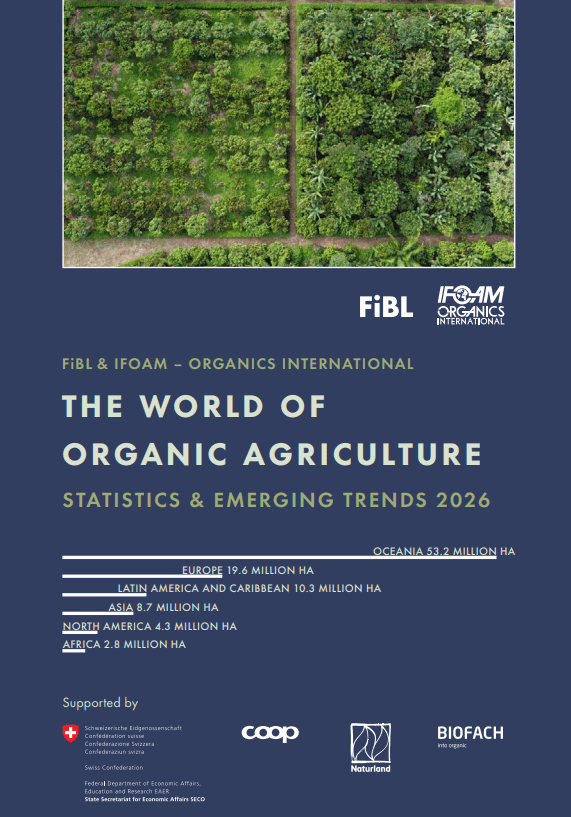
Just click the picture to be able to download your copy!
I was particularly interested in the special section on Peanuts. This is a “special” section because there is so little production in the world but there is an increasing demand. I am hopeful we can maybe find a way into this market!
Here are the lead paragraphs by Nicolas Lefebvre with FiBL.
Despite their visible presence in European retail – from organic peanut butter to snack products – organic peanuts remain one of the rarest crops in global organic agriculture. Based on available data, organic peanuts account for around 0.1 percent of global peanut area. Even allowing for data gaps in some producing countries, the conclusion is clear: organic peanut production is exceptionally limited.
Biological and agronomic constraints
Peanuts are a legume crop grown in warm climates. The primary organic production regions include Asia (mainly China), Latin America, the United States (particularly the Southeast and Texas), and several African countries, with Egypt being a major producer that relies heavily on intensive irrigation. Peanut cultivation is best suited to sandy soils and is characterized by relatively high-water requirements. While some organic pilot initiatives exist in Europe (notably in Austria and France), climatic constraints remain significant: temperatures are often limited, and wet conditions during autumn harvest can critically compromise crop quality.
The peanut pods develop underground, making the crop highly sensitive to fungal diseases, especially under humid conditions. In conventional systems, these risks are managed with repeated applications of fungicides (mainly systemic), starting with seed treatment at planting time. In organic farming, no comparable solutions are available, resulting in significantly higher yield variability and crop failure risk.
A further major constraint is the risk of aflatoxin contamination. Peanuts are among the crops most exposed to aflatoxins, toxic substances produced by fungi of the Aspergillus genus. These toxins are strictly regulated in the European Union and in the United States, and exceeding the legal limits makes entire lots unmarketable.
Aflatoxin contamination usually occurs at the end of the growing cycle, but it can also develop very rapidly after harvest if storage conditions are poor. For organic producers and traders, the risk is higher, as organic lots cannot be blended or downgraded into conventional markets. One unfavorable season or inadequate post-harvest handling can therefore wipe out the entire economic return. A less visible consequence is that heavily contaminated lots (mainly in less developed countries) may be sold at lower prices on local markets, creating food safety.
This intro to worldwide organic peanut production makes it plain that we have very little competition, but the next section makes it clear that we are the world’s primary producer, and I think the world’s best and cleanest producer!
Economic disincentives and weak infrastructure
From an economic perspective, organic peanuts combine high production risk with limited market incentives. Organic yields are generally lower, labor and monitoring costs are higher, and crop losses can be total. In addition, compared with other open field arable crops, peanut production requires highly specific harvesting equipment, as well as dedicated sorting and shelling infrastructure that is not compatible with other crops. These technical constraints imply substantial fixed investments, making entry into organic peanut production particularly costly for large-scale organic arable farms.
At the same time, consumer willingness to pay organic premiums is more limited than for other nuts such as almonds or cashews. As a result, many farmers prefer alternative organic crops with more predictable returns.
In addition, many major peanut-producing regions lack well-developed organic infrastructure. Advisory services, organic breeding programs, and segregated post-harvest facilities are often missing. Consequently, only a small number of highly specialized projects are able to supply organic peanuts reliably for export markets.
The article concluded with this paragraph below and it highlights our lack of US Organic Peanut penetration into the European Market
Conclusion
Organic peanuts illustrate the limits of organic expansion in crops with high biological and food safety risks. Their extremely low share of global organic area reflects fundamental agronomic and economic constraints rather than a lack of consumer interest. The EU import collapse of 2022–2023 was driven by a combination of climatic shocks, aflatoxin risk, regulatory transition and market conditions, followed by a partial normalization in 2024. Organic peanuts are therefore likely to remain a small but strategically important niche within global organic supply chains.
Lastly they provide some numbers of organic peanut production.
Statistics on world-wide organic peanuts
Organic peanuts remain a niche crop globally (estimated 0.1 percent of total peanut area), but the recorded global organic peanut area increased from 11,101 hectares (2016) to 41,972 hectares (103,717 acres) in 2024 according to the FiBL survey on organic agriculture worldwide. The strong jump in 2024 should be interpreted with care, because it was driven largely by a new data source for the United States, which reported a much larger organic peanut area than the source used previously.
In 2024, the top three countries by organic peanut area were the United States (18,990 hectares (46,925 acres); almost half of the reported global organic peanut area), China (12,238 hectares; ~30 percent), and Mexico (4,116 hectares; ~10 percent).
More Good Market News!
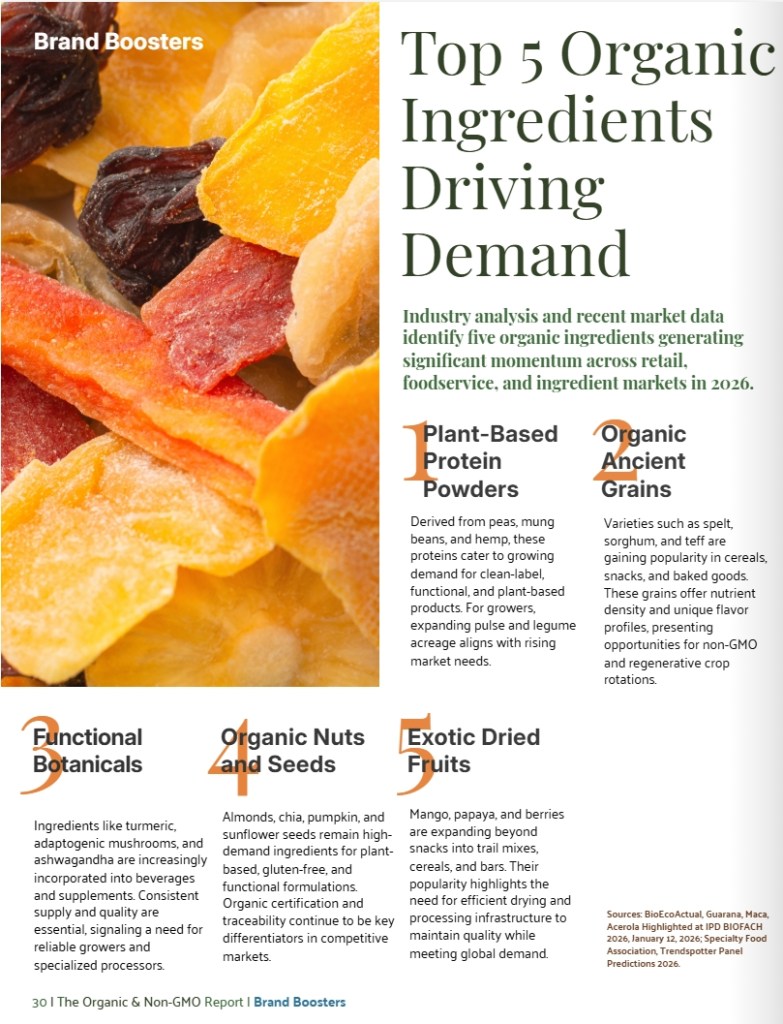
Wintertime is the time for meetings, and both Organic organizations and Organic companies are hosting meetings all over the world to discuss and plan for market programs over the 2026 market year and beyond. This article appeared in the February edition of The Organic and Non-GMO Report which I subscribe to. This is one of my favorite magazines with great articles and good market information. I have seen some similar information from other sources but for sure numbers 1, 2 and 4 fit Texas Organic and fit us well. A big thanks to The Organic & Non-GMO Report for calling our attention to this huge market!
Discover more from Texas A&M AgriLife Organic
Subscribe to get the latest posts sent to your email.

 Texas A&M AgriLife Organic