Why does it matter?
by: Dr. Brian Baker
Published in the OMRI Materials Review quarterly newsletter and reprinted with permission. omri.org/ I thought this was a great article and I learned some things about early organic organization I had not heard before. A big thanks to OMRI and Dr. Baker for allowing me to share this article. Bob Whitney

Organic standards in the United States differ from those in other parts of the world in many ways. One significant difference between the USDA’s National Organic Program (NOP) standard and other international standards is the way that inputs are evaluated and approved for use in organic production and handling. In general, the United States’ Organic Foods Production Act of 1990 ( OFPA) legally defined an agricultural production system based on sustainable production methods that rely primarily on natural materials. The OFPA authorizes the USDA to establish organic standards. These standards allow only synthetic materials that appear on the National List. The OFPA also gives the USDA the authority to prohibit non-synthetic substances deemed to be harmful to human health and the environment. Anyone can submit a petition to the NOP to add a substance to the National List. The USDA cannot add any synthetic substance to the National List without a National Organic Standards Board (NOSB) recommendation from a supermajority vote, after considering criteria in the OFPA related to the substance’s necessity and impact on health, the environment, and sustainability. All substances on the National List are required to be re-reviewed every five years and reaffirmed through a legislative sunset process. This unique process was established 35 years ago and has been in effect since 2002.
Why did the U.S. adopt an approach that was so heavily oriented toward the source, origin, and manufacturing process of inputs?
Private and State Standards
The roots of the natural/synthetic framework for agricultural inputs trace back to the first organic certification program in the U.S., conducted by the Rodale Press’ Organic Gardening and Farming magazine in the early 1970s, which defined organically grown food as: “Food grown without pesticides; grown without artificial fertilizers; grown in soil whose humus content is increased by the additions of organic matter; grown in soil whose mineral content is increased with applications of natural mineral fertilizers; and has not been treated with preservatives, hormones, antibiotics, etc.”
Rodale ceased their certification program and spun it off to various organic farmers’ organizations, including California Certified Organic Farmers, the Maine Organic Farmers and Gardeners Association (MOFGA), and Northwest Tilth, later to become Oregon Tilth and Washington Tilth. These grassroots organizations based their standards and procedures on Rodale’s model but modified them to meet local conditions.
The original certification standards were brief and subject to interpretation. Prior to federal regulation, the USDA’s Report and Recommendation on Organic Farming found that the organic farming movement covered a broad spectrum. Some organic farmers took a purist approach and used no synthetic inputs. Other organic farmers applied various synthetic fertilizers and/or pesticides selectively and sparingly. Many of the organic farmers that belonged to the organizations that set standards and conducted certification recognized the need to use some synthetic inputs to be economically viable and to grow high quality crops, but only a few that they considered necessary. These exceptions varied by region.
While most standards were set and enforced by the private sector, organic farmers were able to get some state legislatures to pass laws to protect the organic label. Oregon and Maine passed statutes to set organic standards in 1973. In 1979, California passed the California Organic Foods Act, which codified into law the paradigm that synthetic inputs are prohibited and nonsynthetic inputs are allowed, with a limited list of synthetic substances listed as exceptions in the statute. Because California was the state that both produced and purchased the most organic food, the California Organic Foods Act became the most recognized U.S. organic standard. However, it was not the only one. Private certifiers, particularly in the Midwest, were certifying organic products for export to Europe. These certifiers relied on the standards consistent with those set by the International Federation of Organic Agriculture Movements (IFOAM). The IFOAM standards were more practice oriented, with inputs less important than methods. IFOAM established a closed positive list of inputs permitted for use in organic production and handling that was less open-ended than the California law. It also allowed several synthetic sources of naturally occurring substances, like potassium sulfate, and omitted several nonsynthetic substances, most notably sodium nitrate. The IFOAM standards became the basis for the European Union regulation on organic food and farming that passed in 1991. Various state laws governing organic food production also used a positive list approach to regulating inputs.
Organic Becomes a Federal Matter
In 1989, the CBS television show 60 Minutes reported on a study conducted by the Natural Resources Defense Council that the U.S. Environmental Protection Agency knowingly allowed residues of a cancer-causing chemical to be present on certain foods. The pesticide implicated was a plant growth regulator used in apple production called Alar (daminozide).
Organic sales skyrocketed immediately after the episode was aired. However, fraud in the organic market was already rampant. Growing demand outstripped the supply of legitimate organic food, which spurred greater fraud. Various states enacted new organic food legislation. Those with existing laws significantly strengthened their standards. By the 1990s, over 20 states had laws on the books that regulated organic food, and each one was different.
The use of pesticides in organic production was hotly debated. Environmental and consumer groups, along with some long-time organic farmers, called on Congress to categorically ban all pesticides in organic production – even natural ones like rotenone and pyrethrum. Most organic farmers’ organizations, processors, and input suppliers lobbied for a bill that allowed some synthetic inputs, including a few pesticides.
The organic community presented Congress with three alternative approaches to address pesticides and other inputs. In addition to the natural/synthetic approach taken by California, and the closed positive list approach taken by many states and domestic private organizations, as well as IFOAM and the EU, another alternative considered was “agronomic responsibility.” That approach proposed organic standards that would permit any input allowed in organic production under limited specific circumstances, with metrics for improving soil. However, the agronomic responsibility model was opposed by certification bodies, environmental groups, and consumer advocates. That narrowed the debate to either the IFOAM/EU model or the California model.
Meanwhile, USDA officials testified against OFPA before Congress. If Congress mandated a closed positive list, USDA officials indicated that they would allow all inputs that were legal to use in conventional production for organic production as well, regardless of origin and without any additional limitations beyond current regulations. Those who promoted a closed, positive list realized that they could not reconcile growing differences between the various state and private standards before the 1990 Farm Bill. The factions of the organic movement worked out a consensus with Senate Agriculture Committee staffer, Kathleen Merrigan, that drew from all three model standards and convinced Congress to pass a bill that took a procedural approach to guide rulemaking.
The Senate Report on the OFPA explained the rationale for this approach: “Most consumers believe that absolutely no synthetic substances are used in organic production. For the most part, they are correct and this is the basic tenet of this legislation. But there are a few limited exceptions to the no-synthetic rule, and the National List is designed to handle these exceptions.”
The OFPA set a high bar for the USDA to make exceptions to the synthetic/nonsynthetic rule. It required an open, transparent process involving stakeholders to review and recommend those exceptions. Congress also recognized that some natural substances pose environmental or human health hazards and should be prohibited for organic production and handling. The National List includes nonsynthetic substances prohibited for organic production to address this anomaly. Congress explicitly mentioned arsenic and botanical insecticides as specific concerns.
Where We Are Today
Today’s National List evolved from organic food standards established prior to OFPA. The synthetic/nonsynthetic foundation of the law comes from tradition and consumer expectations that still hold true today. Exceptions are rarely made. Those few exceptions require a rigorous technical evaluation and a broad consensus of the organic community. The National List process takes a precautionary approach that protects human health and the environment. That approach provides an incentive for innovation that benefits all agriculture.
— End of reprinted article —
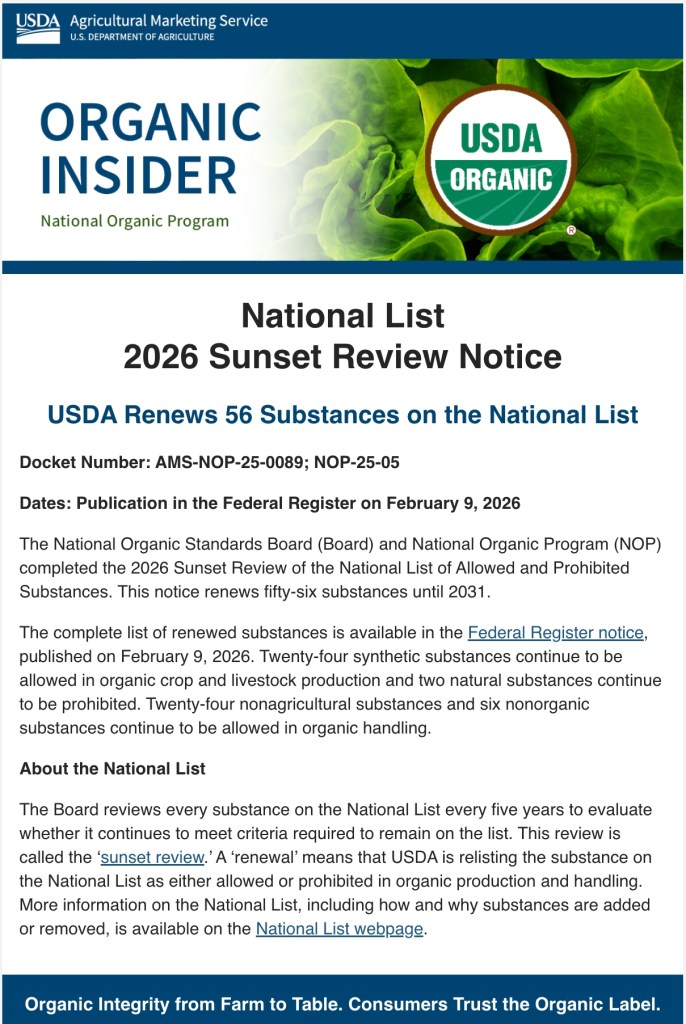
Periodically USDA NOP approved inputs are reviewed and either allowed or prohibited to continue to be used in certified organic system plans. This Sunset Review process involves the NOSB and National Organic Program.

Discover more from Texas A&M AgriLife Organic
Subscribe to get the latest posts sent to your email.

 Texas A&M AgriLife Organic