
In my career as an Extension professional (extension agent, researcher, specialist) I have had a lot of agriculture training, but I have also had a lot of training for training agriculturists which includes just about every group in agriculture today. One of the early lessons we learned was a simple theory about learning called the Rogers’ Adoption Curve.
I couldn’t begin to tell you much about Rogers or his overall work as an educator, but I do know about this curve and in my career this “curve” has proven to be true over and over again. What you see in this picture is the classic “bell curve” representing the concept of knowledge or technology. People who adopt new knowledge or technologies are represented along the bottom axis and the progression is from left to right, i.e. the first to adopt are on the left and over time the others adopt the technology. So, looking at this we see that the first group to adopt the technology are innovators followed by early adopters and so on. This picture shows a break called “The Chasm” between early adopters and early majority. This chasm is difficult to cross and can represent a lot of time or even failure for the technology.
Organic farmers are mostly in the innovator/early adopter category. Organic agriculture is not easy and in general requires a good knowledge of agriculture systems before getting into the details of growing organic. As an extension educator I tend to try and find innovators and early adopters to work on demonstration or research projects because I know they are just as anxious to explore new technologies as I am.
That said, let me ask you where you are today? Occasionally we need to take a break and get away from it all because we are falling into the late majority or laggard category doing the same thing we always did. Don’t lag too far behind because as you can tell from the “curve” there are a lot of people already on the downhill slide!
Using the Curve!
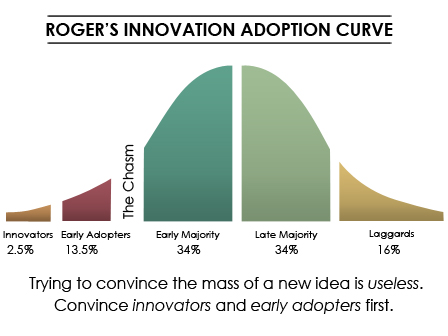
Rogers’ Adoption Curve is a model that outlines the adoption process of new technologies or ideas through different segments of a population. Developed by Everett Rogers in 1962, it’s widely used in the fields of social science, marketing, and innovation management but is very useful in organic agriculture too.
Rogers’ Adoption Curve is an effective tool for understanding how new practices, like organic agriculture, are adopted within a community. Extension professionals can use this model to tailor their educational and promotional strategies for organic agriculture to different segments of the agricultural community.
- Innovators (2.5% of the Population)
Characteristics: These are the first individuals to adopt an innovation. They are risk-takers, have financial liquidity, are social networkers, have closer contact with scientific sources and interaction with other innovators.
Role in Adoption: Their acceptance of an innovation is a key step in the process. Being a small segment, they serve as a testing ground and are crucial in initial debugging or refinement of the product or idea.
Targeting Innovators
- Approach: Provide detailed, technical information on organic agriculture, focusing on innovation and environmental benefits.
- Why: Innovators are keen to experiment with new techniques and can provide valuable feedback.
- Example: Conducting pilot projects with innovators to demonstrate the efficacy of organic practices.
2. Early Adopters (13.5% of the Population)
Characteristics: This group has the highest degree of opinion leadership among the other adopter categories. They are typically younger, more socially forward, and have a higher social status and more financial lucidity.
Role in Adoption: Early adopters are crucial for the validation and initial dissemination of the innovation. Their acceptance acts as an endorsement, influencing the next wave of adopters.
Engaging Early Adopters
- Approach: Emphasize the social and economic benefits of organic agriculture. Use early adopters as role models.
- Why: Early adopters have strong influence over their peers. Their success stories can inspire others.
- Example: Showcasing successful organic farms managed by early adopters in workshops and field days.
3. Early Majority (34% of the Population)
Characteristics: They adopt an innovation after a varying degree of time. This period is significantly longer than the innovators and early adopters. They are typically more deliberate before adopting a new idea, often influenced by interactions with peers.
Role in Adoption: Their adoption is a pivotal point in the lifecycle of an innovation, marking the moment when an innovation reaches a critical mass of users.
Convincing the Early Majority
- Approach: Focus on practicality and the mainstream benefits of organic farming. Provide evidence of success from early adopters.
- Why: The early majority are cautious and need proof of effectiveness.
- Example: Organizing farm tours to successful organic farms and creating user-friendly guides.
4. Late Majority (34% of the Population)
Characteristics: This group is skeptical about change and will only adopt an innovation after the majority of society has embraced it. They typically have below-average social status and financial liquidity.
Role in Adoption: Their adoption signifies the innovation has become mainstream. They usually require external pressures from peers or societal changes for adoption.
Addressing the Late Majority
- Approach: Use peer pressure and economic incentives. Highlight the risks of not adopting organic practices.
- Why: Late Majority are skeptical and influenced by the norms established by the majority.
- Example: Offering financial assistance or subsidies for transitioning to organic farming.
5. Laggards (16% of the Population)
Characteristics: They are the last to adopt an innovation. Unlike some of the previous categories, they aren’t looking for information on new ideas and are focused on traditions. They tend to be of an older age, lower in social status, and less financially fluid.
Role in Adoption: Their adoption is usually not vital for the overall success of an innovation but signifies complete market saturation.
Reaching Laggards
- Approach: Use personal relationships and focus on tradition and security aspects of organic farming.
- Why: Laggards are resistant to change and trust familiar faces and traditional methods.
- Example: One-on-one meetings, focusing on how organic farming aligns with traditional farming values.
Importance in Agriculture Extension and Teaching Organic
In the context of agriculture extension, understanding Rogers’ Adoption Curve is vital. It helps in identifying the right strategies to promote new agricultural practices or technologies. By recognizing the characteristics and motivations of each group, extension professionals can tailor their approach, ensuring that innovations are adopted effectively across different segments of the farming community.
For example, introducing organic farming techniques or new sustainable practices can follow this curve. Innovators might experiment with these techniques first, followed by early adopters who validate and popularize them. As these practices gain credibility, they gradually become adopted by the majority.
- Tailored Communication: Develop different communication strategies for each group. Innovators and early adopters might prefer digital communication, whereas late majority and laggards may respond better to traditional methods like community meetings.
- Feedback Loops: Establish feedback mechanisms with each group. Innovators can provide technical feedback, whereas the majority can give insights into mainstream acceptance.
- Continual Education: Offer ongoing support and education, adapting to the changing needs and responses of each group.
Conclusion
Rogers’ Adoption Curve provides a framework to understand how innovations like organic agriculture spread within a community. This understanding is crucial for professionals in fields like agriculture extension, where the goal is to implement new, often more sustainable, practices and technologies. By catering to the unique characteristics and needs of each adopter category, the adoption process can be more efficient and widespread.
By understanding and applying Rogers’ Adoption Curve, we can more effectively promote organic agriculture. Tailoring strategies to each segment of the adoption curve ensures that communication and education are relevant and engaging, increasing the likelihood of widespread adoption of organic practices. This approach not only aids in the dissemination of organic farming methods but also ensures a supportive community (the organic family) is built around these practices.
Discover more from Texas A&M AgriLife Organic
Subscribe to get the latest posts sent to your email.

 Texas A&M AgriLife Organic