
From Farm to Consumer: Why Organic Markets Need Transparency and Storytelling to Grow
In our recent “Texas Organic News” newsletter, I conducted a single question survey and the question was: “What’s standing in the way of producing and/or selling more organic products?”
Here are the results from the 1,360 newsletters sent out – only 32 responses! In this survey you could only pick one answer for the question and here are the results so far.
- Lack of grower contracts or reliable customers for organic products — 13 responses (40.6%) This is a question about demand for organic production or products, which ever segment you are involved in. If we don’t get customers, we don’t get paid!
- Paperwork and certification take too much time or effort — 8 responses (25%) Of course everyone in organic says this is a problem but it ranks second behind selling more organic products.
- Competition from imported organic products that reduce grower contracts or retailer profitability — 5 responses (15.6%) I thought this might be more of an issue and it is for some commodities but right now it ranks third.
- Not enough profit margin in organic production or sales — 2 responses (6.3%)
- Growers: Not enough organic inputs or supplies to grow efficiently — 3 responses (9.4%)
- Handlers: Not enough consistent organic product available to sell — 1 response (3.1%)
Although overall response numbers have been low, I think the pattern is clear: the two largest barriers identified by producers are market access (customers/contracts) and certification/time-burden. These aren’t simply agronomic issues—they point to deeper economic and institutional challenges in our organic systems. We need to do a better job attracting customers and we need to improve certification systems to make them easier and cheaper.

Transaction Costs and What the Survey is Telling Us
When I review your responses through the lens of transaction cost economics, I see how these barriers are really about the extra costs of doing business in organic—not just the cost of production. A cost is anything that takes up time or money both of which are scarce. Scarce means if you do this one thing you can’t be doing another thing. If you have to spend a lot (time and/or money) on certification or finding customers/contracts, you have to get it back from the products or you have to quit!
- The largest barrier, lack of reliable customers, highlights search, matching, and information-costs. If you don’t know who will buy your product or what contract terms look like, you carry higher risk and uncertainty. Organic struggles with this every day of every month of every year!
- The second barrier, certification and paperwork burden, is about compliance, monitoring and institutional costs. The farm work, the record-keeping, the audit visits—even before you sell—these costs eat into margins. USDA NOP has discussed some of this and even talked about some streamlining and simplifying proposals, but we are still a long way from it.
- Lastly, weak contracts or imports or even hard to find markets point to market thinness and pricing transparency. When markets aren’t transparent, when contracts are hidden or inconsistent, the organic market players struggle to negotiate fairly or spend too much time struggling to be in the market.
In short: to expand organic production and meaningful sales in Texas, the US or the world, we must look beyond just “how do I grow it organically?” and ask:
How do I connect reliably with a buyer, how do I keep my certification cost manageable, and how does the market signal value all the way through the chain?
Organic as a Credence Good
Here’s a key idea: organic products are credence goods (belief or acceptance that something is true or valid). That means consumers (a shopper in HEB) cannot easily verify for themselves many of the important attributes—crop rotation, chemical input avoidance, processing protocols, supply-chain segregation. Instead, they rely on trust signals: certifications, labels, audits, inspections.

Because
of this,
two things
matter:
- Integrity of production and supply chain systems — the farm-to-shelf process must be robust and verifiable. Organic has built this into its system with legal force while most or all others do not come close. Non-GMO is a label that is highly trusted too, but they have experienced problems recently with this part of their label. Lost trust is almost impossible to get back.
- Clear communication of value to the consumer — if consumers don’t understand the organic claim or don’t believe it has value, the premium disappears. Right now there are many, many stories about how “something” is better than organic. This tells me organic has set the standard all are trying to beat but this bombardment without a response also weakens organic’s message.
The newsletter survey results align exactly with this: producers are facing market access problems (demand side) and compliance burdens (supply side). Both sides are inherent to credence-good systems. You’re not just farming or manufacturing differently—you’re participating in a system of trust. Right now, organic agriculture has the highest rated system of trust according to survey after survey. Unfortunately, our customers are not valuing that “trust” as much as they used to do simply because they are being bombarded with so many choices that look similar but are not at all similar to Certified Organic! Step up and reinforce that message now, before we lose it!
Every Part of the Value Chain Must Be a Promoter
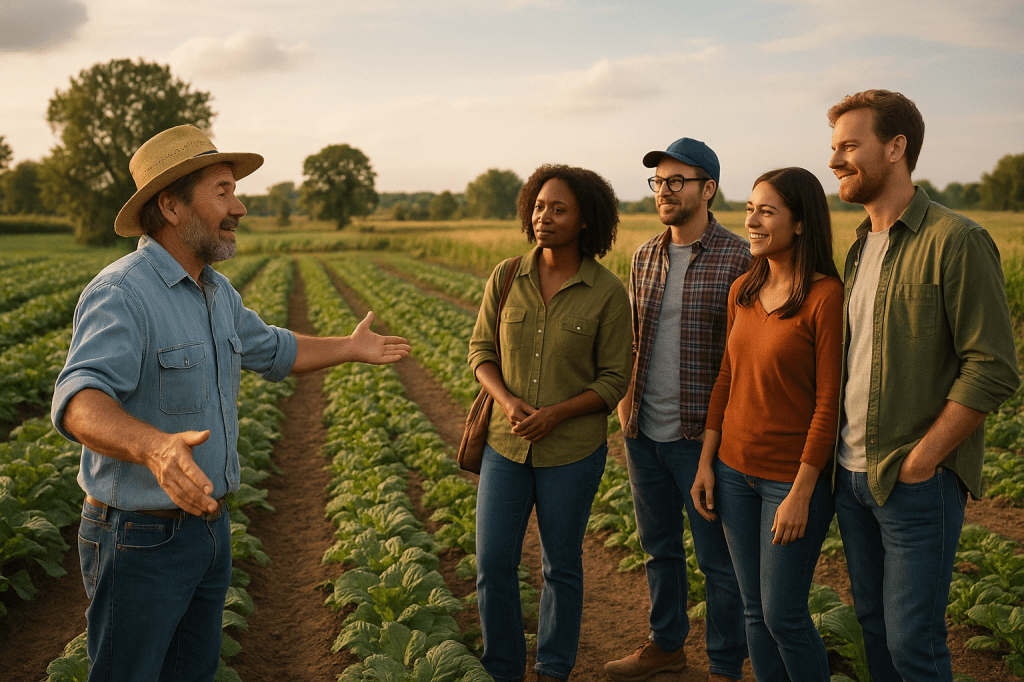
In a business built on trust (credence goods), production alone isn’t enough. The value behind the organic label depends on every actor in the chain actively understanding and communicating that value.
- Farmers need to ask: What story am I giving my buyer about how I grew this crop and why it matters? Have you ever given your buyer a letter with your crop that tells your story? You send a certificate but why not more?
- Handlers must ask: How am I representing the farms I source from, and how am I passing that value and the value I add to retailers or final buyers?
- Retailers and brands should ask: Am I explaining to consumers why this product commands a premium, beyond just placing it on the shelf? FYI – Retailers usually make more off organic products than conventional!
- Certifiers and institutions must ensure: I maintain the trust-signal, yes—but do I also support the chain in telling the story in a credible, consistent way? Is your certifier making sure “you,” their customer is promoted?
If any link fails to actively promote the value, the trust signal weakens. Here’s what it means in practice:
- Transparency up and down the chain: Farms must provide clear information to handlers; handlers must pass that to retailers; retailers must convey the value to consumers—and that consumer feedback should circle back into production and market planning. You may be paid for a product in organic, but your “name” goes with that product all the way to the consumer!
- Active marketing of integrity: The organic label is a trust-signal. If it isn’t actively promoted, consumers may forget what it stands for or assume it doesn’t matter. This is especially true in an age of so much label confusion.
- Shared responsibility: It’s not enough for a farmer to get certified and think the rest of the chain will carry the message. Every actor must see themselves as part-of the collective promoter of the label’s meaning and the products value.
- Feedback loops: The final customer’s expectations shape what comes back up the chain. Growers should listen to what consumers care about, and that should influence how they position their production and communicate with buyers.
- Value-chain transparency equals value creation: The more visible the chain, the more confident the consumer, the stronger the premium, the more stable the market. Hidden trade, opaque pricing, and weak storytelling all erode trust and hinder growth.
Final Thought
The very simple and easy survey I sent in a newsletter has highlighted what many of us already sense: participating in organic isn’t simply about adopting different growing practices. It’s about being part of a system built on trust, communication, and shared value. Certification and production matter—but they are only half the story. The lack of participation (only 30 out of 1360) in this simple, one question survey is telling me that certified organic entities (farms, handlers, retailers, certifiers) have not figured out everyone has a part to play in this “credence good” or it becomes just another “good” to purchase.
If you choose to farm organic, you’re not just choosing a way to grow.
You’re choosing to be part of a movement built on trust, and you’re signing up to help tell the story. You are paying a lot to be part of this movement.
When we, as farmers, handlers, retailers—and even consumers—understand this and act on it, we reduce hidden costs, build stronger markets, and make organic not just viable, but sustainable and profitable.
 Texas A&M AgriLife Organic