
The U.S. International Trade Commission has added 29 new organic-specific Harmonized Tariff Schedule (HTS) codes for products imported into the United States. While HTS codes may sound like a technical customs issue, this change is important for organic importers, handlers and anyone trying to better understand organic markets.
HTS codes are the numbers used by U.S. Customs and Border Protection to classify products entering the United States. When an organic-specific HTS code exists for a product, that organic code must be used for the import filing. Exporters also use the appropriate organic HTS code when requesting the USDA National Organic Program Import Certificate associated with the shipment. (CCOF)
What Changed July 1, 2026?
Beginning July 1, 2026, USDA changed the filing status for 29 organic HTS codes from optional filing to required filing in the Customs and Border Protection Automated Commercial Environment, commonly called ACE. (U.S. Customs and Border Protection)
The new organic classifications cover a surprisingly broad group of products, including:
- Brussels sprouts and frozen vegetable mixtures
- Hemp seed and other oilseeds
- Plant materials and vegetable extracts
- Avocado oil and other vegetable oils
- Sugars
- Cocoa powder, chocolate and other cocoa products
- Pasta and cereal products
- Biscuits and other baked products
- Orange, berry and mixed fruit juices
- Soups and broths
- Other prepared foods
- Vodka, tequila and vinegar
The number of processed foods on the list is noteworthy. Organic trade tracking is increasingly moving beyond basic agricultural commodities and into the ingredients and finished products that make up today’s organic food supply chain.
Why Does This Matter?
One of the continuing challenges in understanding organic markets is determining how much organic product is actually entering the United States.
When an organic product has no organic-specific HTS classification, it can be difficult to separate organic trade from conventional trade using traditional customs statistics. Creating additional organic-specific codes allows imports to be identified more precisely by commodity.
That improves our ability to answer some important market questions:
How much organic product is being imported? Where is it coming from? Is import volume increasing or decreasing? What products are competing with U.S.-produced organic products?
For producers, handlers, researchers and policymakers, better trade data means a better picture of what is actually happening in the organic marketplace.
Organic HTS Codes and the NOP Import Certificate
The HTS codes also work together with another major change in organic import oversight: the electronic NOP Import Certificate.
Since March 19, 2024, each shipment of certified organic agricultural products imported into the United States must be associated with an NOP Import Certificate issued by an accredited certifying agent through USDA’s Organic INTEGRITY Database. USDA states that one NOP Import Certificate is issued per commodity/product or HTS code. (USDA Agricultural Marketing Service)
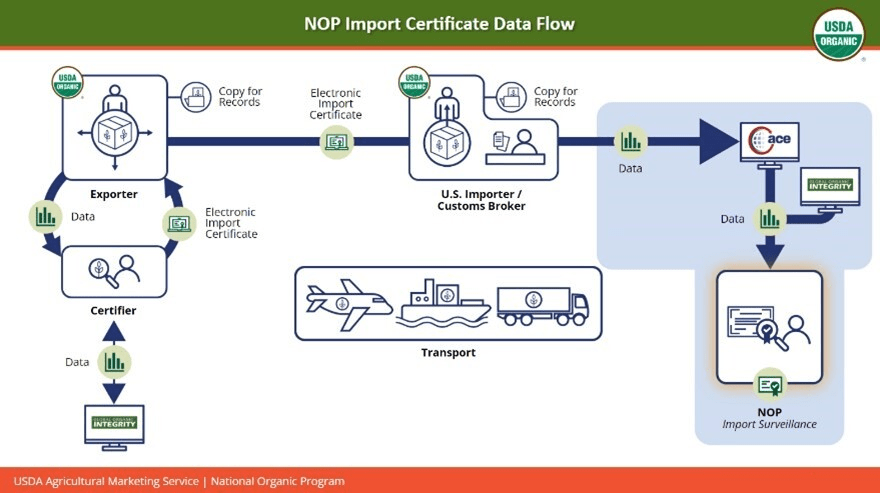
That creates an important connection between organic certification and customs information:
NOP Import Certificate → verifies the organic shipment
Organic HTS Code → identifies the organic product entering the country
Together, these systems provide USDA and Customs and Border Protection with better tools for traceability, enforcement and market information.
An Important Point for Organic Handlers and Importers
U.S. Customs and Border Protection warns that organic shipments arriving without a valid NOP Import Certificate number can be subject to re-export, restricted donation or destruction. Shipments with incorrect or nonconforming certificate information may also receive additional scrutiny or be rejected. (U.S. Customs and Border Protection)
For handlers importing organic products, this makes correct product classification increasingly important. Importers should make certain that their customs broker is using the correct organic HTS code when one exists and that the HTS information agrees with the NOP Import Certificate.
Better Information for the Organic Marketplace
Twenty-nine additional organic trade classifications will not answer every question about organic imports, but they are another important step toward making the organic supply chain more transparent.
For those of us trying to understand organic markets, that is particularly valuable. Instead of simply hearing that “imports are increasing,” better organic-specific trade data can help us determine which products are entering the United States, how much is entering and where those products originate.
That is information both organic farmers and organic handlers can use.
More Resources
- CCOF – New Organic HTS Codes for U.S. Imports and Exports
- U.S. Customs and Border Protection – New Organic HTS Code Flagging and Filing Reminders — includes the complete list of the 29 organic HTS codes.
- USDA AMS – Electronic Organic Import Certificates
- U.S. International Trade Commission – Harmonized Tariff Information
- U.S. International Trade Commission – Search the Harmonized Tariff Schedule
- USDA AMS – Strengthening Organic Enforcement

