
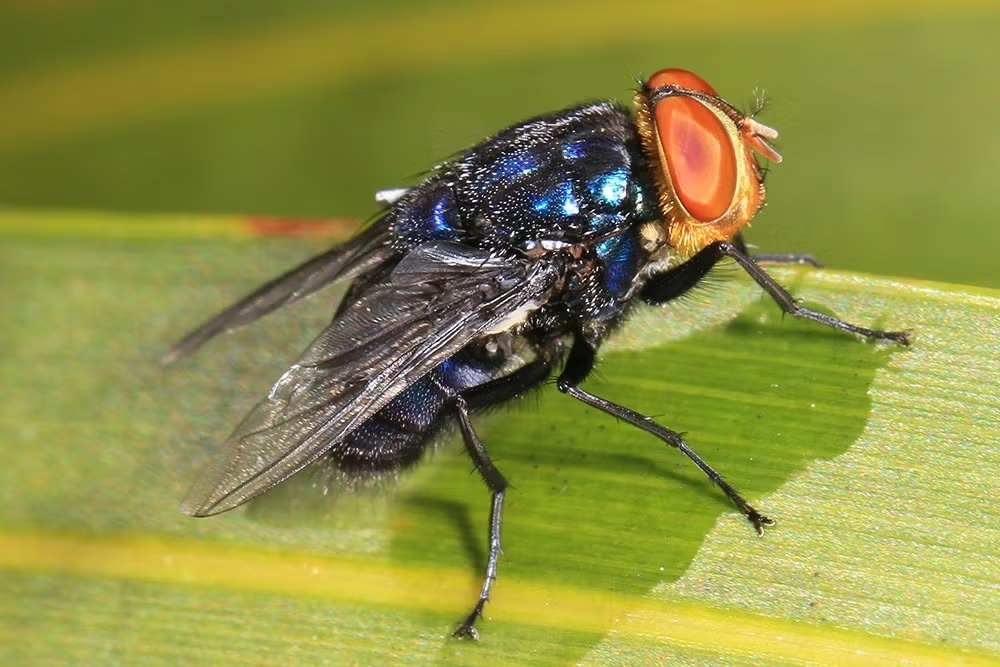
New World Screwworm (NWS, Cochliomyia hominivorax) is recognized as a highly destructive pest.¹,² NWS fly larvae, also known as maggots, invade the tissue of living animals, resulting in severe and often fatal injuries. This species can infest warm-blooded hosts, including livestock, pets, wildlife, humans, and even birds.²
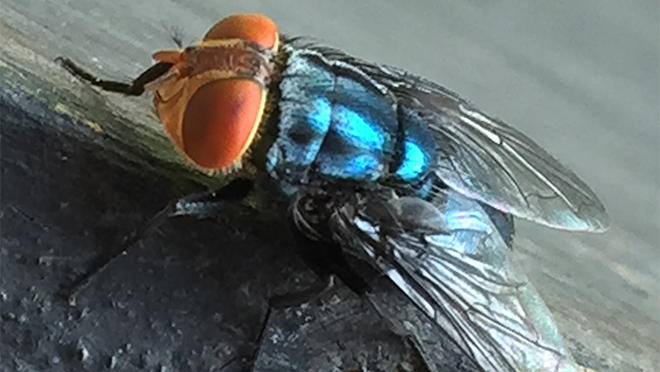
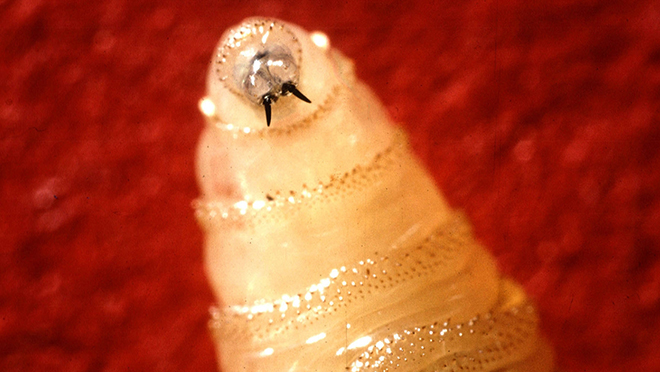
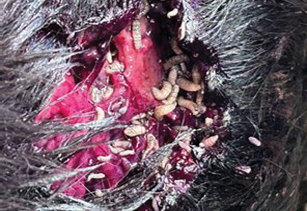
Top and middle photos courtesy of CDC, bottom photo Marcy Ward, New Mexico State University.
The term “screwworm” is derived from the larvae’s characteristic feeding behavior, where they burrow into wounds in a manner like a screw penetrating wood.¹ Maggots inflict significant harm by tearing at host tissue with their sharp mouth hooks; consequently, the wound may enlarge and deepen as additional larvae hatch and feed on viable tissue.² The impact of NWS infestations can be substantial, frequently leading to life-threatening conditions for affected animals. Adult screwworm flies are comparable in size to common houseflies or slightly larger and are distinguished by orange eyes, metallic blue or green bodies, and three dark stripes along their backs.¹
Historically, screwworm caused severe economic losses in U.S. livestock production prior to eradication efforts, with annual losses estimated in the hundreds of millions of dollars (mid-20th century values).⁴
USDA Strategy and Sterile Insect Technique
Central to eradication efforts is the sterile insect technique (SIT), a scientifically validated area-wide pest control method.⁵
Female NWS flies mate only once, so mating with a sterile male prevents reproduction and collapses the population over time.³,⁵ Sterile flies are released by air or ground, with aerial dispersal preferred for covering large areas. USDA produces sterile flies at the COPEG facility in Panama and is expanding domestic capacity at the Rio Grande Valley in Texas.¹
The sterile insect technique has been credited with the successful eradication of screwworm from the United States and much of Central America.³
Organic Considerations
For organic producers, livestock health care practices are governed under 7 CFR §205.238 of the National Organic Program regulations, which require preventive health care and prompt treatment of illness or injury.⁶
While APHIS provides guidance for detection and reporting,¹ there is very limited organic-specific direction currently available. Organic Materials Review Institute (OMRI) listings can be consulted to determine compliance of specific insecticides. ⁷ Typical insecticide suppression of New World screwworm is not highly effective because larvae can infest wounds in wildlife hosts, so control relies primarily on detection, surveillance, and sterile male release rather than routine spray applications. ⁴
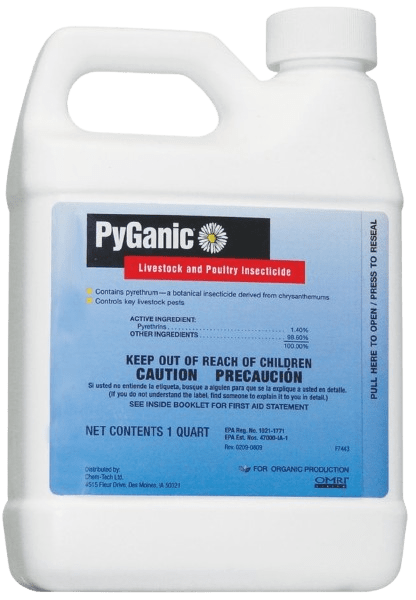
PyGanic is the only organic product labeled for livestock to kill adult flies, in particular blow flies. There are some other products for livestock but labeled as repellants. It is a natural pyrethrum product and falls within the same broad insecticide class referenced in federal guidance for adult fly control.8 However, there is currently no published data evaluating PyGanic specifically against New World Screwworm adults or larvae. Therefore, its potential role would be limited to adult fly suppression rather than eradication, and it should be considered as part of a broader management response rather than a stand-alone solution.
Moxidectin Use in Organic Livestock
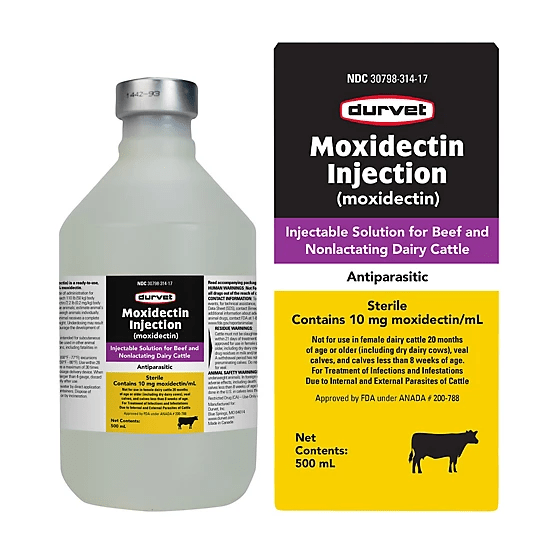
Example of Moxidectin Injection which is sold in stores and online. Be sure to check with your certifier before using any product in your operation and especially moxidectin since it is only allowed in severe parasitism. The current treatment for NWS is “Dectomax” which means your animal would be removed from organic certification.
Organic livestock producers may be familiar with moxidectin because it is permitted under USDA National Organic Program (NOP) regulations for the treatment of severe parasitism when preventive organic management practices are not adequate. Questions have recently arisen regarding whether moxidectin could play a role in managing New World Screwworm (NWS) infestations. While FDA recommendations for NWS treatment in cattle currently focus on approved products containing doramectin (Dectomax), research conducted with Old World Screwworm (OWS) has shown that injectable moxidectin can provide substantial protection against myiasis and reinfestation in cattle of OWS.9 However, these studies involved OWS rather than NWS, and there is currently limited information available regarding the effectiveness of moxidectin against New World screwworm. As a result, any expectations regarding NWS control should be considered preliminary until additional research becomes available. At present, moxidectin should be viewed as a potential area for future investigation rather than a proven NWS treatment option.
Producer Prevention and Reporting
Producers should:
- Monitor livestock closely for wounds or signs of infestation.¹
- Minimize injury risks by inspecting facilities and equipment.
- Treat livestock and potential wounds promptly with approved products. If wounds are infected with NWS then report and treat with approved products.
- Prevent introduction by controlling animal movement.
If screwworm is suspected, it must be reported immediately to State animal health officials and APHIS to enable rapid containment.¹
References
¹ USDA APHIS – New World Screwworm Information Page
Animal and Plant Health Inspection Service. (n.d.). New World screwworm (Cochliomyia hominivorax). U.S. Department of Agriculture.
https://www.aphis.usda.gov/livestock-poultry-disease/cattle/ticks/screwworm
² University of Florida Institute of Food and Agricultural Sciences. (2025). New World screwworm: Cochliomyia hominivorax (Primary screwworm). EDIS Publication IN1146. https://edis.ifas.ufl.edu/publication/IN1146
³ Krafsur, E. S., Whitten, C. J., & Novy, J. E. (1987). Screwworm eradication in North and Central America. Parasitology Today, 3(5), 131–137.
https://pubmed.ncbi.nlm.nih.gov/15462936/
⁴ Texas A&M AgriLife Extension – New World Screwworm Fact Sheet
Phillip Kaufman, Sonja L. Swiger & Andy Herring. (2025). New World screwworm fact sheet. Texas A&M AgriLife Extension Service.
https://agrilifeextension.tamu.edu/new-world-screwworm-fact-sheet/
⁵ Sterile Insect Technique (Scientific Foundation)
Vreysen, M. J. B., Robinson, A. S., & Hendrichs, J. (Eds.). (2007). Area-wide control of insect pests: From research to field implementation. Springer.
https://www.iaea.org/topics/sterile-insect-technique
⁶ National Organic Program Regulation
Electronic Code of Federal Regulations. (2023). 7 CFR Part 205—National Organic Program.
https://www.ecfr.gov/current/title-7/subtitle-B/chapter-I/subchapter-M/part-205
⁷ OMRI Listings
Organic Materials Review Institute. (n.d.). OMRI product search.
https://www.omri.org/omri-search
8 USDA APHIS. 2025. Pesticides for Control of New World Screwworm (Cochliomyia hominivorax). Revised September 2025. United States Department of Agriculture. https://agrilifeorganic.org/wp-content/uploads/2026/03/pesticides-for-nws.pdf
9Hassan, E., Al-Karogholli, A. Y., Hassan, A., & Al-Ani, M. (2005). Comparative efficacy of Moxidectin and Ivermectin in cattle naturally infected with old world screw worm larvae. https://doi.org/10.33899/ijvs.2005.46740

 Texas A&M AgriLife Organic