

We are right in the middle of the growing season, which also means that many certified organic farmers are receiving their annual organic inspection. During some inspections, the inspector may collect plant tissue, harvested grain, fruit, vegetables, soil, water or another sample and send it to a laboratory for pesticide residue testing.

Then the farmer receives a message saying, “A pesticide residue was detected.”
Those words can create some immediate panic! However, a pesticide detection does not automatically mean that your farm has lost organic certification or that you intentionally applied a prohibited pesticide. There is a process that the organic certifier must follow to determine what was detected, how much was found and where it may have come from.
Use Only Products Approved by Your Certifier
Let me start with the most important reminder: every material used on a certified organic farm should be approved by your certifier before it is applied. This includes pesticides, fertilizers, seed treatments, biological products, soil amendments, adjuvants, surfactants and even products used to clean equipment that may contact an organic crop. An OMRI listing is very helpful, but an OMRI-listed product should still be submitted to your certifier and included in your Organic System Plan before use. USDA states that all substances used on an organic operation must be approved by the operation’s certifying agent before use.
There are several reasons for this:
- The product may only be allowed for certain uses.
- The label formulation may have changed.
- A product with a similar name may not be the same formulation.
- The certifier may need to verify active and inactive ingredients.
- Some allowed pesticides can only be used after preventive, cultural and biological controls have been documented.
My advice is simple: do not depend only on the OMRI logo on the container. Send the complete product label to your certifier and get written approval before application.
Why Are Organic Farms Tested?
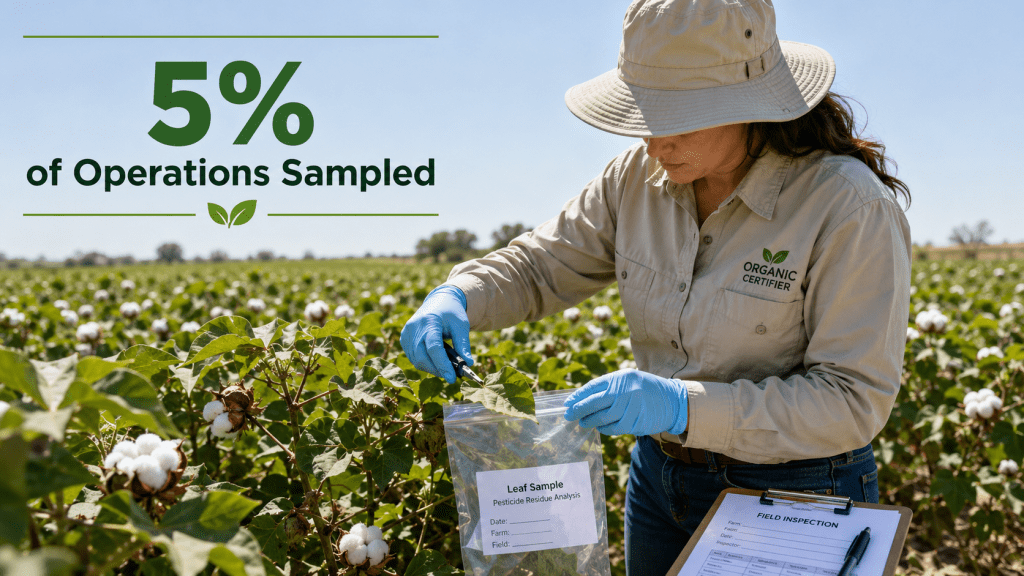
USDA requires organic certifiers to sample and test products from at least 5 percent of the operations they certify each year. A certifier with fewer than 30 certified operations must test at least one operation annually.
The certifier may select farms:
- randomly;
- because they produce a large volume of organic products;
- because the crop or location presents a higher contamination risk;
- because of a complaint or suspected problem; or
- as part of an investigation.
Being selected for testing does not mean that the farmer is accused of wrongdoing. Testing is a normal part of protecting the integrity of the organic label. The certifier pays for this required periodic testing, and the sample must be collected by an authorized inspector, maintained under a proper chain of custody and analyzed by an accredited laboratory.
What Happens When Nothing Is Detected?
The easiest result is “not detected.” This means that the laboratory did not find any of the pesticides included in the laboratory screen above the method’s reporting limit. Remember that “not detected” does not necessarily mean that absolutely zero molecules were present. It means that the laboratory did not detect the pesticide at or above the level the test could reliably identify and report. A report may show glyphosate at >0.01 ppm which means it is there and detectable but at very low levels.
What Happens When a Pesticide Is Detected?
Remember you are in a farming area and pesticide residues can sometimes come from:
- spray drift from a neighboring field;
- contaminated irrigation water (especially in rice country);
- contaminated harvest or transportation equipment;
- inadequate cleanout of storage bins;
- commingling during handling;
- residues remaining from earlier land use; or
- an input that contained an ingredient not disclosed on the label.
The certifier must consider the pesticide, the amount detected, the crop tested and the available production records.
The 0.01 ppm—or 10 Parts per Billion—Decision Point
NOP guidance identifies 0.01 parts per million, or 10 parts per billion, as an important decision point. A concentration of 0.01 ppm is extremely small. It is roughly comparable to one second in a little more than three years. Modern laboratories can detect some pesticides at very low concentrations, which is why a laboratory may find a residue even when the farmer did not intentionally apply that pesticide.
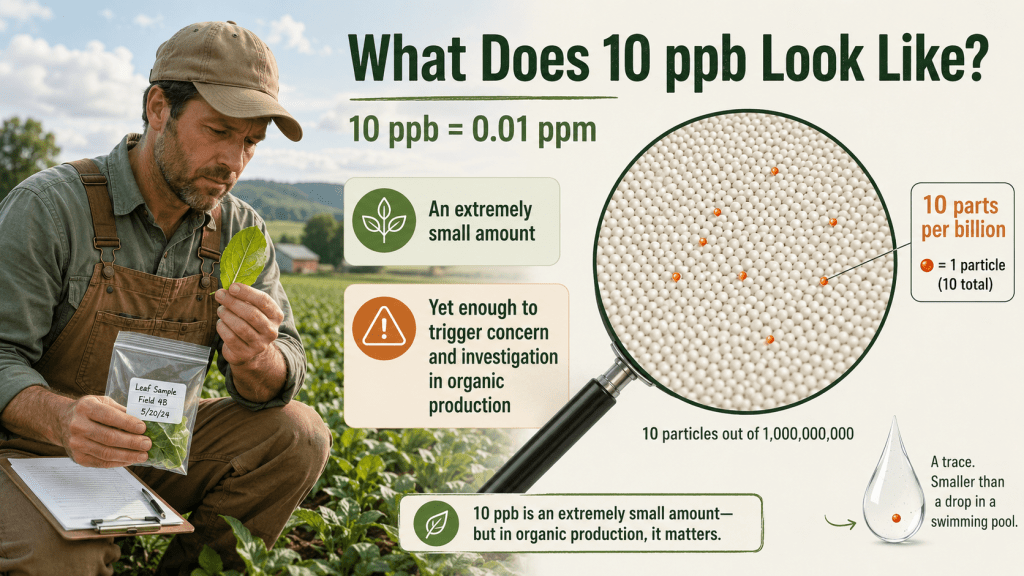
When a prohibited pesticide is detected at or above 0.01 ppm, the certifier first determines whether EPA has established a legal tolerance for that pesticide on the particular crop or commodity tested.
That crop-specific detail is important. A pesticide may have:
- one tolerance on cottonseed;
- a different tolerance on corn;
- another tolerance on vegetables; or
- no legal tolerance at all on a particular crop (a pesticide is detected but one that is not for the crop being tested. I had an organic hay producer with a detected potato fungicide on the crop. Where did that come from?).
What Is an EPA Pesticide Tolerance?
An EPA tolerance is the maximum amount of a pesticide residue that may legally remain in or on a food or agricultural commodity. This is primarily a conventional pesticide and food-safety standard. It is not an organic pesticide allowance. The organic regulations use 5 percent of the EPA tolerance as the level at which an affected product must be excluded from organic sale.
For example, suppose EPA has established a tolerance of 1.0 ppm for a particular pesticide on a particular crop.
Five percent of that tolerance would be: 1.0 ppm times 0.05 = 0.05 ppm
The organic exclusion threshold would therefore be 0.05 ppm, or 50 parts per billion. This example means that if a residue is found in testing your crop that is greater than 0.05 ppm your crop cannot be sold as organic and you will get a notice of noncompliance.
Below 5 Percent of the EPA Tolerance
When the residue is at or below 5 percent of the EPA tolerance, the crop is not automatically excluded from organic sale solely because of the residue level.
However, the certifier may still investigate:
- whether the farmer applied the pesticide;
- whether spray drift occurred;
- whether buffers were adequate;
- whether shared equipment was properly cleaned;
- whether storage and transportation protected the organic crop; and
- whether the farmer followed the approved Organic System Plan.
If the farmer did not apply the pesticide and had reasonable preventive practices in place, the result may represent unavoidable contamination rather than a violation by the farmer. The certifier may still require corrective action. For example, the farmer may need to increase a buffer, improve equipment-cleaning records, communicate with a neighboring applicator or change how the harvested crop is stored.
Above 5 Percent of the EPA Tolerance
When testing detects a prohibited pesticide at a level greater than 5 percent of EPA’s tolerance for that pesticide on that commodity, the affected agricultural product cannot be sold, labeled or represented as organic. This does not necessarily mean that the entire farm immediately loses certification.
The certifier must determine what product the sample represents. Depending on the circumstances, the affected product could be:
- one field;
- one harvest lot;
- one bin;
- one truckload;
- one storage unit; or
- a larger quantity that was commingled.
Good field, harvest and storage records become extremely important. If a farmer can clearly show which field supplied each lot or bin, the certifier may be able to limit the problem to the affected product. When records are incomplete and several fields or loads have been mixed together, it may be difficult to separate the contaminated product from the rest of the crop.
What if There Is No EPA Tolerance?
Sometimes a laboratory detects a pesticide for which EPA has not established a tolerance on the tested crop. If there is no EPA tolerance and no applicable FDA action level, NOP guidance says that a prohibited pesticide residue above 0.01 ppm generally results in the affected product being excluded from organic sale. The certifier must also determine whether the result should be reported to EPA, FDA or the appropriate state agency. This is one reason that the name of the pesticide and the crop tested are just as important as the amount detected.
What if the Farmer Applied the Pesticide?

The 5-percent threshold does not create permission to use a prohibited pesticide. If an investigation shows that a prohibited pesticide was intentionally applied, the farmer may be out of compliance even when the residue detected is very low.
The certifier may consider:
- exclusion of the affected crop from organic sale;
- a notice of noncompliance;
- suspension or revocation of certification; and
- whether the field must complete a new 36-month transition period.
The basic organic requirement remains that prohibited substances cannot be applied to land during the 36 months before harvesting an organic crop. The residue level helps determine what happens to the product, but the investigation determines whether prohibited use occurred.
What Should a Farmer Do After Receiving a Positive Result?
First, do not panic—but do respond promptly.
I would recommend that the farmer:
- Ask for the complete laboratory report.
- Confirm the pesticide that was detected.
- Confirm the concentration in ppm or ppb.
- Ask whether EPA has a tolerance for that pesticide on the tested crop.
- Review all input and application records.
- Review neighboring pesticide applications and any drift concerns.
- Review equipment cleanout, harvest, storage and transportation records.
- Identify exactly which field, lot, bin or load the sample represents.
- Provide the certifier with any information that could help identify the source.
- Document corrective actions that may prevent another occurrence.
Do not immediately assume that a neighboring farmer caused the detection. The location of the sample, pesticide chemistry, timing of nearby applications, weather, field pattern and other evidence should be considered before reaching that conclusion.
 Texas A&M AgriLife Organic