When USDA’s Transition to Organic Partnership Program began in Texas in 2023, it arrived at an unusually important time for organic agriculture in the state.

Texas already had many of the ingredients needed for organic growth: a large agricultural land base, established organic farmers, certified cotton gins, grain elevators, peanut shellers, dairies and other handlers, expanding markets, and producers looking for alternatives that could improve farm profitability. What was often missing was the connection between those pieces—helping a farmer understand certification, find a market, learn from an experienced organic producer, solve production problems, and move from interest to certification.
During the period from July 2023 through September 2026, those pieces have increasingly come together.
146 New Certified Organic Operations
Perhaps the clearest measure is certification itself. Since July 1, 2023, 146 new Texas operations have become certified organic. As a cross-check on that number, the USDA Organic Integrity Database shows approximately 148 new crop certificates issued during essentially the same period. The close agreement between these independently derived counts provides a useful cross-check on the magnitude of recent crop-certification growth.
But the number alone does not explain what has been happening. One of the most important characteristics of organic transition in Texas is that many producers do not begin with land that has recently been conventionally farmed.
Based on Texas TOPP program records and producer contacts, approximately 93% of these newly certified operations entered organic production using land that was already eligible, or nearly eligible, for certification. Much of this acreage had been enrolled in the USDA Conservation Reserve Program, had been idle for several years, or in some cases had not received prohibited materials for decades.
One of the biggest advantages Texas has is land that may already have completed most or all of the three-year organic transition period before a farmer ever applies for certification.
Under USDA organic regulations, land must have had no prohibited substances applied for 36 months before harvest of an organic crop. In many Texas situations, that clock has already run before the farmer ever considers organic certification. For land that has already satisfied the 36-month requirement, the remaining organic certification process may take only a few months. A farmer can begin the certification process during the fall or winter, complete an Organic System Plan, document the land-use history, undergo inspection and, if all requirements are met, be ready for certified organic production the following growing season. That gives Texas an important structural advantage and likely contributed to the nearly 120,000-acre increase in certified organic acreage since summer 2024.
Handler Growth Strengthened Organic Market Infrastructure
Another important change during the TOPP period has been the rapid increase in certified organic handlers in Texas. In 2023, Texas had fewer than 400 certified organic handlers. By September 8, 2026, that number had increased to 728. This growth is important because organic transition depends on much more than certifying farmland. Farmers need certified businesses that can receive, store, process, transport, feed, gin, shell, clean, package or market organic products while maintaining organic integrity.
In Texas, these handlers include businesses such as organic cotton gins, grain elevators, peanut shellers, dairies purchasing organic feed, processors and other agricultural businesses. Their presence creates market pathways for crops such as cotton, wheat, corn, sorghum, peanuts, cowpeas, hay and silage.
The increase in certified handlers therefore helps explain why organic transition has been concentrated in particular areas of Texas. Where certified handlers, established organic growers and suitable farmland occur together, a farmer considering organic production faces much less market uncertainty. In practical terms, a producer is far more likely to transition when the question is not, “Who will buy my crop?” but rather, “Which organic market fits my farm?”
The growth from fewer than 400 to 728 certified handlers reflects both expansion of the Texas organic supply chain and changes in USDA certification requirements. The Strengthening Organic Enforcement rule, fully implemented in March 2024, required certification of many businesses involved in organic trade that previously could operate without certification. Even with that qualification, the large number of certified handlers demonstrates the breadth of the infrastructure now available to move organic products from Texas farms into markets.
Organic Agriculture Grows in Clusters, Not One Farm at a Time
The new certifications are also not randomly distributed across Texas. They tend to occur in organic production-and-market clusters—what might informally be called organic “hot spots”—where several parts of the organic supply chain already operate together.
In these areas, a producer may have experienced organic neighbors, an organic cotton gin, a certified grain elevator, a peanut sheller, an organic dairy purchasing feed, or buyers looking for organic wheat, corn, sorghum, cotton, peanuts, cowpeas, hay or silage. That infrastructure changes the transition decision.
Certification itself does not create a market. A producer needs somewhere to deliver the crop, someone who understands organic segregation and handling, and preferably some confidence about price and demand before planting. Where that infrastructure already exists, the risk of organic transition is substantially reduced.
Experienced organic growers are equally important. A producer considering organic wheat or cotton in an area with established organic farms can see how neighboring growers manage weeds, rotations, fertility, insects and certification records. The discussion changes from “Can organic farming work here?” to “How do I make it work on my farm?”
That may be one of the most important lessons from the Texas experience: organic agriculture tends to build around clusters rather than isolated farms. Production, handling, markets, information and farmer experience reinforce one another.
TOPP Helped Connect the Pieces
USDA created the Transition to Organic Partnership Program as part of its Organic Transition Initiative. Nationally, TOPP was designed around farmer mentoring, technical assistance, community building and organic workforce development. Texas A&M AgriLife Extension participated through the Western and Southwestern regional program led by the CCOF Foundation. TOPP did not create Texas organic agriculture, nor can the growth in certified operations be attributed to one program. What TOPP did provide was additional capacity at exactly the time that producer interest, market opportunities and organic research were expanding. That additional capacity was expressed most clearly through expanded producer education, farmer mentoring, technical assistance and development of Texas-specific organic resources.
TOPP Expanded Extension Reach and Farmer-to-Farmer Learning
One of the most direct impacts of Texas TOPP funding has been the ability to greatly expand face-to-face outreach across the state. Texas is large, and organic agriculture is spread across widely separated production regions. Reaching transitioning and certified organic farmers requires travel, staff time and the ability to bring farmers, researchers, certifiers, buyers and other organic specialists together.
TOPP provided resources that allowed the Texas A&M AgriLife Organic Program to participate in approximately 278 educational venues during the TOPP period, averaging about 69 annually. These have included producer meetings, conferences, tours, field days, short courses, online meetings, market updates and invited presentations across Texas.
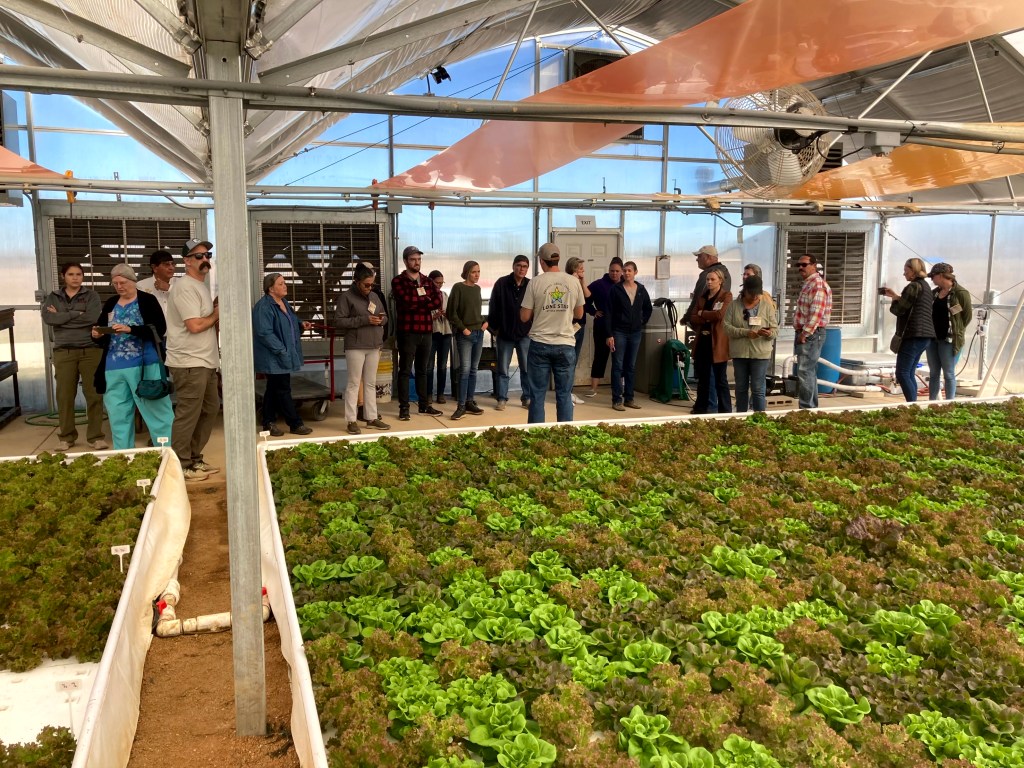
TOPP funding also helped the program organize and host organic-specific educational events rather than relying only on general agricultural meetings. These events created opportunities for transitioning and certified farmers to see organic production in the field, visit with experienced growers, learn from researchers and hear directly from organic businesses and technical experts.
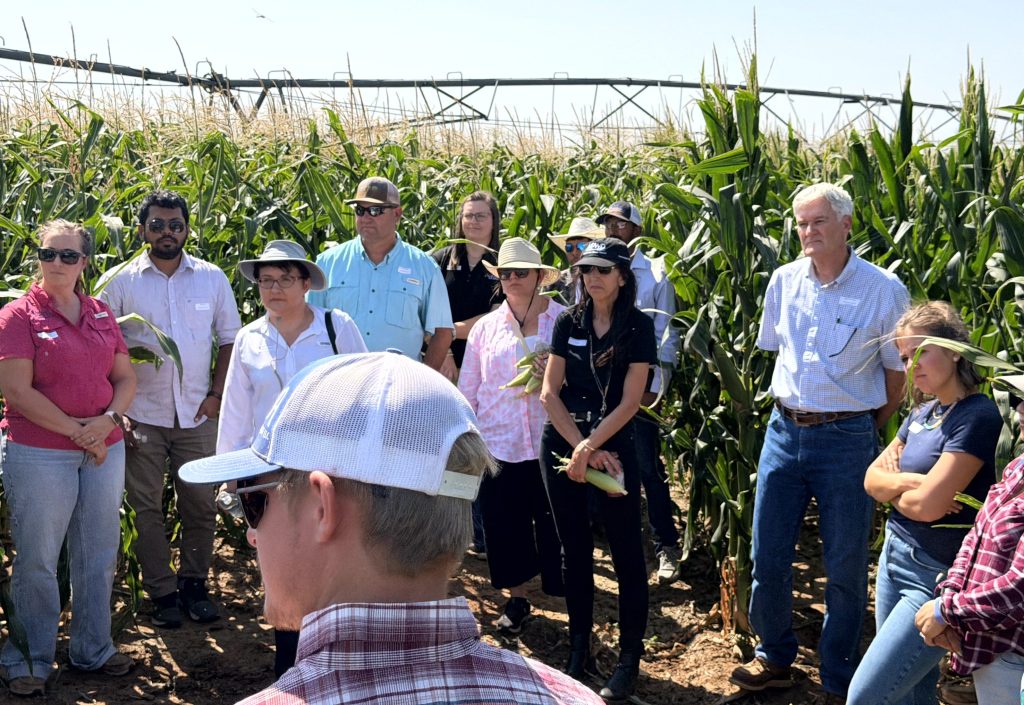
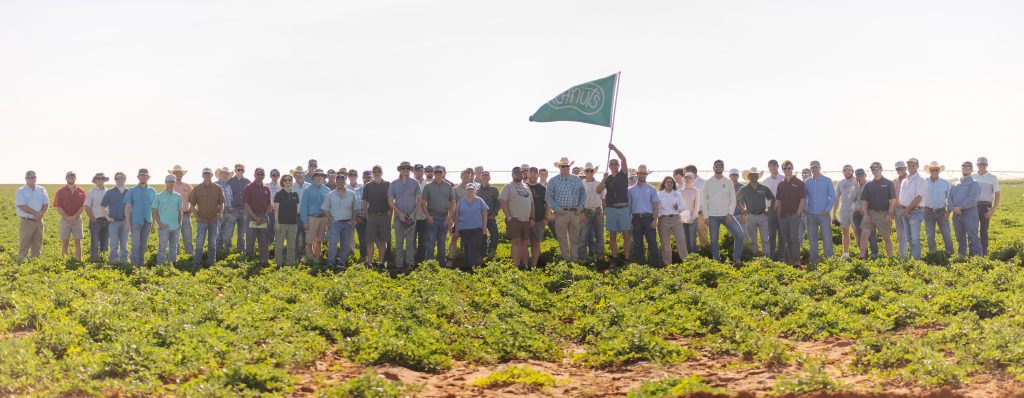
Participation has demonstrated the demand for this type of education. A recent Organic Cotton and Peanut Tour attracted more than 100 participants and 18 organic industry sponsors, bringing farmers, researchers, Extension personnel and businesses together around two of Texas’s most important organic crops.
An annual February agricultural event has also provided an opportunity to feature an organic speaker before an audience of more than 250 participants, extending organic production information to farmers who may not yet identify themselves as organic producers but may be considering transition or interested in organic practices.
TOPP resources have also made it possible to bring recognized organic experts into Texas to address emerging production, certification and market issues. This has given Texas producers access to information and expertise that would otherwise be difficult or expensive to obtain locally. These activities are important because organic transition is not accomplished through publications alone. Farmers often need to see another organic farm, examine equipment, ask questions of experienced producers, talk with buyers and handlers, and hear how other farmers solved problems similar to their own.
In that sense, TOPP helped create more than educational events. It helped build a statewide organic learning network in which farmers, researchers, Extension educators, certifiers and agricultural businesses could interact directly. That network is one of the program’s most important lasting contributions.
Farmer Mentors Became a Core Part of the Texas Organic Network
Farmer-to-farmer mentoring has also been an important part of the Texas TOPP effort. Over the course of the program, 13 experienced organic farmers served as mentors, providing direct assistance to 37 transitioning farmers who specifically requested mentoring support. These relationships helped producers work through practical questions about certification, crop production, recordkeeping, markets, equipment, weed management and other issues that are often best understood by someone who has already managed an organic farm.
The mentors’ influence extended well beyond these formal mentoring relationships. They also interacted informally with many of the 146 operations that became certified during the TOPP period, answering questions, sharing experiences and helping new producers understand how organic production works under Texas conditions.
Mentors regularly participated in organic tours, field days, short courses and producer meetings, where their experience complemented information provided by Extension specialists, researchers and certifiers. They also met informally with the Texas A&M AgriLife Organic Program and became an important source of current information about production conditions, markets, emerging problems and farmer concerns.
In many ways, these producers became the program’s boots on the ground. Because they were actively farming within different organic production regions, they could provide an immediate picture of what was working, what was changing and where additional Extension or research support was needed. This informal network may be one of the more durable outcomes of TOPP. The formal grant period ends, but the relationships among experienced organic farmers, new producers, Extension educators, researchers and agricultural businesses remain.
Digital Outreach Expanded Access to Organic Information
At the end of 2022, the Texas A&M AgriLife Organic website recorded 7,153 annual page views from 3,605 visitors. During just the first eight months of 2026, the site had already reached 60,341 views from 21,425 visitors. By August 2026, website views were already more than eight times the total recorded during all of 2022, while the number of visitors was nearly six times greater.
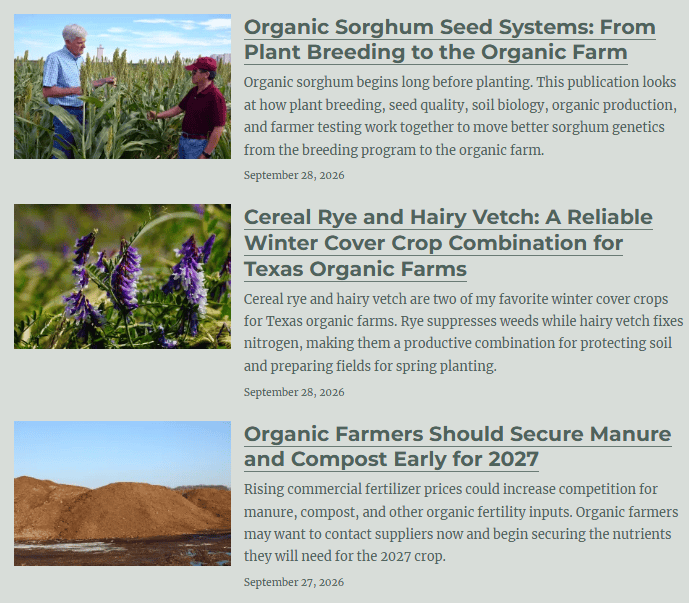
Since 2023, approximately 183 webpages and online resources have been developed addressing organic certification, crop production, soil fertility, pest management, markets, regulations and other issues faced by transitioning and certified producers.
The monthly organic email newsletter has grown from approximately 480 subscribers in 2023 to more than 1,410 subscribers in 2026.
Those numbers matter because organic transition is unusually information-intensive. Farmers need agronomic information, but they also need to understand certification standards, recordkeeping, allowable inputs, markets and the consequences of management decisions under the USDA National Organic Program. Building a readily available body of Texas-specific information reduces that barrier.
Research Investment Has Changed as Well
Another major development since 2023 has been the rapid expansion of organic research in Texas. In 2023, two major USDA National Institute of Food and Agriculture (NIFA), Organic Research and Extension Initiative (OREI) projects were awarded involving Texas A&M researchers: the Climate-Smart Organic Sorghum Partnership for Grain and Silage Production and Fostering Sustainable Organic Cotton Production in the U.S. through Research and Outreach on Organic Regenerative Practices. USDA records confirm both projects as major Texas organic research efforts. Those projects represented nearly $7 million in initial research investment.
Since then, three additional NIFA OREI grant applications have been submitted to improve Texas organic agriculture totaling more than $8 million, while other organic-related research and demonstration projects in the works have contributed approximately another $500,000.
The significance extends beyond the dollar amount. These projects are building an organic research community in Texas that includes faculty, Extension specialists, postdoctoral researchers, graduate students, technicians and cooperating farmers. Organic fields are increasingly becoming primary research sites where recommendations can be developed and tested within organic systems rather than relying primarily on adaptation of conventional recommendations.
That distinction matters. Organic systems have different weed-management constraints, nutrient-release patterns, crop rotations, biological interactions and market requirements. Research conducted within organic systems allows scientists to investigate those differences directly. Importantly, these projects also contain transition components. Researchers are examining what happens to soils, crops, weeds, nutrients and biological communities as fields move from conventional management into organic production. The result should be increasingly useful recommendations not only for established organic farms but also for the producer asking the most basic transition question: What should I expect during the first several years?
Investment Expanded Organic Market Infrastructure
Production research alone cannot expand organic agriculture if there is nowhere for products to go. USDA’s Organic Market Development Grant program was specifically created to expand organic processing, aggregation, storage, transportation and market capacity. USDA described the program as an effort to address missing market pathways for commodities including organic grains, livestock feed, dairy, fiber and rotational crops.
Texas organic businesses received substantial investment through this program, including projects involving processing equipment, market development and new value-added opportunities. USDA records, for example, document Texas projects ranging from organic citrus processing in the Rio Grande Valley to organic yaupon tea marketing and expanded organic spice, herb and grain processing. Collectively, five Texas organic businesses or organizations received more than $3 million in Organic Market Development Grant funding.
These investments matter to producers because transition is much easier when market capacity grows along with production capacity. A new organic farmer is considerably more likely to succeed when there is a certified elevator, gin, dairy, sheller, processor or other buyer within a practical hauling distance.
Organic Has Become Economically Significant in Texas
All of this activity is occurring within an industry that has become economically important to Texas agriculture. Texas certified organic agricultural sales totaled $424.3 million in 2019, generating an estimated $938.9 million in statewide economic output and supporting more than 8,300 full- and part-time jobs.
By 2021, certified organic sales had reached $572.2 million, a 35% increase from 2019. Those sales were associated with approximately $1.10 billion in statewide economic output, $453.6 million in value added, $267.6 million in labor income and approximately 8,683 jobs.
Using that verified 2021 baseline and a conservative 7% annual growth assumption, Texas organic agricultural sales are estimated at approximately $802.5 million in 2026, supporting about $1.55 billion in total statewide economic activity and more than 12,000 jobs. These 2026 figures are projections based on the verified 2021 baseline and should not be interpreted as USDA-reported 2026 sales.
The important point is not simply that organic acreage or the number of certificates has increased. Organic agriculture is generating meaningful economic activity in rural Texas. Cotton requires ginning. Peanuts require shelling. Grain requires storage, cleaning and transportation. Dairy requires large quantities of feed. Seed production, crop consulting, certification, trucking, processing and other services generate additional economic activity beyond the farm gate. Organic agriculture increasingly functions as a supply chain, not simply as an alternative production practice.
What the 2023–2026 Period Has Shown
Looking back over the 2023–2026 period, I think the most important lesson from Texas is that farmers transition to organic most readily when several conditions occur simultaneously. Suitable land must be available, a market must exist, handling and processing infrastructure must be accessible, farmers need reliable production information, they need help understanding certification, and they benefit from experienced organic producers nearby.
Researchers need to be working on the production problems farmers encounter, and farmers need confidence that organic agriculture has a future beyond the next crop year. During the TOPP period, Texas strengthened nearly all of those pieces. TOPP helped strengthen the connections among them. When the Texas portion of TOPP reached the end of its grant-funded period on September 30, 2026, perhaps its most important accomplishment was not a single meeting, mentorship, publication or website statistic. It is that organic transition in Texas now operates within a much stronger ecosystem of farmers, markets, handlers, researchers, Extension educators, certifiers and agricultural businesses than existed when TOPP began in 2023. The federal TOPP project may end, but that infrastructure does not disappear.
Texas A&M AgriLife Extension’s organic program, the producer networks developed through TOPP, the research projects now underway, the market infrastructure being built and the expanding community of certified organic farmers remain.
And that may ultimately be the most important measure of the investment: Texas has increased not only the number of organic farms, but also its capacity to support the next farmer who decides to become one.
Data note: Certification counts and certified acreage are based primarily on USDA Organic Integrity Database records. USDA NASS Organic Survey figures are used for agricultural sales and related economic measures where indicated. Because the two USDA datasets are developed for different purposes, their operation and acreage totals are not necessarily identical.
Discover more from Texas A&M AgriLife Organic
Subscribe to get the latest posts sent to your email.


