
In August of 2024 (replanted September 12 but that is another issue!) we planted test plots for cover crops with the objective of determining which works best for the next crop we want to plant. This was really late in the summer to be planting a summer crop but to be honest we were waiting on a rain and finally gave up and irrigated. The individual cover crops were in the less than average range for growth but still all plots grew and ended up putting on a seed crop simply because we had a long fall. The plots were watered twice and then got some rain. We left the plots to grow as much as possible and after a killing frost plowed the cover crop back into the soil. We then took soil samples on March 6, 2025, and submitted them to the Texas A&M Soil Testing Lab.
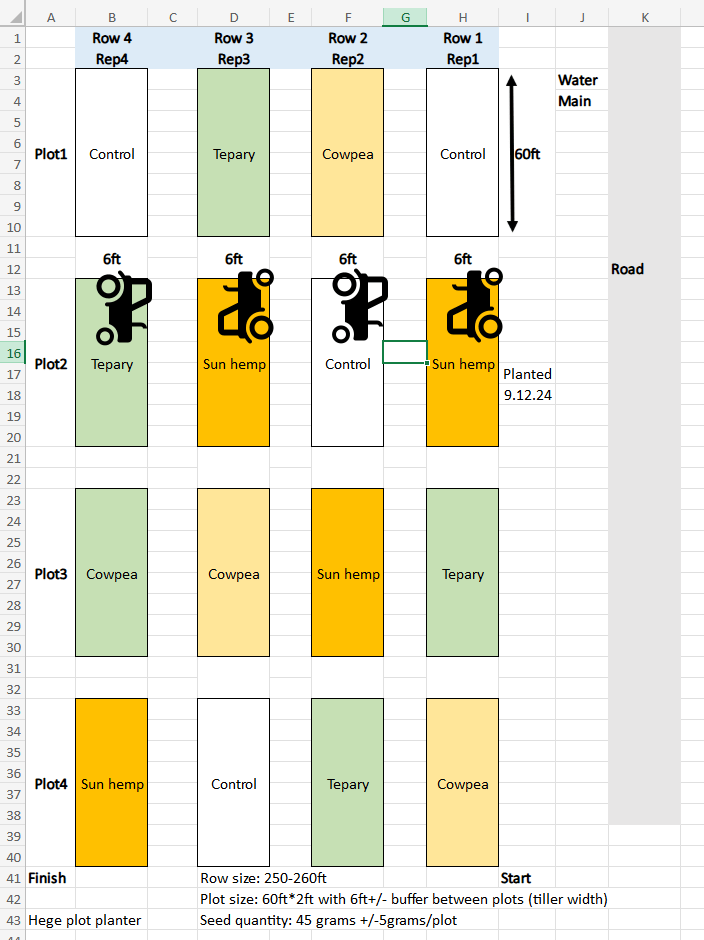
Below is the plot layout
The soil test reports cover four treatments: Check, Sunn Hemp, Tepary Bean, and Cowpea. Click here if you want to read more about Texas Cover Crops. Below is a summarized comparison of key soil characteristics and nutrients across these treatments which shows how each crop affected the soil it was grown on.
1. Soil pH and Conductivity
- Check: pH 6.6 (Slightly Acid), Conductivity 91 umho/cm
- Sunn Hemp: pH 6.5 (Slightly Acid), Conductivity 80 umho/cm
- Tepary Bean: pH 6.6 (Slightly Acid), Conductivity 138 umho/cm
- Cowpea: pH 7.1 (Neutral), Conductivity 117 umho/cm
🔹 Observation:
- Cowpea resulted in the highest pH (7.1), making the soil more neutral.
- Tepary Bean had the highest conductivity (138 umho/cm), indicating more soluble salts.
- Sunn Hemp had the lowest conductivity (80 umho/cm), potentially reducing salt buildup.
2. Nitrate-N (Soil Available Nitrogen)
- Check: 14 ppm
- Sunn Hemp: 13 ppm
- Tepary Bean: 17 ppm
- Cowpea: 12 ppm
🔹 Observation:
- Tepary Bean had the highest nitrate-N (17 ppm), likely contributing more nitrogen to the soil.
- Cowpea had the lowest nitrogen levels (12 ppm), possibly due to uptake by the crop.
3. Phosphorus (P)
- Check: 40 ppm
- Sunn Hemp: 34 ppm
- Tepary Bean: 35 ppm
- Cowpea: 32 ppm
🔹 Observation:
- Check treatment maintained the highest phosphorus level (40 ppm) likely due to residual P from previous crops or fertilizer applications.
- Cowpea depleted the most phosphorus (32 ppm), requiring the highest P₂O₅ recommendation (35 lbs/acre).
4. Potassium (K)
- Check: 300 ppm
- Sunn Hemp: 301 ppm
- Tepary Bean: 319 ppm
- Cowpea: 316 ppm
🔹 Observation:
- Tepary Bean (319 ppm) accumulated the most potassium suggesting a strong potassium cycling effect.
- Check had the lowest potassium (300 ppm), indicating less uptake or retention compared to the legumes.
5. Calcium (Ca)
- Check: 817 ppm
- Sunn Hemp: 815 ppm
- Tepary Bean: 818 ppm
- Cowpea: 1,122 ppm
🔹 Observation:
- Cowpea significantly increased soil calcium (1,122 ppm), likely due to deeper-rooted nutrient mining.
- Other treatments had similar calcium levels (~815-818 ppm).
6. Magnesium (Mg)
- Check: 149 ppm
- Sunn Hemp: 157 ppm
- Tepary Bean: 163 ppm
- Cowpea: 174 ppm
🔹 Observation:
- Cowpea led to the highest magnesium levels (174 ppm).
- Magnesium followed a trend similar to calcium, with legumes slightly increasing Mg levels.
7. Sulfur (S)
- Check: 15 ppm
- Sunn Hemp: 12 ppm (Needs 5 lbs S/acre)
- Tepary Bean: 14 ppm
- Cowpea: 17 ppm
🔹 Observation:
- Cowpea maintained the highest sulfur level (17 ppm), possibly through decomposition.
- Sunn Hemp had the lowest sulfur (12 ppm) and was recommended for an additional 5 lbs of sulfur per acre.
8. Micronutrients (Iron, Zinc, Manganese, Copper, Boron)
| Nutrient | Check | Sunn Hemp | Tepary Bean | Cowpea | Critical Level |
| Iron (Fe) | 17.5 | 18.9 | 15.9 | 15.2 | 4.25 ppm |
| Zinc (Zn) | 0.76 | 0.65 | 0.73 | 0.67 | 0.27 ppm |
| Manganese (Mn) | 10.3 | 9.7 | 8.9 | 10.3 | 1.00 ppm |
| Copper (Cu) | 0.71 | 0.68 | 0.66 | 0.59 | 0.16 ppm |
| Boron (B) | 0.26 | 0.17 | 0.23 | 0.30 | 1.30 ppm |
Some General Observations
- Sunn Hemp had the highest Iron (18.9 ppm), suggesting enhanced Fe availability.
- Cowpea had the lowest Copper (0.59 ppm), which may warrant monitoring in future crops.
- All treatments were below the critical Boron level (1.3 ppm), but Sunn Hemp had the lowest (0.17 ppm). A boron application of 1 lb/acre was recommended for all treatments.
Final Takeaways & Recommendations
- Cowpea improved pH stability and significantly increased calcium and magnesium levels.
- Tepary Bean led to the highest nitrogen and potassium levels, making it beneficial for nutrient cycling.
- Sunn Hemp had the lowest sulfur and boron levels, suggesting it may require supplementation.
- The Check treatment retained the highest phosphorus level, while Cowpea depleted the most phosphorus.
- All treatments except Check had slightly reduced Zinc, Copper, and Manganese levels, but still above critical levels.
- Use these results to help you plan for your next crop and then monitor that crop! This is what we plan to do by planting a Sorghum Sudangrass crop that we will collect both soil samples and plant samples.
Best Option for Long-Term Soil Improvement?
- Cowpea appears to be the best option for improving soil pH, calcium, and magnesium.
- Tepary Bean is ideal for nitrogen retention and potassium accumulation.
- Sunn Hemp had the least impact on conductivity and may be better suited for salinity-sensitive crops.
Other Organic Resources
- Biopesticides and Biostimulants: Innovation, Challenges, and Growth
- Understanding the Proper Use of Organic and Biological Products in Pest Control
- What is the True Cost of Compost (or manure) in 2024?
- Soil Testing, soil results, soil test labs
- Organic Fertilizer – what is it, what are the rules, and where do you buy it?
- Organic Materials/Products Lists
- Organic Weed Control
- Best Cover Crops for Weed Control and Fertility
- Allelopathy – What is it, what has it, and how do we use it?
- Organic Seed May Soon Be Required
Discover more from Texas A&M AgriLife Organic
Subscribe to get the latest posts sent to your email.


fetching! 29 2025 What Do Cover Crops Leave Behind? Comparing Sunn Hemp, Tepary Bean, and Cowpea magnificent
LikeLike