
- Variety Selection in Organic Rice Production
- Importance of Seedling Vigor
- Updated Considerations
- Rice Variety Research
- More Rice Variety Information
- Ratoon Rice?
- Seed Rice Varieties
- Where to Buy Seed Rice
- Companies In the Organic Rice Milling Business
- Other Resources
Variety Selection in Organic Rice Production
In organic production systems, the challenges to producing an economically successful crop are quite different than in conventional systems. Research has shown that the choice of cultivar is one of the most important decisions in determining performance under organic management.
There are many different target markets for rice, including:
- Standard Milled Long or Medium Grain Rice: Commonly used in everyday cooking.
- Brown Rice: Retains the bran layer and is considered healthier due to higher fiber content.
- Aromatic Rice: Varieties such as jasmine and basmati that are valued for their distinctive fragrances. These are being developed by TAMU Rice Researchers and should be available soon.
- Special Purpose Rice: Includes rice for flour production or colored bran rice, which can be marketed for its unique nutritional or aesthetic qualities.
Understanding the preferences of these markets and identifying outlets for specific types of rice may offer added economic opportunities for growers. For example, there is a growing market for aromatic and colored bran rice due to increasing consumer interest in unique and healthful food options.
Importance of Seedling Vigor
In organic production, the use of many conventional seed treatments is prohibited. Therefore, selecting varieties with excellent seedling vigor and seedling quality is crucial. Seedling vigor refers to the ability of seeds to germinate and grow rapidly under field conditions, leading to strong early stand establishment. This is particularly important in organic systems for several reasons:
- Early Flooding: Strong early growth allows for an early flood, which is a key practice for weed control in rice fields.
- Weed Competition: Vigorous seedlings can outcompete weeds, reducing the need for mechanical or manual weeding.
- Disease Resistance: Early and healthy growth can help seedlings better withstand diseases and pest attacks.
Updated Considerations
Recent advancements and trends in organic rice production emphasize several additional factors:
- Adaptability to Organic Inputs: Varieties should perform well with organic fertilizers and soil amendments, which release nutrients more slowly than synthetic fertilizers. Varieties developed in organic systems develop beneficial relationships with the microbiome.
- Disease and Pest Resistance: With fewer pest control options available, selecting varieties that are resistant to common diseases and insects in the 2 rice growing regions is more critical.
- Environmental Resilience: Varieties that can tolerate local environmental stresses such as drought, salinity, or extreme temperatures are preferred.
By focusing on these updated considerations, organic rice growers can better navigate the unique challenges of organic production and tap into diverse market opportunities, ultimately leading to more successful and sustainable farming operations.
Rice Variety Research
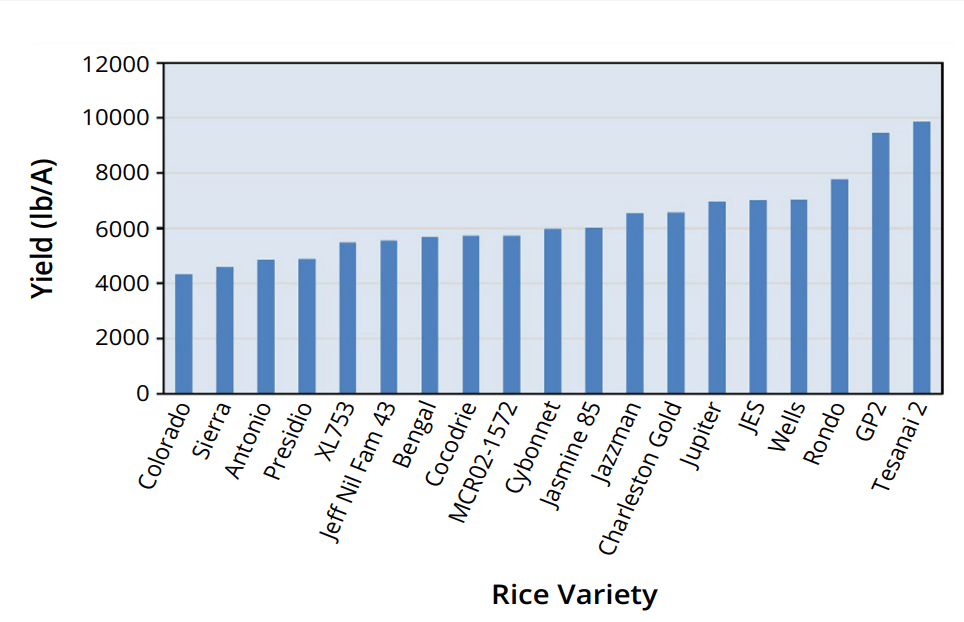
Rice varieties have different yield potentials under organic versus commercial production systems. Cultivars such as Tesanai 2, Rondo, and hybrids have
high yield potential, as demonstrated in a research plot trial conducted in Texas (see picture below). Based on a 5-year (2015 through 2019) organic commercial production survey, the average yield of XL723 (a popular hybrid variety in Texas, used in organic production) was 4,094 pounds per acre, while Presidio’s yield (a popular inbred variety) was only 2,452 pounds per acre. The selection of high yielding rice varieties with tolerance to weeds and diseases is the key to successful organic rice production.
This is the yield performance of 19 rice varieties and germplasm lines grown organically in Beaumont, Texas in 2015 and 2016 at the Rice Research Center.
More Rice Variety Information
This rice variety test below was conducted by RiceTec in 2023 on the Chriss Schiurring Farm near Garwood.
The measurements provided (bushels and barrels) are generally for rough rice, which includes the hulls and is the form in which rice is typically harvested and initially processed.
- Bushel of Rice: A bushel of rough rice typically weighs 45 pounds.
- Barrel of Rice: A barrel of rough rice is typically defined as weighing 162 pounds.

Ratoon Rice?
Ratoon rice production involves harvesting a primary rice crop and then allowing the stubble left in the field to regrow and produce a second crop, known as the ratoon crop. This method leverages the remaining growth potential of the plant to produce an additional harvest without replanting, thereby saving time, labor, and resources. Ratoon cropping can increase overall yield and efficiency, although it typically produces a lower yield than the primary crop.
The average yield of a ratoon rice crop is typically about 50-70% of the main crop’s yield. This reduced yield is due to the limited growth potential and shorter growing period of the ratoon crop compared to the main crop. However, ratoon cropping can still be economically beneficial due to the reduced input costs and labor requirements. In many organic rice production fields, the ratoon crop is the profit crop and makes or breaks the farms success!
Seed Rice Varieties
Hybrid Rice Varieties
Hybrid rice is produced by crossbreeding two distinct rice plants with the goal of: higher yields, better disease resistance, and greater environmental stress tolerance compared to conventional varieties. Unlike conventional rice, hybrid rice seeds need to be purchased each planting season, as the hybrid traits do not persist in subsequent generations. Additionally, hybrid rice typically requires a lower planting rate (13-22 lbs. per acre or sometimes more in organic systems) due to its vigorous growth and higher productivity. To read more about how hybrid rice is produced click this link: Hybrid Rice Breeding
RiceTec XL723
For a decade now, XL723 has delivered unsurpassed value through its combination of high yield and outstanding milling yields. Long grain rice. XL723 should be harvested at 18%-20% moisture at first drydown to help maximize grain quality and grain retention.
- Superior milling yield
- Ideal for straighthead-prone soils
- Excellent ratoon potential
- Great fit for organic cultivation
RiceTec XP753
Up until 2023, XP753 was the highest-yielding long-grain rice available, providing the greatest net income potential of any competitive rice product. XP753 should be harvested at 18%-20% moisture at first drydown to help maximize grain quality and grain retention.
- Protected by RiceTec’s superior disease package
- Improved grain retention
- Excellent ratoon potential
RiceTec RT7301
Introduced in 2020, RT7301 represents an evolution of RiceTec traditional rice products, capturing the best attributes of XP753 a long grain rice. RT7301 should be harvested at 18%-20% moisture at first drydown to help maximize grain quality and grain retention.
- Very high yield potential
- Protected by RiceTec’s superior disease package
- Improved grain retention
RiceTec RT7302
New in 2023, RT7302 represents the next breeding evolution of RiceTec traditional rice products, capturing the best in yield and grain quality. RT7302 will raise the bar for yield among the RiceTec portfolio of long grain rice. RT7302 be harvested at 18%-20% moisture at first drydown to help maximize grain quality and grain retention.
- high yield potential
- Protected by RiceTec’s superior disease package
- high grain quality
- 25% amylose content* for a more separate cooked product
*Amylose content in rice refers to the amount of amylose, a type of starch, present in the grains. Rice with intermediate amylose content (typically 20-25%) tends to have a balanced texture—neither too sticky nor too dry. This makes it versatile for a variety of culinary uses, providing a satisfactory chewiness without being overly firm or sticky.
RiceTec RT3202
RT3202 is a medium grain rice.
- Early maturity (110 days)
- High yield hybrid potential
- Average ratoon potential
Conventional and/or Inbred Rice Varieties (non-hybrid)

Conventional rice varieties are traditional types of rice that are open-pollinated and can be replanted each season from harvested seeds (there are laws regulating saving some seed varieties, click to read more). They are important for maintaining genetic diversity, which helps ensure crop resilience against diseases and pests. Additionally, they often have unique flavors and qualities prized in local cuisines and cultural practices. Planting rates are in the range of 60-80 or even to 120 lbs. per acre. Check with your sales representative or agronomist. Organic seeding rates can be up to 1.5 times more.
You may see the term “inbred.” Inbred rice varieties are those developed through self-pollination over multiple generations to achieve a stable, uniform genetic makeup. Unlike hybrid varieties, which are produced by crossbreeding different parent lines, inbred varieties maintain consistent traits across generations when their seeds are replanted. They are often valued for their stability, specific traits, and adaptability to local growing conditions.
Dyna-Gro DG245L
Semi-dwarf, early maturing, long-grain variety with exceptional milling yields and grain quality. Medium plant height of 36 inches and great stalk strength for lodging resistance and storm tolerance. Very stable yields in five years of research with excellent ratoon crop potential. Intermediate gel temperature* and intermediate amylose content.
*Gel temperature refers to the temperature at which the rice starch granules gelatinize or become sticky during cooking. Rice varieties with intermediate gel temperature generally produce grains that are soft but not mushy when cooked, offering a desirable texture that balances between firmness and tenderness.
Dyna-Gro DG263L
High yielding long grain variety with excellent quality with excellent disease package including blast and smuts. Plant height and stalk strength for lodging resistance and storm tolerance with a proven field performance. Uniform grain size and very good miller (58/69). Lower seeding rates than most varieties (45-65 lbs. per acre).
Dyna-Gro DG353M
High yielding medium grain variety with excellent quality with uniform grain size and a very good miller (60/70). Great standability and favorable plant height (36 inches). Very stable yields in four years of research. Lower seeding rate (50-75 lbs. per acre) than other conventional medium grain inbreds.
Horizon Ag CL153
CL153 is an early, semi-dwarf, long-grain Clearfield rice variety developed by the LSU AgCenter H. Rouse Caffey Rice Research Station. Known for its excellent yield potential and high head rice yields with minimal chalkiness, CL153 offers several agronomic advantages. It has a yield potential comparable to or slightly below that of CL151 but with better lodging resistance. The variety also features excellent grain length, translucency, and whole milled rice output, meeting industry standards.
In terms of disease resistance, CL153 is moderately susceptible to blast, Cercospora, bacterial panicle blight, and straighthead, but it is susceptible to sheath blight. It carries the Pita gene, providing broad-spectrum resistance to common blast races in the southern USA. This makes it a robust choice for growers seeking a variety with good disease management traits.
Horizon Ag CLL16
CLL16 is a long-grain, conventional height, Clearfield rice variety developed by the University of Arkansas System Division of Agriculture. It boasts excellent yield potential and stability, maintaining strong yields even with later planting dates. The variety has excellent seedling vigor and is a few inches taller than typical Louisiana Clearfield varieties, but it is moderately resistant to lodging.
CLL16 features the Pita gene (not a GMO), providing strong resistance to blast, and the CRSP2.1 gene (not a GMO), offering resistance to narrow brown leaf spot. It is moderately susceptible to Cercospora infection on the stem, sheath blight, and bacterial panicle blight. However, milling yields and ratoon potential are observed to be lower than other some other varieties.
Organic rice farmers looking for a reliable variety will find CLL16 to be a strong contender due to its consistent performance, high milling quality, and industry-leading blast resistance. In university tests, CLL16 has shown good rough rice yields, averaging higher than the Diamond variety, making it a comprehensive choice for rice farmers.
Horizon Ag CLL18
CLL18 is a long-grain, conventional height Clearfield rice variety developed by the University of Arkansas System Division of Agriculture. It boasts excellent yield potential and stability, maintaining strong yields even with later planting dates. With excellent seedling vigor, CLL18 is slightly taller than typical Louisiana Clearfield varieties but is moderately resistant to lodging. However, its milling yields are observed to be lower than other Clearfield varieties.
CLL18 does not contain the Pita blast resistance gene and is moderately susceptible to blast, making it less suitable for areas prone to this disease. It does contain the CRSP2.1 gene, providing resistance to narrow brown leaf spot, but is moderately susceptible to Cercospora infection on the stem, sheath blight, and bacterial panicle blight. Despite these susceptibilities, CLL18 has consistently outyielded CLL16 by about 5% in Arkansas trials. Its earlier maturity makes it a good planting partner with CLL16, allowing farmers to stagger their harvests effectively.
Stratton Jupiter
A short-season, semi-dwarf, medium grain with excellent yield potential and milling quality. It is a small grain size but has moderate resistance to bacterial panicle blight.
Stratton Titan
Titan is a very early, short-stature, medium-grain rice variety known for its excellent yield potential, often comparable to or better than Jupiter. It matures about a week earlier than Jupiter and is similar in height. Titan has a preferred large grain size but is moderately susceptible to blast and bacterial panicle blight. It is important to harvest Titan at the correct moisture level, as milling yields drop off significantly when harvested at lower moisture. This short-season variety is valued for its robust performance and high yield potential.
Stratton Cheniere
A short-season, semi-dwarf long grain with excellent yield potential and milling quality comparable to Cypress. An early, high-yielding, high-quality, rice variety with, good lodging resistance and moderate resistance to straighthead. It is moderately susceptible to blast and bacterial panicle blight and susceptible to sheath blight and Cercospora. The variety displays excellent grain quality characteristics, has a higher amylose content and cooks less sticky than typical U.S. long grains.
Stratton Jewel
A mid-season long grain variety with good yield potential and milling yield. Susceptible to straighthead. Moderately susceptible to sheath blight, blast, Cercospora, false smut and lodging. Moderately resistant to bacterial panicle blight.
Stratton Diamond
A mid-season, long-grain variety with excellent yield potential and good milling quality. Very good straw strength. Susceptible to blast and sheath blight, moderately susceptible to bacterial panicle blight. Very susceptible to false smut
Where to Buy Seed Rice

RiceTec Seed
- https://www.ricetec.com/
- PO Box 1305, Alvin, TX 77512
- Office: 281.756.3300
- Fax: 281.393.3532
- Email: CustomerService@ricetec.com
- Joe Pankey, Regional Business Innovation Agronomist
- Cell: 318.381.3280
- Email: jpankey@ricetec.com
- Derrol Grymes, Region 15 Sales
- Cell: 281.381.9371
- Email: dgrymes@ricetec.com
- Craig Hamm, Region 14 Sales
- Cell: 281.387.7247
- Jeff Mosley, Regional Sales
- Cell: 662.719.1034
Dyna-Gro Seed
- https://dynagroseed.com/
- Nutrien Ag Solutions, El Campo
- 676 Country Road 324, El Campo
- Dr. Qiming Shao, Rice Breeder
- Office: 979.541.3912
- Nutrien Ag Solutions, Wharton
- 1015 Nelson Lane, Wharton
- Office: 979.532.2371
Horizon Ag Seed
- https://www.horizonseed.com/
- 8275 Tournament Dr., Suite 255, Memphis, TN 38125
- Office: (866) 237-6167
- Office: (901) 818-3070
- Fax: (901) 818-3117
- Email: info@horizonseed.com
- Hunter Brown, District Field Representative
- Email: hbrown@horizonseed.com
- Cell: 337.546.7288
Stratton Seed
- https://gostrattonseed.com/
- 1530 HWY 79 South, Stuttgart, AR 72160
- Office: 800.264.4433
- Keith Hammer, Sales Manager – Arkansas, Texas, Oklahoma
- Cell: 501-326-3845
- Email: khammer@strattonseed.com
Companies In the Organic Rice Milling Business
Doguet’s Rice Milling
- https://www.doguets.com/
- 795 S. Major Drive, Beaumont, Texas 77707
- Email: doguets@doguets.com
- Office: 409.866.2297
- Fax: 409.866.1646
Gulf Pacific Rice Milling
- http://gulfpac.com/
- 12010 Taylor Road, Houston, Texas 77041
- Office: 713.464.0606
- Fax: 713.467.0325
- Email: gpsales@gulfpac.com
McKaskle Family Farm
- https://mckasklefamilyfarm.com/
- PO Box 10, Braggadocio, MO 63826
- Office: 573.752.5001
- Email: info@mckasklefamilyfarm.com
- Email: sales@mckasklefamilyfarm.com
Harvest Grain Mills
- https://harvestgrainmills.com/
- David Kirkham and Donald Wilcox
- 2191 FM 563, Anahuac, TX 77514
- Office: 409.267.9423
Other Resources
- Texas Organic Rice Production Guidelines
- Water Seeded Rice
- Possible Organic Rice Fungicide for Brown Spot and Narrow Brown Leaf Spot
- LockDown Organic Herbicide for Northern Jointvetch
- Organic Rice Varieties?
- What is the True Cost of Compost (or manure) in 2024?
- Soil Testing, soil results, soil test labs
- Organic Fertilizer – what is it, what are the rules, and where do you buy it?
- Organic Materials/Products Lists
- Organic Weed Control
- Best Cover Crops for Weed Control and Fertility
- Allelopathy – What is it, what has it, and how do we use it?
- Organic Seed May Soon Be Required

Discover more from Texas A&M AgriLife Organic
Subscribe to get the latest posts sent to your email.

 Texas A&M AgriLife Organic