
Revision Note – October 2026: This publication was updated to expand the biological control section for stored-grain insects. The revision adds information on parasitoid wasps, including Anisopteromalus calandrae for weevils and lesser grain borer and Cephalonomia tarsalis for sawtoothed grain beetle, and clarifies that commercial availability of these specialized biological control agents in the United States may be limited.
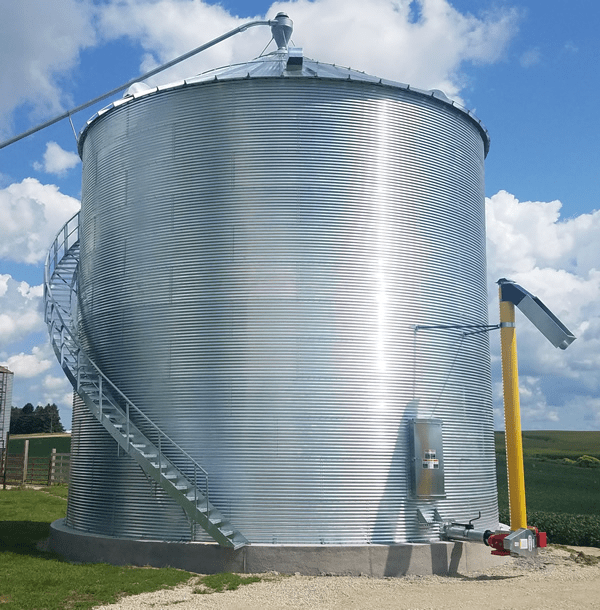
Properly managing stored grain is essential to maintaining its quality and preventing insect infestations. Below are some strategies for controlling insects in organic grain storage, focusing on beneficial insects, biological sprays, and preventive measures. Before applying any material to an empty storage structure or directly to organic grain, verify that the product is allowed by your certifier, is included in your Organic System Plan when required, and is labeled for the intended use. A material being “natural,” OMRI Listed, or containing an allowed active ingredient does not by itself make every use of that product acceptable.
Table of Contents (just click on one)

Organic Grain Storage Preventive Measures
Clean Storage Areas: Thoroughly clean and disinfect storage areas before storing new grain. Remove any residual grain, debris, and dust, as these can harbor pests.
Proper Drying: For many stored grains, moisture near or below 13–14% is commonly targeted for storage, with lower moisture needed for longer-term storage. High moisture levels can promote mold growth and attract insects.
Sealed Containers: Seal entry points: Repair holes, cracks, seams, roof leaks and other openings that allow insects or moisture into the bin. In systems specifically designed for hermetic storage, maintaining an airtight seal can also provide insect control.
Regular Monitoring: Inspect stored grain regularly for signs of infestation. Use pheromone traps to monitor pest activity and take action if necessary.
Temperature Control: Keep storage areas cool, as high temperatures can encourage insect activity. Aerate grain periodically to maintain uniform temperature and moisture levels.
Aeration is one of the most useful tools for suppressing stored-grain insects. Cooling the grain mass slows insect development and reduces moisture migration and condensation. The objective is not simply to run the fan periodically, but to use favorable outside air to move a cooling front through the grain mass.
Beneficial Insects for Grain Storage
Beneficial insects and mites can be useful components of an integrated pest management program for stored organic grain. Some are predators that consume multiple prey, while others are parasitoids whose immature stages develop on or in a single host and eventually kill it. Because these natural enemies differ in the pests and life stages they attack, correct pest identification is important before selecting a biological-control organism.1
Predatory Mites: Several predatory mites feed on stored-product mites, insect eggs, and small insect larvae. Their usefulness depends on the pest species, grain conditions, temperature, and humidity.
Trichogramma Wasps: Trichogramma species are very small parasitoid wasps that attack the eggs of moths. In stored-grain systems they may be useful against moth pests such as the Indianmeal moth and other stored-product moths. The female lays her egg inside the moth egg, preventing the pest larva from developing.2
Anisopteromalus calandrae: This small parasitoid wasp attacks several important stored-grain beetles, particularly weevils such as Sitophilus species and the lesser grain borer, Rhyzopertha dominica. Females can locate late-stage beetle larvae concealed within grain kernels, pierce the kernel with the ovipositor, paralyze the host, and lay an egg on or near it.3 Research has demonstrated suppression of stored-grain pests by A. calandrae under both laboratory and larger-scale grain-storage conditions.4
Cephalonomia tarsalis: This parasitoid is especially associated with the sawtoothed grain beetle, Oryzaephilus surinamensis. Unlike weevils and lesser grain borer, sawtoothed grain beetle larvae are generally free-living within the grain mass rather than developing inside intact kernels. Research has shown that C. tarsalis can move through stored grain, locate sawtoothed grain beetle larvae, and substantially reduce their populations.5
Biological control works best as part of a broader stored-grain management program that includes sanitation, drying, aeration, monitoring, and early pest detection. Biological control agents should be selected according to the pest actually present rather than used as a general treatment for all stored-grain insects.

Trichogramma Wasp
Beneficial Insect Companies
Commercial Availability: Specialized stored-grain parasitoids such as Anisopteromalus calandrae and Cephalonomia tarsalis have been commercially produced for biological control, but current commercial availability in the United States is limited. Several European insectaries continue to produce these parasitoids. Growers should confirm current availability and applicable USDA import or movement requirements before planning a release.
- Koppert Koppert Biological Systems (koppertus.com)
- BioBest Home | Biobest (biobestgroup.com)
- Bioline Agrosciences Bioline AgroSciences: Biocontrol & Integrated Crop Management Bioline
- Applied Bionomics Welcome – Applied Bio-nomics Ltd.
- Beneficial Insectary https://www.insectary.com
- Kunafin https://www.kunafin.com
- Arbico ARBICO Organics Gardening Supplies and Biological Pest Control Products (arbico-organics.com)
- Bugs For Growers – Bugs for Growers
- TipTop Biocontrol Tip Top Bio – Beneficial Insects – Tip Top Bio-Control (tiptopbiocontrol.com)
Biological Treatments of Stored Grain Insects
Diatomaceous Earth (DE): DE is a natural powder made from fossilized remains of diatoms. It works by damaging the exoskeletons of insects, causing them to dehydrate and die. It’s a safe and effective method for organic grain storage. Apply DE to the grain before storage to create a protective layer.

General Application: Use DE at a rate of approximately 1-2 pounds per ton of grain. Surface Treatment: For treating the surface of stored grain, apply a layer of DE at about 0.5 to 1 pound per 1,000 square feet.
How to Apply DE: Ensure the grain is clean and dry before applying DE. The moisture content should be below 14%, as DE is more effective in dry conditions.

Mixing with Grain: Add DE to the grain as it is being transferred into the storage bin. This can be done using a grain auger or conveyor belt. The movement will help mix DE uniformly throughout the grain.
Top Dressing: After filling the storage bin, apply DE on the top surface of the grain. This creates a barrier to prevent insects from entering the grain mass. For best results, ensure even distribution. DE should be mixed thoroughly with the grain to cover all kernels. Use personal protective equipment (PPE) such as a dust mask and gloves to avoid inhaling DE dust during application. A hand spreader or scoop can be used for smaller quantities, while larger operations may require mechanized equipment for even distribution.
Benefits of Using DE: DE is a natural, non-toxic substance safe for humans and animals. It leaves no harmful residues, making it suitable for organic storage systems. DE is effective against a wide range of insects, including weevils, beetles, and moths.
Additional Tips for DE: Maintain optimal storage conditions. DE is most effective in dry environments, so keeping grain dry and well-ventilated will enhance its efficacy. In long-term storage situations, periodically check the grain and reapply DE if needed, especially if there is significant handling or movement of grain. Always handle DE with care to avoid inhalation and ensure it does not contact eyes. Use in a well-ventilated area or wear appropriate protective gear.
Neem Oil (Azadirachtin): Extracted from the neem tree, neem oil has insecticidal properties that disrupt the life cycle of insects by interfering with their growth and reproduction. Some azadirachtin products have insecticidal activity against stored-product pests, but labels vary considerably. Before treating stored grain, verify that the specific product is labeled for postharvest grain use and is approved for the intended organic use. Here are some products:
| Azadirachtin 1.2% | Aza-Direct, AzaPro |
| Azadirachtin 3% | AzaGuard, Molt-X |
| Azadirachtin 4.5% | Neemix 4.5 |
| Azadirachtin: 6.0% | Azasol |
Bacillus thuringiensis (Bt): Bt is a soil-dwelling bacterium that produces proteins toxic to certain insects. When ingested by insects, Bt causes them to stop feeding and eventually die. Bt formulations can be sprayed on grain to control pests like moths and beetles. Here are some products:
| Bacillus thuringiensis aizawai | Agree, Xentari | Certis, Valent | bacteria |
| Bacillus thuringiensis kurstaki | DiPel, Deliver, Javelin, BT Now, Leprotec | NuFarm, Valent, Certis, BioSafe, Vestaron | bacteria |
Using Pheromone Traps for Organic Grain Storage Pest Control

Pheromone traps are an effective tool for monitoring and controlling insect pests in organic grain storage. They work by emitting synthetic versions of insect pheromones, which attract pests to the trap, thereby reducing their populations and minimizing damage to stored grain.
Benefits of Pheromone Traps
1. Target Specific Pests: Pheromone traps are designed to attract specific insect species, making them effective in targeting particular pests without affecting non-target organisms.
2. Monitoring Pest Activity: These traps help farmers monitor pest populations and detect early infestations, allowing for timely intervention.
3. Reducing Chemical Use: By using pheromone traps, farmers can reduce or eliminate the need for chemical insecticides, aligning with organic farming principles.
Types of Pheromone Traps
1. Sticky Traps: These traps are coated with a sticky substance that captures insects when they land on them. They are commonly used for moths and beetles.
2. Delta Traps: Reusable plastic traps that are suitable for a variety of pests. They are durable and weather-resistant, making them ideal for outdoor use.
3. Wing Traps: These traps are weather-resistant and feature a grid pattern on the bottom for easy counting of trapped insects. They are effective in orchards and greenhouses.
How to Use Pheromone Traps
1. Placement: Position traps at the top and in the center of the grain mass. Pheromone traps can also be placed around the storage area to monitor incoming pests.
2. Monitoring: Check the traps regularly to monitor pest activity. Replace the pheromone lures as needed, typically every 4-6 weeks.
3. Maintenance: Keep traps clean and ensure they are in good condition to maintain their effectiveness.
Sources for Pheromone Traps
Oklahoma Company that I have used a lot!
STORGARD® WB Probe II® Grain Beetle Trap – Trécé, Inc. (trece.com)
References
- Schöller, M., Prozell, S., Al-Kirshi, A.G., and Reichmuth, C. 2006. “Towards biological control as a major component of integrated pest management in stored product protection.” Journal of Stored Products Research 42:81–97. ↩︎
- Grieshop, M.J., Flinn, P.W., and Nechols, J.R. 2006. “Biological control of Indianmeal moth (Plodia interpunctella) on finished stored products using egg parasitoids.” Journal of Economic Entomology 99:113–120. ↩︎
- Belda, C., and Riudavets, J. 2010. “Attraction of the parasitoid Anisopteromalus calandrae (Howard) to odors from grain and stored product pests in a Y-tube olfactometer.” Biological Control 54:29–34. ↩︎
- Del Arco, L., Riudavets, J., Campos-Rivela, J.M., Martínez-Ferrer, M.T., Agustí, N., and Castañé, C. 2023. “Effectiveness of the parasitoid Anisopteromalus calandrae in the control of Sitophilus zeamais and Rhyzopertha dominica in paddy rice.” Biological Control 181:105216. ↩︎
- Del Arco, L., et al. 2024. “Cephalonomia tarsalis for the control of the sawtoothed grain beetle, either alone or in combination with the predatory mite Blattisocius tarsalis.” Journal of Stored Products Research 105:102250. ↩︎
Other Resources
- Management of Stored Grain Pests in Organic Systems
- Stored-product Insects and Biological Control Agents
- Preventing Stored Grain Pest Infestations
- Building Soils for Better Crops
- Soil Balancing Basics for Organic Farming
- Biostimulants – The Next New Frontier for Ag
- Best Cover Crops for Weed Control and Fertility
- What is the True Cost of Compost (or Manure) in 2024
- Composts and Herbicides Don’t Mix
- Managing Soil Biology for Organic Farming
- The Economics of Transitioning to Certified Organic Farming
- Farming with Soil Life
- Managing Soil Biology for Organic Farming
- Soil Balancing Basics for Organic Farming
- The Economics of Transitioning to Certified Organic Farming


