Make plans to attend the first ever Organic Growers Conference hosted by the Williamson County Extension Office in Georgetown, Texas, October 18-19. The cost is being worked out but around $50 (was $100!) per participant. For more information or to early register call the Extension Office at (512) 943-3300 or here is a direct link to register:
Sometimes you really have to debate with yourself on whether to buy something or not. I had this ongoing debate with myself when I was trying to decide if I should buy this book in the picture. It was recently released, it is by an author I know, Dr. Gentry, and it is on a subject I enjoy reading about. The problems though are that it is a textbook, it is expensive, and I had to ask, would it be practical or theoretical? I took the plunge, and I am now on my second reading through the over 700 pages!
This book is absolutely written for anybody that works in organic agriculture and it certainly has applications for everybody in agriculture. The chapters are written by many different authors and explain real world stuff. I am by no means a microbiologist, but I still enjoy understanding plants and soils and how they interact with the microbiome that generally inhabit both.
There are many wonderful chapters but the one I want to talk about is written by Dr. Linsey Slaughter, Department of Plant and Soil Science, Texas Tech University and is simply entitled, “Rhizosphere.” On page 269 she writes, “The rhizosphere is the zone of soil immediately influenced by the root with altered microbial diversity, increased activity and number of organisms, and complex interactions between soil microorganisms and the root. The significance of the rhizosphere arises from the release of organic material from the root and the subsequent effect of increased microbial activity on nutrient cycling and plant growth. The unique assemblage of microorganisms in the rhizosphere, known as the rhizosphere microbiome, where microbial community composition, abundance, and functional attributes are distinct from the bulk soil microbiome of the surrounding environment, can influence plant growth in beneficial, neutral, variable, or harmful ways.”
This “influence” starts with the seed. As she explains, “the seeds exude organic compounds such as carbohydrates and amino acids during imbibition, or adsorption of water to rehydrate the seed, at the onset of germination and as the seed coat ruptures to form the primary root. Soil microbes immediately begin to colonize and compete for these resources. Other antimicrobial and signaling compounds are also exuded (by the seed) to protect the seed against pathogenic (disease causing) microbes.”
Dr. Slaughter next discusses roots and root formation. “The root tips at the apex of each root type are responsible for directional growth of the root and are the primary location for water and nutrient absorption and rhizodeposition. The success of the plant depends in large part on the ability of the root tips to sense environmental signals and direct root tip growth in response. The massive number of root tips in the soil accounts for a considerable portion of root surface area and is the most significant location for root interactions with rhizosphere microbial communities. Because of the importance of root tips for root development and function, they are also the site where microbes may have the most significant effect on plant root systems and ultimately the development and physiology of the entire plant.“
Okay this is the part of the chapter I want to emphasize and is the first time I have seen a picture that actually shows what a plant can do. I hope I am not breaking copyright law or any other law by putting this picture here, but it really shows the influence plants have on the rhizosphere surrounding the plant. Here is Dr. Slaughter’s comments, “The rhizosphere is a spatially and temporally heterogeneous zone created by active roots. Physical effects of root growth increase microscale compaction and impact aggregation as soil is pushed aside by the root or enmeshed by root hairs. Nutrient absorption, respiration, and exudation by plant roots create zones of nutrient depletion or enrichment as well and changes in pH and aeration.”
Impact of plant species on rhizosphere pH. Note lower rhizosphere pH for chickpea (left & right) versus maize (corn) (center). Chickpea is well adapted to growth in nutrient-poor soils because of its ability to acidify the rhizosphere through root exudation. Bar = 10 mm.
From Marschner and Römheld (1983).
Page 275, “Principles and Applications of Soil Microbiology.” Elsevier Publishing
As you can see, the roots are changing the pH of the soil surrounding the two different plants. The chickpea is lowering the soil pH which allows it and its microbiome to uptake nutrients it needs while the corn is raising the pH to a 7.5. These changes to the rhizosphere allow the plant to absorb the nutrients it needs.
There is so much more to talk about from this book. Chapters on soil fungi, bacteria, and protozoa. Soil properties and their effect on microbes, soil fauna or insects, composts, etc., etc. I do recommend the book if you want to go deeper into what you do in organic agriculture – it is fascinating to understand and it is our future!
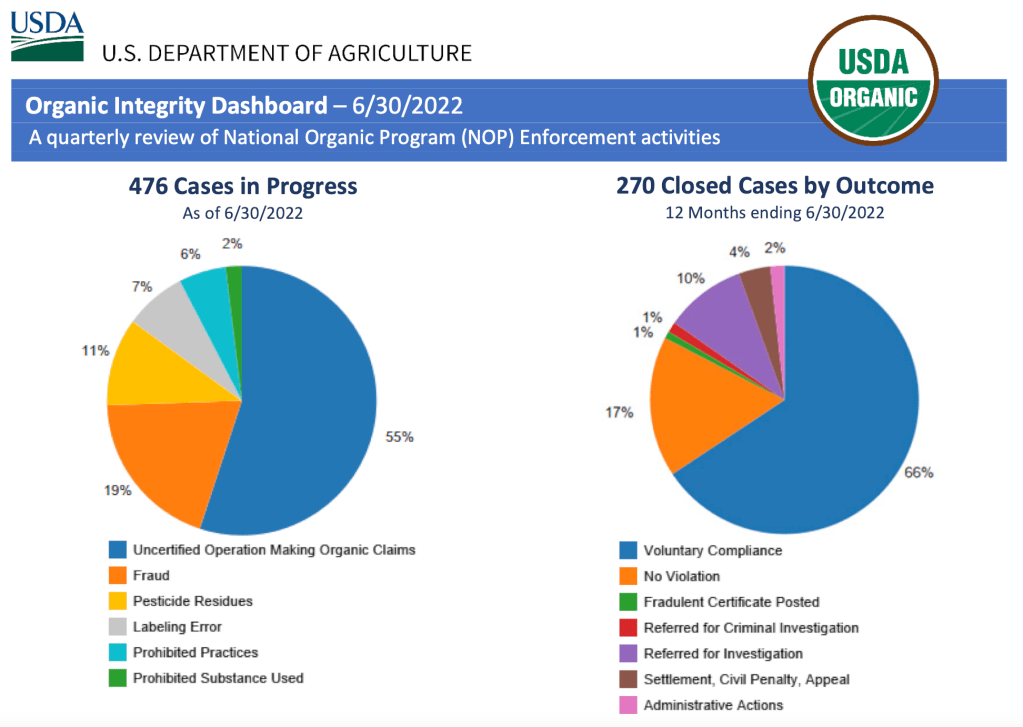
Couple of things I recently received. First, I do like to highlight the quarterly reports from the NOP on enforcement. As you can see in the picture there are 476 cases in progress and the bulk are uncertified operations saying they are organic. I run into this all the time! Folks think that because they use an organic practice or just believe in organics that they are automatically organic.
Second, there is this story from the US Attorney’s Office for the District of Minnesota.
Cottonwood County Farmer Charged with $46 Million Organic Grain Fraud Scheme
MINNEAPOLIS – A Jeffers, Minnesota man has been indicted for defrauding grain purchasers by selling non-GMO grains falsely labeled as organic. According to court documents, between 2014 and 2020, James Clayton Wolf, 64, a certified organic farmer, engaged in a scheme to defraud grain purchasers by selling them non-GMO grains falsely represented as organic. Wolf, who did not hold a legally required grain buyer’s license, repeatedly purchased non-organic corn and soybeans from a grain seller and resold the grain as organic product. As part of his scheme, Wolf also grew conventionally farmed crops using chemical fertilizers and pesticides, in violation of organic farming standards.
Wolf provided grain purchasers with copies of his National Organics Program certification but withheld the material fact that the grains were not organically farmed. As a result of his fraud scheme, Wolf received more than $46,000,000 in payments from grain buyers.
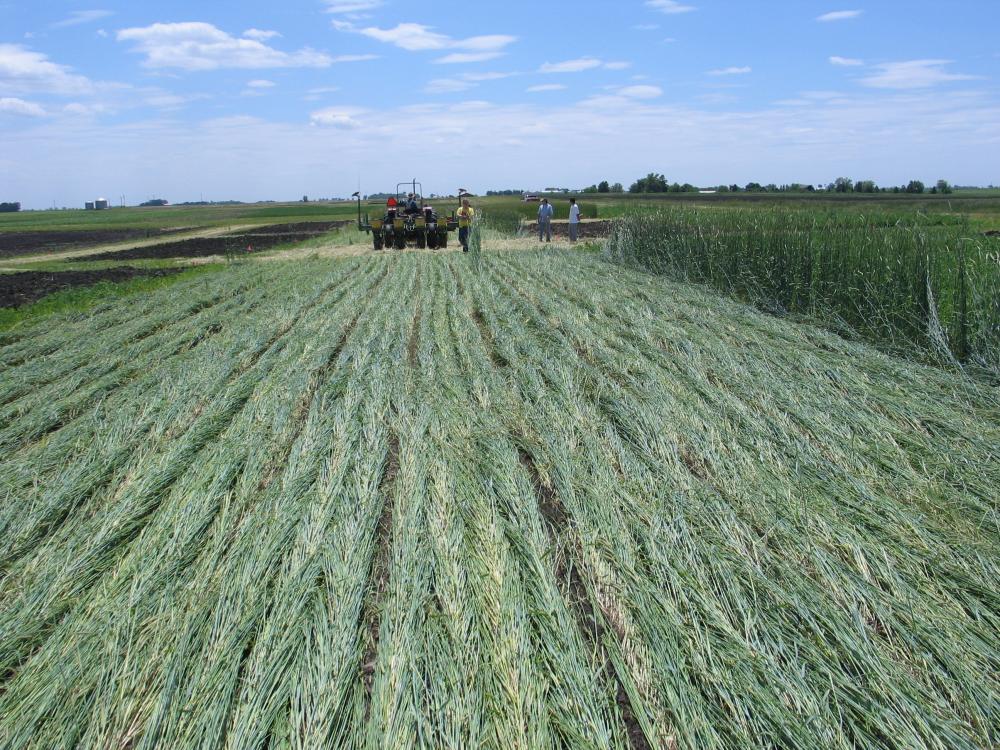
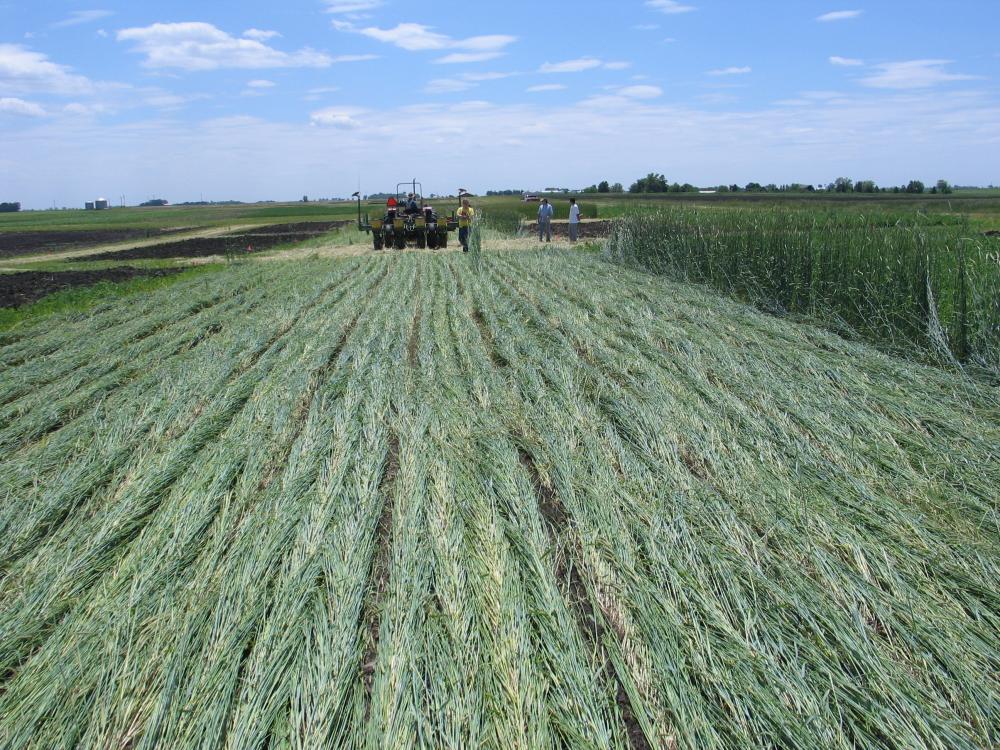
Cover crops are a part of any certified organic plan, and their importance is growing in all agriculture systems for many reasons. Unfortunately, they can also be a source of frustration (for many reasons!) and this year some of the top reasons are the short supply of seed, high prices, and the persistent drought. Still the benefits can certainly outweigh the costs and include:
Cover crops improve soil health. The living soil microbiome must have plant roots to survive, and plants need that soil microbiome to produce. Growing cover crops provides roots and consequently root exudates. Microbes feed on the exudates and then the roots feed on what the microbes leave behind, namely plant nutrients. Also, there are lots of fauna (insects and animals) that live and feed in and on those cover crops. This includes earthworms, potworms, beneficial nematodes, collembola (springtails), etc. These insects and animals play a huge role in breaking down organic matter, removing weed seeds and creating soil aggregates.
Cover crops reduce water use. We commonly talk about EvapoTranspiration rates in agriculture. This summer it is not unusual to see ET rates over 0.4 inches per day. ET is drastically reduced with soil cover and becomes T (plant transpiration) with soil cover. Added to reduced water use is the ability of soils with cover crop residue for taking in and holding or storing more water!
Cover crops lower soil temperature. This is often overlooked but with air temperatures over 100° we can see soil temperatures rise to over 120°. This will affect root development negatively in the top few inches of soil, and this is where we irrigate roots.
Cover crops are fertilizer. They are a significant source of nutrients with nitrogen being the primary. Everyone knows that legume cover crops are a source of nitrogen, but all cover crops are a source of nitrogen! But they are also a source of most major and minor nutrients too. It is not unusual for a good crop of cowpeas to supply 100 units of N to the following crop plus P and K. Also, the microbiome around cover crop roots is taking in many micronutrients and chelating them for future use by crops.
Cover crops help control pests. There is a lot of research that shows how cover crops “recruit” beneficial insects, fungi and bacteria preventing plant pathogens. They basically start the beneficial cycle so that when you plant your cash crop, they are in the soil or in the above ground cover ready for “prey” (aphides, mites, caterpillars, etc.) to eat. For instance, cowpeas have floral nectaries in the petioles and leaflets that attract beneficial insects to the plant.
Okay, maybe this picture is not exactly a beginner organic class but by the next newsletter it could be you in the picture. I just love the one young boy off to the left, he is the future organic farmer!!
Mark it on your calendar, the first “Beginner Organic Training” program will be held on Tuesday, October 18 starting a 1pm and going through 5 pm, Wednesday, October 19 in Georgetown, Texas. This “beginner” training program is really for anyone who has an interest in learning more about organic production, but it is certainly important and informational for those considering “the plunge” into certified organics.
Topics are being planned but include an overview of the Texas organic program, tour of a local organic nursery, soils and soil microbiome, cover crops for Texas, organic products & pest control, organic fertilizers, biostimulants and a compost tour, what’s involved in organic certification, beneficial insects in organic production and panel discussions. Speakers include Extension Specialists, Texas Dept. of Ag. Organic Program, Extension Agents, Organic Producers, and more.
We are working out the details for cost and a final agenda, but plans are to make it affordable, easy to participate, and fun to attend. Put it on your calendar with more to come! If you are interested don’t hesitate to contact Kate Whitney, Williamson County Extension Horticulturist at (512) 943-3300.
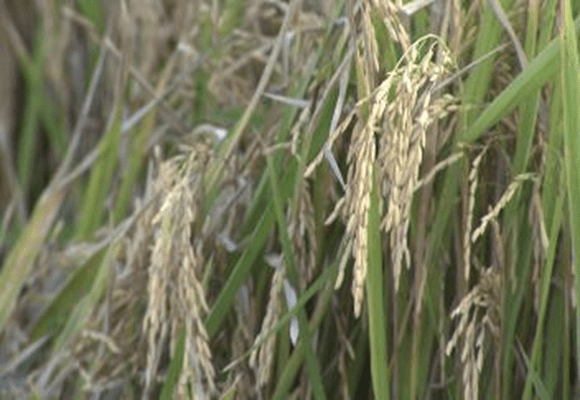
June and July were both months to highlight rice research in Texas. On June 28 a Rice Field Day was held at the Eagle Lake Rice Research Center and on July 14 a Rice Field Day was held at the Beaumont Rice Research Center. Why two? Well, there are two areas of rice production in Texas split by the City of Houston!
The field days provided opportunities to work on two organic rice projects with producers. First, Texas A&M AgriLife Extension is part of a multi-state project to facilitate the growth of organic rice production and foster the growth of the domestic organic rice market. We are working on the adoption of new and innovative organic production practices, barriers to adoption of those practices by producers, some economic information about organic rice production and overall consumer attitudes toward organic rice in the US. During the field day we were able to meet with organic rice producers and start this rice project.
A second project is just beginning but will have a huge impact on improving organic rice production. Dr. Tanumoy Bera along with other researchers and extension specialists are working on a project entitled, “Development of Sustainable Organic Rice Ratoon Production Systems.” In the past, research has led to improvements in main crop organic rice production, but data on how to optimize ratoon (second crop) crop organic rice nutrient management and assess sustainability are sorely lacking. Developing economically and environmentally sustainable practices is critical to further expansion of organic rice production in the US. We propose to conduct comprehensive field experiments to assess the effects of cultivars, cover crops, and nitrogen rates on ratoon crop rice yields, milling quality, pest pressures, environmental sustainability, and economic viability. This project will be conducted in organic grower fields and give us great data to improve overall organic rice yields.







 Texas A&M AgriLife Organic