This is an update to an article written in Spring of 2022 that is now down below. This update is to show how I have taken the information from Jacy Lewis, Extension Horticulturist, for growing raspberries in Texas and adapted it to my home garden. Maybe it will work for you.
I was given some raspberry plants by my Extension Horticulture daughter Kate last year (Spring 2023) and I didn’t cover them – like I should or like Jacy says down below! So, they grew very well but the intense sun and heat last year began to wear them down and by the end of summer I thought they all had died.
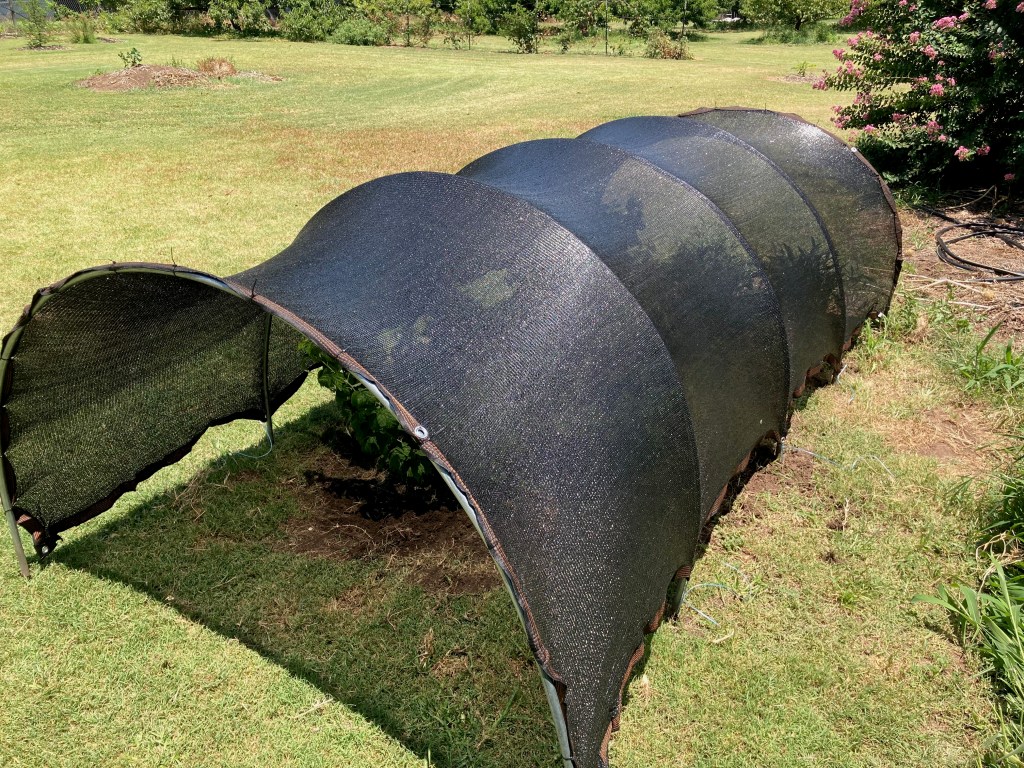
Fortunately, they returned with a vengeance this spring and are spreading like wildfire. But unfortunately, the intense heat and sun of the last ten days of June/July has begun to “fire” them up. Tips were browning and I knew I had to do something. This tunnel below was put up in minutes with the help of my wife holding things up till I could “hammer” them in or tie them down. This is more tunnel than I need right now but eventually I will let them grow to fill it up.
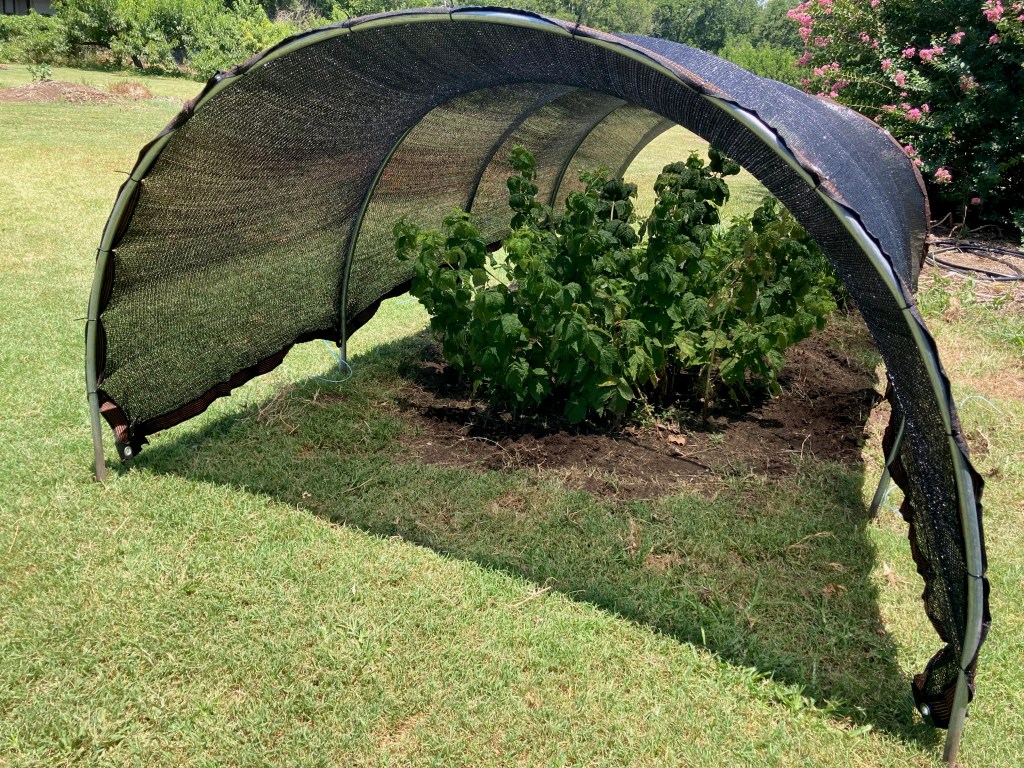
I built this tunnel from some materials I use for winter gardening. I like to use 10-foot electrical conduit as “hoops” for plastic tunnels in the winter. You can bend them on a shop table easily into half circles. This makes a nice 10′ half-moon for a tunnel or in this case a shade cover. I bought a 10 X 13 50% shade cloth in black since I couldn’t find red and white was in sizes too big. This was only $30, and you know gardeners spare no expense to grow plants!

Since I use these tunnels a lot, I built me some stakes that are quite handy. I just weld a cut chain link onto a 3/8ths rebar about halfway up. Half goes in the ground and the other half is sticking up to put the conduit on.
You can see in this picture below that some of the shoots are showing the burn injury of intense sun but since putting up the shade cloth almost all the shoots have new tip growth, and that young growth is really looking good even in 100-degree temperatures. Hard to see but in the back of this picture are lots of new raspberries on about 4 shoots!
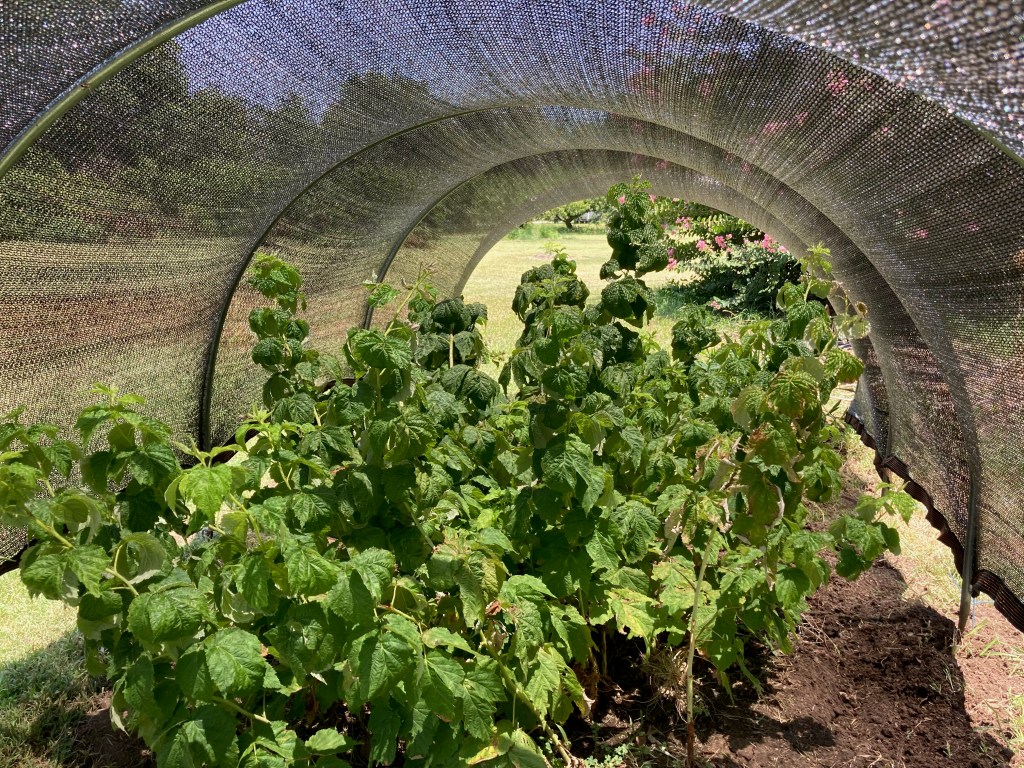
Last thought to consider! This idea does have a big drawback, but I didn’t have a choice. How do you pick the raspberries? Right now, it is really easy to just crawl in and pick but eventually that won’t work. But it is July, and the sun is intense so do what you can when you can!
Growing Raspberries in Texas? Yes, you can!
The rest of this article below was written in Spring of 2022 after a tour of the Fredericksburg facility. I was quite impressed with the idea so knew I had to try my own. Read about the research below:
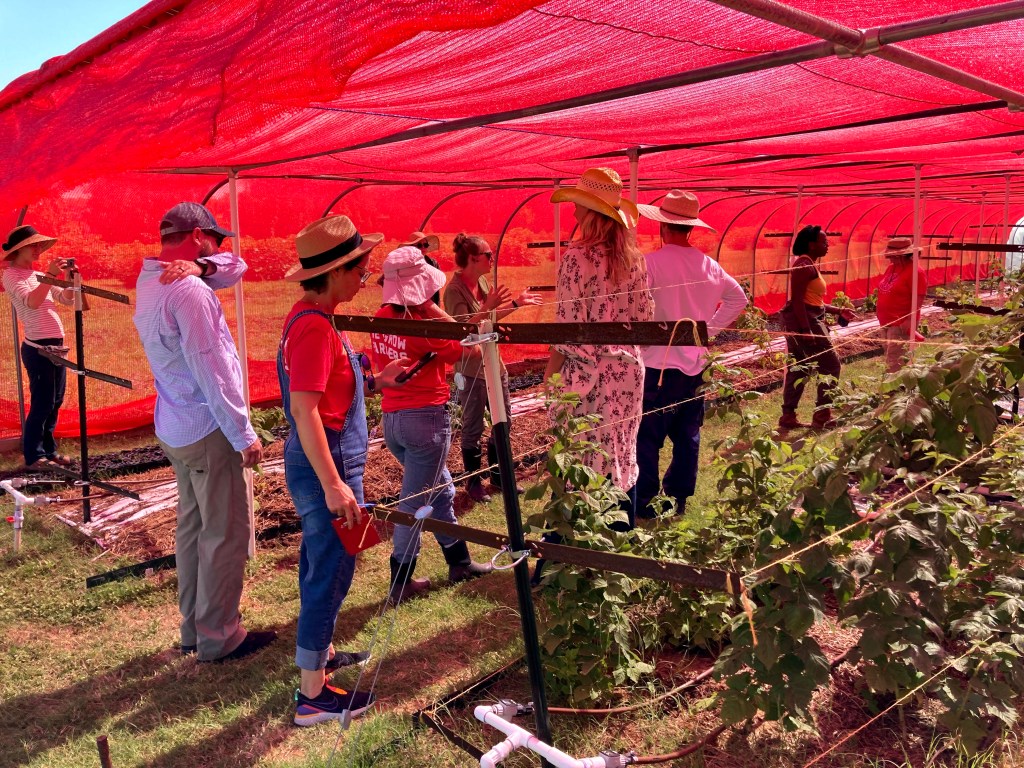
If you have lived in Texas very long you will learn that you can’t grow raspberries here! They struggle with our hot summers, both heat and intense sunlight are tough! I know, I have tried…

That was the way of thinking till Jacy Lewis, Program Manager at the Extension Viticulture and Sustainable Fruit Applied Research Program in Fredericksburg began to experiment with a very different environment for raspberry growing. For the last couple of years, she has looked at many different varieties grown under 3 different colors of shade cloth.
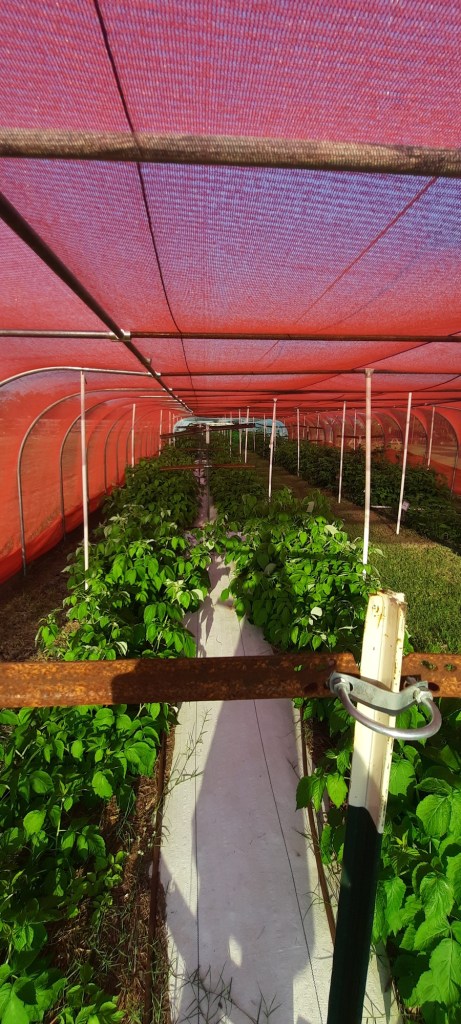
The experiment is continuing but so far, the fruit has outstanding flavor with intense sweetness, yields are good, and the plants are doing very well. Most raspberry plants, Dorman Red is the most recommended, perform very poorly and eventually just die. These plants are doing just the opposite with good fruit set, great limb growth and lots of vigor. The experimental shade cloth colors are red, black and white and so far, the red is looking slightly better, but the experiment is far from over.
Organic growers pay attention! There are very little disease or insect issues growing raspberries and they love organic fertilizers. The organic market for raspberries is $3 for conventional 6-ounce packages and $5 for organic 6-ounce packages. My sources say they can sell all the organic they can get!
Great Article on Growing Raspberries in Tunnels in North Carolina
Just click the picture to read it!

Breaking Berry Boundaries by Simon Gonzalez
Discover more from Texas A&M AgriLife Organic
Subscribe to get the latest posts sent to your email.

 Texas A&M AgriLife Organic
Did the plants survive the intense heat and drought in summer of 2022?
LikeLike
sorry to be late to reply but yes. They are doing well
LikeLike
does this include black raspberries?
LikeLike
Yes! They did. As of this date, 2024 most plants have survived the intense heat and droughts of 2022 and 2023, though new plantings in those years did struggle.
LikeLike
To answer Dennis’s question regarding black raspberry. The short answer is no. Unfortunately, we have not trialed black raspberry and there are a number of reasons why. First, black raspberry is not just a different color but is actually a different species than red or gold raspberry. To put it more simply, black raspberry is a hybrid of the typical red raspberry and a wild black raspberry. This gives it some unique traits, one is that it is commonly accepted that it is less tolerant to high heat and light, another important one for commercial and some home producers is that black raspberry can harbor virus’s that can be deadly for blackberry while remaining asymptomatic in the black raspberry. Finally, we are focusing on primocane production for raspberries in Texas and I am not aware of a primocane producing black raspberry.
With all of that said, if you really want some I would not discourage you from experimenting with a few plants. I have had some contact with a few home growers in the northern parts of the state who have had some success in growing black raspberry on a small scale. So it may be worth a try. Just remember if you grow blackberries as well, take care that they are separated by at least 500 ft, and for commercial operations where the stakes are high, I would not suggest trying to comingle these two operations at all.
Hope this helps!
LikeLike
Where in Texas do you live, are you using a red shade cloth and what is the growing season? Also, if you are using a color shade cloth, where do you buy them?
LikeLike
Alexxander, my office is in Stephenville at the Texas A&M AgriLife Research and Extension Center, and I live nearby. Jacy is doing her shade cloth studies at the Texas A&M Research and Extension Center in Fredericksburg. Raspberries are perennials but they fruit in the summer. We grow the raspberries year-round under the red shade cloth, but the shade cloth becomes important in the heat and sun of summer. A quick internet search for shade cloth and you will find many, many companies that sell them in a variety of colors depending on size, shade %, and overall quality.
LikeLike
Thanks for this info, Bob. Any advice on % coverage to try or recommended varieties other than Dormer red?
LikeLike
Jewel and Red Amit raspberry plants , without any recomendations of shade cloths selling in Texas, is there any research done on it lately?
LikeLike
Ann, you would need to check with Jacy Lewis who is doing the research. Her email is jacy.lewis@ag.tamu.edu. Bob
LikeLike
Ann, this research is continuing and is now being replicated in Lubbock, and San Marcos with proposals to fund additional trials in progress.
LikeLike
I would love to grow raspberries here in the Texas Hill Country, right outside of Austin. I have many varieties of blueberries, and they have produced well early on.
Do you recommend a specific type of red shade cloth? Would it work well with blueberries , blackberries, elderberry, as well as a few vegetables I am growing bear by? If so, could you please refer to where I can acquire a good quality cloth?
I appreciate any advice or feedback. Thanks!
JW Andrew
LikeLike
You might email Jacy Lewis directly. She has been working on this project and has information you will find useful. jacy.lewis@ag.tamu.edu
LikeLike
What variety of raspberries are the best for Texas? I live in Houston and would like to try growing them.
LikeLike
Anna,
That is a difficult question to answer. I’d like to start by saying that there likely is no “best” raspberry to grow in all parts of Texas. It is likely very dependent on local conditions. I have no experience with growing raspberries that far south, but luckily, I am currently in the process of trying to put a trial in down south, so hopefully I can have better information for you in the near future.
For now, I would say given the challenges of your area, I would go with something very vigorous like Joan J. or Himbo Top. These are both vigorous varieties but in different ways. Joan J. spreads prolifically while Himbo Top tends to put on very long and strong canes yearly while staying a little more compact with regard to spread. Both have excellent fruit quality in my experience. I would never recommend anyone grow a variety that didn’t. The important part, regardless of variety is to be certain the plants get adequate shade and protection from drying winds. In Houston, that will be less of a challenge for you.
Best of luck,
LikeLike