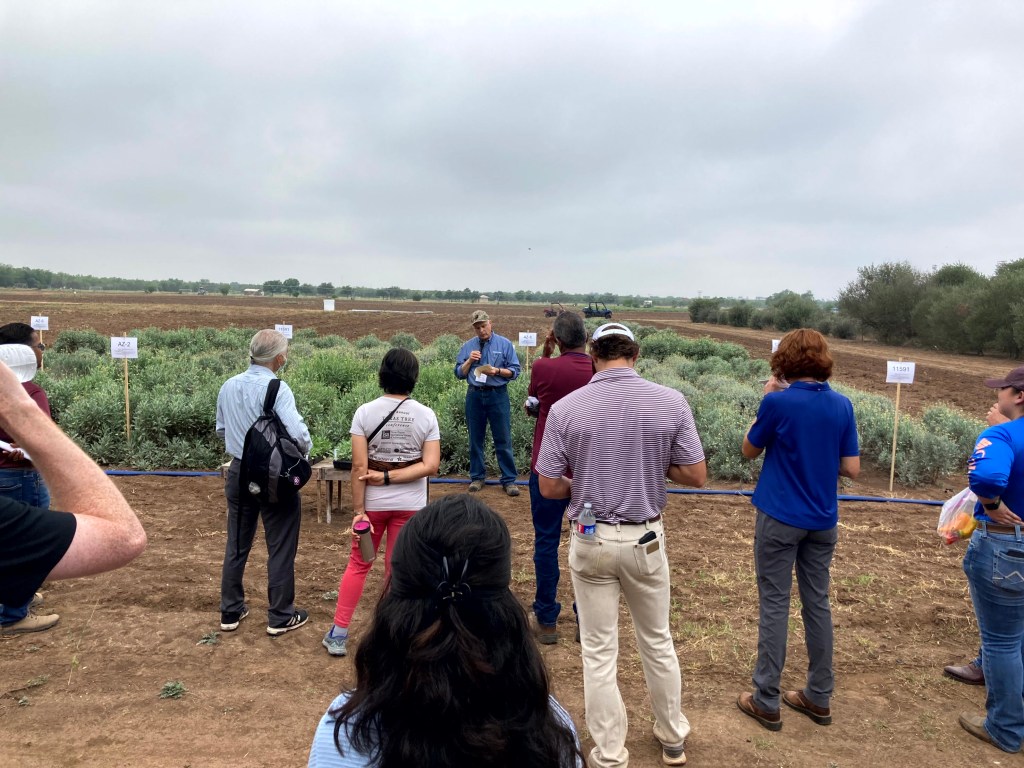
On May 2, 2024, I had the privilege of attending and speaking at the Texas A&M AgriLife Research and Extension Center in Uvalde – Vegetable Spring Field Day. The field day featured a morning walking tour of all the research going on at the center and one of the stops was extremely interesting and informative especially since it covered an area of agriculture I had never heard about. Del Craig with Bridgestone Company (maker of many brands of tires) was on hand to talk about their continued research into a plant called “Guayule,” and it was a fascinating introduction!
Guayule is a shrub native to the southwestern United States and northern Mexico. The correct spelling is Parthenium argentatum, and it’s indeed a source of natural rubber. Guayule is particularly interesting because it offers an alternative to the traditional rubber source, the Hevea brasiliensis tree, which is grown primarily in Southeast Asia.
Characteristics of Guayule
- Habitat: Guayule thrives in semi-arid climates, making it well-suited for regions where few other economic crops can grow.
- Appearance: It’s a woody perennial that can reach up to 3 feet in height. It has a silver-gray appearance due to its hairy leaves, which help minimize water loss.
- Rubber Production: Unlike the rubber tree, guayule produces rubber biopolymers in its bark and roots rather than in its sap. This rubber is harvested by grinding the whole plant and using a solvent-extraction process. Del Craig explained that the whole plant is harvested like you would harvest hay and then taken to processing.
Environmental and Economic Benefits
- Sustainability: Since guayule grows in semi-arid regions, it requires less water than traditional rubber crops, making it an environmentally friendly alternative.
- Hypoallergenic Properties: The rubber from guayule does not contain the proteins responsible for latex allergies, making it safe for use in medical supplies like gloves and catheters.
- Economic Potential: It offers economic benefits for arid and semi-arid regions, providing a viable crop option that can support local economies without the extensive use of irrigation.
Research and Applications
- Research is ongoing into optimizing the cultivation and processing of guayule for rubber extraction. This includes genetic breeding for traits such as increased rubber yield and disease resistance.
- Current applications of guayule rubber include tires, medical products, and even consumer goods like footwear and adhesives.
- The Uvalde Center has been a good test site but Del explained on the tour that they are also establishing a project in the Rio Grande Valley and at the Lubbock Research and Extension Center. These multiple sites allow for lots of experimentation on varieties in different eco-zones.
Could it grow in the South Plains?
In the pursuit for sustainable agricultural solutions in regions like the South Plains of Texas with limited water resources, guayule could be a great alternative to consider. Native to arid environments and native to Texas, this drought-resistant shrub is ideally suited to the South Plains of Texas, where traditional water-intensive crops struggle. Mr. Craig told me personally that they are looking into the possibility of the Plains to Brownfield to Seminole area being ideal for production.
One of the most compelling attributes of guayule is its water efficiency. This plant thrives in semi-arid climates, utilizing very deep root systems that tap into lower soil moisture levels and leaves adapted to minimize water loss. These features allow guayule to sustain itself and produce economically valuable rubber with minimal irrigation, aligning perfectly with the water conservation needs of the South Plains.
Moreover, guayule is adaptable to various soil types, increasing its viability across different landscapes within the region. Its introduction could diversify agricultural practices, reduce economic risks from crop failures, and provide farmers with a new revenue stream through the production of biodegradable rubber products.
The environmental benefits of cultivating guayule are also noteworthy. By stabilizing soil and reducing erosion on marginal lands, it enhances soil health and supports the local ecosystem. Del Craig also commented that they have looked at the carbon sequestration ability of the plant and its deep and extensive root system makes it a winner. To fully integrate guayule into the South Plains, initiatives such as pilot projects to tailor cultivation techniques, local agronomic support, and the establishment of processing facilities are essential.
Resources
- The potential of guayule for commercial rubber production in the southwest
- UArizona engineers lead $70M project to turn desert shrub into rubber
- “Plant to Produce Rubber” Grown in Arid Zones – Guayule; Development of a new source of natural rubber
- University of Arizona Extension Page on Guayule
- University of Arizona Extension Budget for Guayule
Discover more from Texas A&M AgriLife Organic
Subscribe to get the latest posts sent to your email.

 Texas A&M AgriLife Organic