
There are all kinds of ways and amounts to fertilize melons and each of you has their own “special mix” that works just right for you. Even though each producer does it differently there is some interesting information about amounts based on growth that might be useful. Dr. Don Maynard, University of Florida edited the Watermelon Production Guide for Florida for years and in it he listed a fertigation schedule for a seeded and plastic mulched watermelon crop. I am asked occasionally how much nitrogen I should be applying, and the answer is “it depends.” I use the number 120#’s as the total N that you will probably apply in the season minus what you’ve already put out, say 40#’s which leaves 80#’s to apply in 8 weeks or 10#’s per week. This is simple, but it doesn’t consider that sometimes the plants need more nitrogen than at other times. Dr. Maynard includes this schedule which considers the plant’s needs.
This chart assumes that you will apply 120#’s of total N and that 20% or 24 lbs. of N was already put down as a starter N before planting. Assuming it takes 15 weeks from planting a seed to final harvest then you just follow along with each week applying the amount of N recommended per day for seven days then go to the next week. They recommend applying N through the drip each day but not many producers do that so just use the chart to calculate how much N you need and when you need it. He also adds that if you are using transplants then start on week 3 just shortly after you set out the plants.
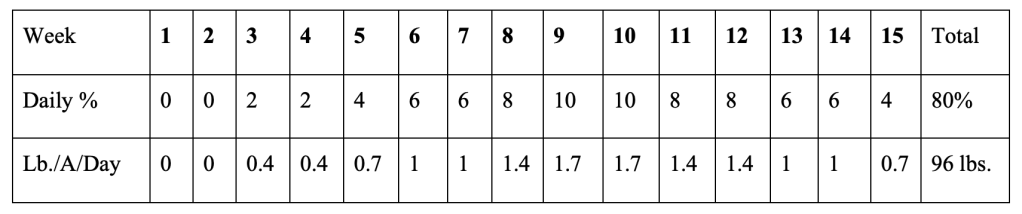
So, what this means is that by week 8 you should have applied 28% of the fertilizer plus the 20% you put down as starter or 48% of the 120#’s. In week 8 you would apply 1.4 lbs. of N per acre per day or 14#’s of liquid 10% (1 gallon is 10.5 lbs.) per acre per day or 98#’s per week which is about 9.33 gallons per week per acre of liquid 10%. Just remember that we are talking pounds of actual nitrogen, but no nitrogen source is pure but is a percentage. Divide the pounds of N needed by the percentage to get amount of fertilizer to apply. 1.4/0.10 = 14#’s. Now an acre is a physical planted acre with plants having about 24 square feet per plant. Reminder: in organic you may want to adjust the schedule earlier, but the principal is that melons need lots of N right before and just after they start sizing melons.
You can see that in weeks 9 and 10 the plants are really using nitrogen and after that the plants begin to concentrate on making fruit instead of plant growth, so nitrogen is used less. Those big plants also have stored nitrogen in the leaves which they can use for maintenance and fruit giving you a safety net. We see the same kind of response in most field crops like corn where we would put most of the nitrogen out before tasseling to insure it is available when the ears are made.
How do you do a fertilizing schedule like this in Organic Production? There are several companies that make fertilizers approved for organic production that can supply lots of somewhat readily available nitrogen. As an example, Nature Safe has a pelleted 11-1-0 for organic production and Ferticell has Active 13-2-2, Ferticell has an Explorer Liquid 10-0-0 and an Explorer 16-0-0. I am sure there are many other companies that sell products like these that will add to your fertilizer needs beyond what you get from using high quality compost.

Always check your soil and your compost for nutrient content before you buy and apply these high nitrogen organic fertilizers. As always, I do recommend you check with your certifier before adding any amendments or soil fertilizers.
- Explorer 16 0 0 – Plant Derived Organic Nitrogen Fertilizer (ferticellusa.com)
- Nitrogen Fertilizer for Organic Farming in Bulk Applications (naturesafe.com)
- Viatrac Fertilizer | The Viable Solution For Your Soil
- Sigma 7-2-1 Bio | American Plant Food
- Back to Nature, Inc. (backtonaturecompost.com)
Discover more from Texas A&M AgriLife Organic
Subscribe to get the latest posts sent to your email.

 Texas A&M AgriLife Organic