
A big thanks to Dr. Holly Davis for writing and sharing the article below. This issue has been mentioned many times and this research helps us use these two biological products in organic peanut farming without worry! Bob Whitney
There have been some concerns about an at-plant, tank mix application of certain biofungicides and Rhizobia inoculants in peanuts. To determine if the biofungicide Bacillus amyloliquefaciens strain D747 (trade name Double Nickel or Convergence™) had any negative impacts on the liquid peanut inoculum Bradyrhizobium sp. (vigna) (trade name Exceed Traditional Liquid for Peanut), Certis Biologicals’ Research and Development team conducted an in-depth study on how these two products interacted in a simulated tank mix.
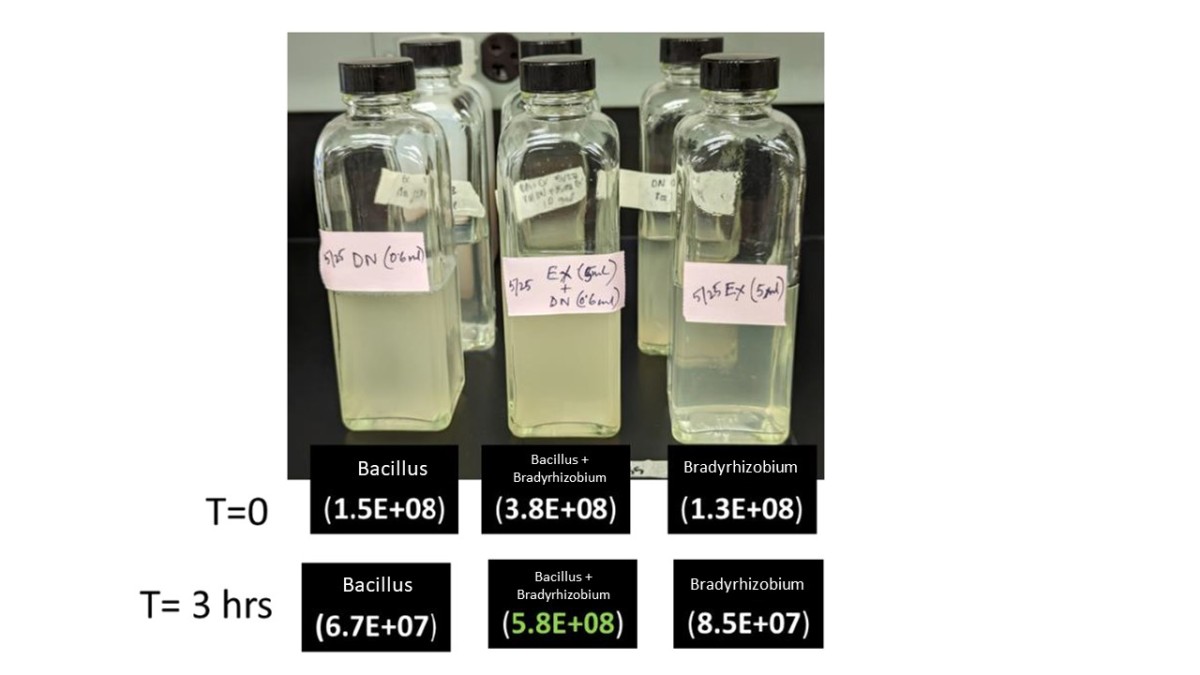
Compatibility was tested by combining the Bacillus at the commercial rate of 8 fl oz per 10 gallons of water with the Bradyrhizobium inoculum at 5X the commercial rate of 15 fl oz per 10 gallons of water. The higher rate of Bradyrhizobium was used because, at the commercial rate, the colony forming unit counts (CFU’s) were very low compared to Bacillus, making the Bradyrhizobium difficult to detect in testing. Mixtures of the two products alone and in combination were incubated at room temperature for 3 hours (Fig. 1). Then, the viability of Bacillus and Bradyrhizobium were measured by counting the number of cells per ml using BactoBox™. If the product samples in combination contained the same log of CFU’s as the controls (unmixed individual samples) over time, then the products were deemed compatible (Figure 1).
Results showed that after 3 hrs., the cell count in Bacillus alone was 6.7×10⁷ cells/ml, and Bradyrhizobium alone was 8.5×10⁷ cells/ml. In a compatible tank mix it would be expected that final counts would be equivalent to adding the cell counts of the individual mixtures together, which would give ~1.5×10⁸ cells/ml. However, the actual mixture showed ~3x that amount giving 5.8×10⁸ cells/ml. This suggests that not only are these two products compatible, but they also grew better together than alone. However, these results did not provide the cell count of Bacillus vs Bradyrhizobium in the tank-mix. Therefore, after 24 hours in a tank mix the flow cytometry power of BactoBox TM was used to distinguish between Bacillus and Bradyrhizobium cells. In Figure 2 you can see two peaks, orange for Bacillus and red for Bradyrhizobium indicating that it was possible to distinguish between the two species.
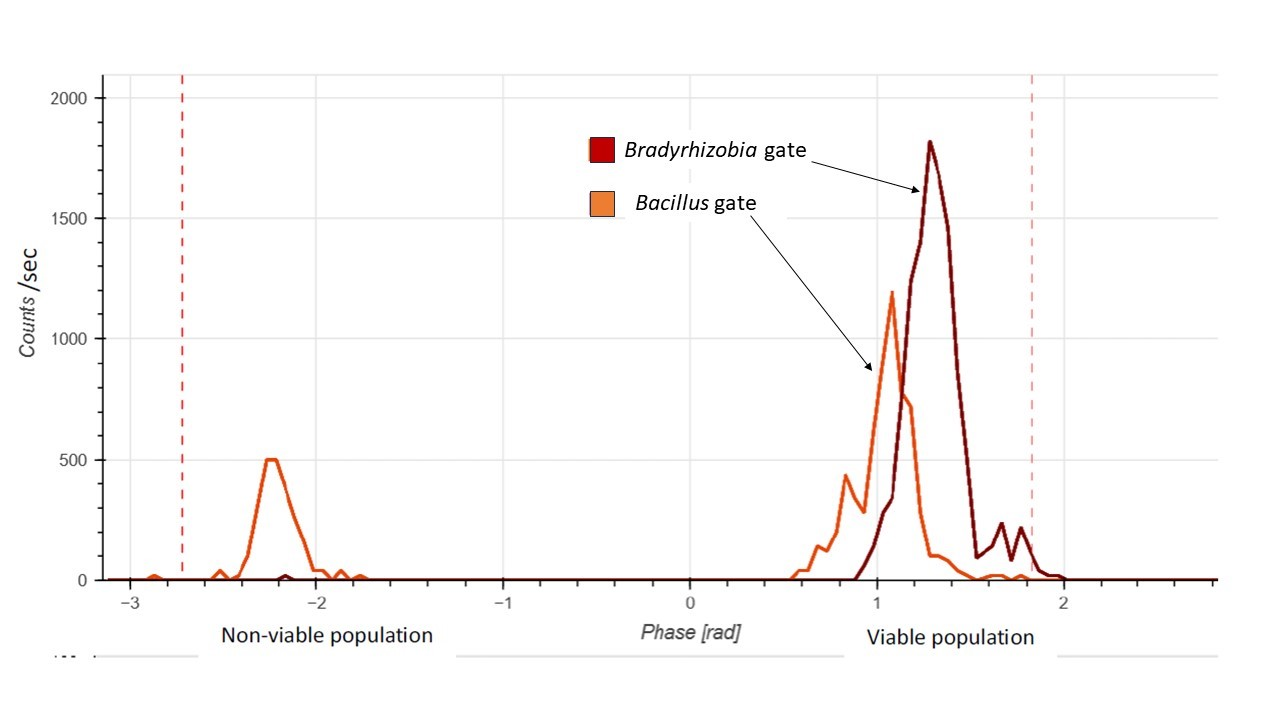
Figure 2. Flow cytometry discerns Bacillus and Bradyrhizobium individually and in mixtures with two peaks of different amplitudes on the y-axis and in different phases on the x-axis.
Using this feature, cell counts were made for the Bacillus (blue) and Bradyrhizobium (orange) at 0 hours and again at 24 hours after being in a mixture (Figure 3). You can see that cell counts were not reduced substantially from 0 to 24 hours for either product.

Results of these two experiments confirm that the biofungicide Bacillus amyloliquefaciens strain D747, Double Nickel or Convergence™, and the liquid peanut inoculum Bradyrhizobium sp. (vigna), Exceed Traditional Liquid for Peanut, are compatible to tank mix and apply at the together as peanut planting gets underway this season!
For more information on Double Nickel, Convergence™ and other Certis Biologicals products, please visit: https://www.certisbio.com/
For more information on Exceed products, please visit: https://www.visjonbiologics.com/
Study conducted and reported by: Dr. Dhritiman Gosh, Manager of R&D, Certis Biologicals and Dr. Shaun Berry, VP of Research and Field Development, Certis Biologicals
Article written by: Dr. Holly Davis, Field Development Manager Certis Biologicals, South Central US
 Texas A&M AgriLife Organic