The Organic Center is great for keeping up with the organic industry and research. They recently highlighted research published in the Journal Nutrients that looked at the ingredients found in both organic and conventional foods. According to the Organic Center this study found that packaged and processed foods with the USDA Organic label contain fewer ingredients that are linked to negative health outcomes than non-organic processed foods. Specifically, organic foods contained fewer ultra-processed ingredients, less sugar and saturated fat, and lower sodium content. The study considered 8,240 organic and 72,205 conventional foods sold in the U.S. from 2019 to 2020. This study is novel because it considers processed foods that many Americans rely on for convenience, and the research focuses on the characteristics and functions of all ingredients in those foods. In contrast, past scientific studies typically compare the difference between nutritional composition or chemical residue occurrence of conventional versus organic foods, and these foods are usually in their raw form (e.g. fruits and veggies). The qualities of the processed organic food in this study are linked to better health outcomes than those found in the non-organic food. To read more from the study click this link.
Recently the Journal Appetite published a great research study to
determine what people perceived about those who ate organic food. In fact, the question was, “When trying to describe someone, people generally use characteristics of that person. For example, if you describe someone who always gets good marks, you might say that this person is smart, serious, and bookish. Now, if we would ask you to describe a 35-year-old woman (vs. man) who very often (vs. very rarely) buys and eats organic food products, which characteristics would you use?“.
There were 23 specific characteristics ranked by study participants about people who frequently eat organic foods. Basically if a person is eating organic food then people think or perceive more positively of that person. Naturally, that person who eats organic food is considered to be more environmentally conscious than someone who eats organic foods only rarely or not at all, but there is an important twist!
The interesting thing is that this person who eats organic food is also seen as more health conscious, more attractive, more in shape, more feminine, less masculine, less inactive, less overweight, sportier, slimmer, and healthier. They were also seen as more educated, intelligent, and wealthier. And, finally they were judged as more considerate, curious, respectful, sensitive, thorough and less lazy. Women who ate organic food frequently were seen as more feminine and less masculine than men. All of these are perceived traits for anyone who eats organic foods, not actual observed traits. What is the saying, “perception is everything?”
What is the takeaway from this study? First, be sure to let people know you are eating organic so they might actually think better of you! Second, we know that eating organic is healthier, but look at all the other wonderful things people could think about you just by eating organic. I think I like the sportier, more intelligent and wealthier – now if they were only true!
I get asked all the time why are we so particular about the word – Organic? Here is a list that I did not write and to be honest do not know where I got it, but it is a good start for protecting the word, brand or label called ORGANIC!
Requirements to Display the USDA Organic Seal—Since 2002, products that display the U.S. Department of Agriculture (USDA) organic seal are certified by the National Organic Standards Board to meet requirements for organic growing, production, handling, storage, and processing practices.
Assurance of Organic Ingredients—The USDA organic seal ensures buyers that the products they purchase contain at least 95% organic ingredients. The remaining 5% can be non-organic ingredients like baking soda, salt, non-synthetic flavors and vitamins and minerals.
Pesticide Testing Program— Farmers must provide a history of every substance applied to their land for the past three years and pass a rigorous pesticide residue testing program. Toxic synthetic pesticides are never allowed in organic production, thus protecting you from harmful exposures.
Animal Health and Welfare— The organic seal verifies that farmers do not use antibiotics or growth hormones, and that they use 100% organic feed and provide animals with access to the outdoors.
Environmental Health—Promotion of ecological balance, conservation of biodiversity and the cycling of resources are key components that producers must adhere to in order to comply with USDA organic certification. Toxic synthetic pesticides, synthetic fertilizers and sewage sludge are not allowed on organic farms.
Avoiding GMOs—Use of GMOs is prohibited in USDA certified organic production. Your best protection against genetically modified ingredients is to buy organic.
External Inspections—30,000 onsite inspections are conducted by certification agents every year to ensure that farmers and producers are in compliance with USDA organic standards.
Third Party Verified—Beginning with seed selection and soil management, an accredited third-party certification agency audits farming, processing, handling, storage, and packaging facilities to ensure compliance with organic seal regulations.
Audit of Third-Party Certifiers—Third party certification agencies are routinely reviewed to be certain that their auditing methods are up-to-date and meet national regulations.
Heavy Penalties for Non-compliance— A fine of up to $11,000 can be imposed on any person who knowingly sells or labels a product organic that is not produced and handled in accordance with the standards set by USDA.
Texas produces numerous organic crops (grains, cotton, oilseeds, vegetables, fruits, and other crops), with organic crop sales from production agriculture totaling $111.6 million in 2019. This production leads to a total statewide economic output of $241.7 million annually, including $129.8 million contribution to gross regional product (value added) and 99.0 million in labor income, and about 4,780 full- and part-time jobs. Labor income is a component of value added, which is part of output, so the figures in Table 1 cannot be summed.
Sales of Texas livestock and poultry totaled $35.5 million in 2019. Organic livestock and poultry production is associated with a total statewide economic output of $75.3 million annually. This total contribution includes $33.8 million contribution to value added, $19.1 million in labor income, and about 820 full- and part-time jobs across the state.
Organically produced livestock products (milk and eggs) contributed an additional $277.1 million in sales, leading to $621.9 million in total output, $213.8 million in value added, $129.5 million in labor income, and about 2,720 full- and part-time jobs across the state.
Total organic sales (crops, livestock and poultry and livestock and poultry products) in the state totaled $424.3 million in 2019. These organic sales supported $938.9 million in output, $377.4 million in value added, $247.6 million in labor income, and about 8,320 full- and part-time jobs across the Texas Economy.
Table 1. Economic Contribution of Organic Production in Texas, 2019
Organic
Sales
Output
Value Added
Labor Income
Employment
Crops
$111,631,000
$241,677,400
$129,791,600
$98,998,500
4,781
Livestock & Poultry
$35,540,000
$75,272,600
$33,751,800
$19,088,200
820
Livestock & Poultry Products
$277,132,000
$621,945,700
$213,833,400
$129,483,600
2,720
Total
$424,303,000
$938,895,700
$377,376,700
$247,570,400
8,322
Indicators included in this analysis include economic output, value-added, labor income, and employment. Economic output is a measure of gross business activity and represents the gross expenditures resulting from direct, indirect, and induced business activity. Value-added is economic output less intermediate purchases from other sectors and represents the industry’s contribution to the state’s gross domestic product (GDP). Labor income includes employee compensation (salary, wages, and benefits) and sole proprietor income. Employment represents the number of full, part-time, and seasonal employees, including sole proprietors.
Bob Whitney, Samuel Zapata, Luis Ribera, Dan Hanselka, and Rebekka Dudensing. Department of Agricultural Economics, Texas A&M AgriLife Extension Service
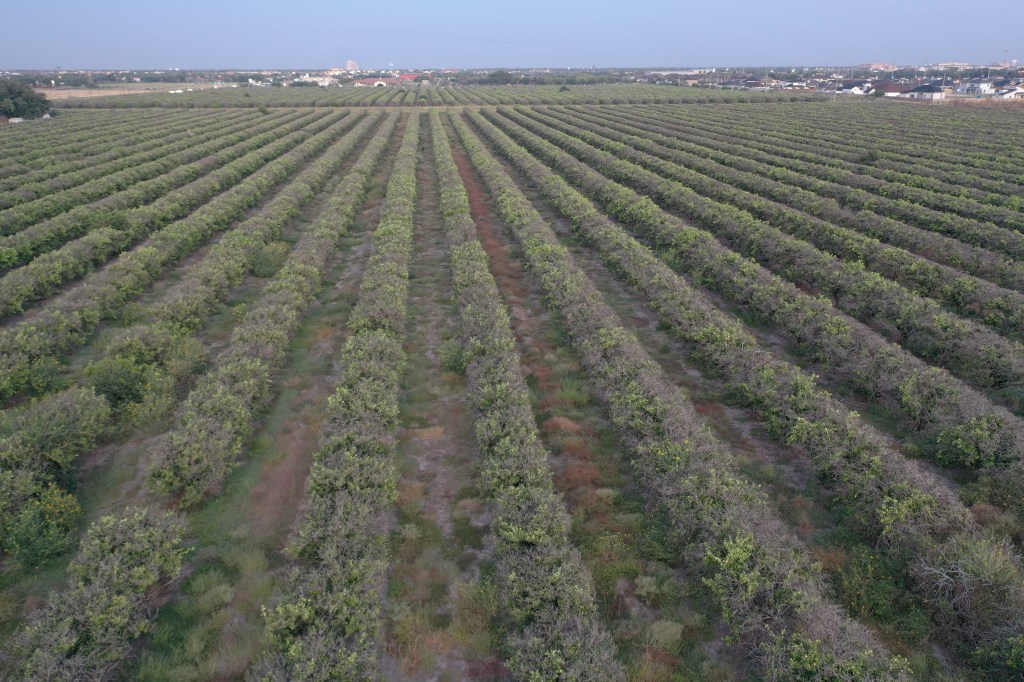
I recently had a chance to visit several organic citrus and vegetable farms in the Rio Grande Valley and the lingering effects of the February freeze are still hard to look at. In this picture above you have a grove that has been all but abandoned. The trees are mostly alive but the massive pruning that needs to happen is just not going to happen anytime soon!
I was impressed by the Holbrook’s (Dennis and Russon) organic groves. They certainly had to prune a lot of dead wood but overall the trees seem to have done better than many other groves I visited. It would be interesting to quantify the difference in the care between the two systems (organic vs conventional) and see if the visual difference is due to organic production or something else. In the Holbrook’s case they will stay organic no matter what!
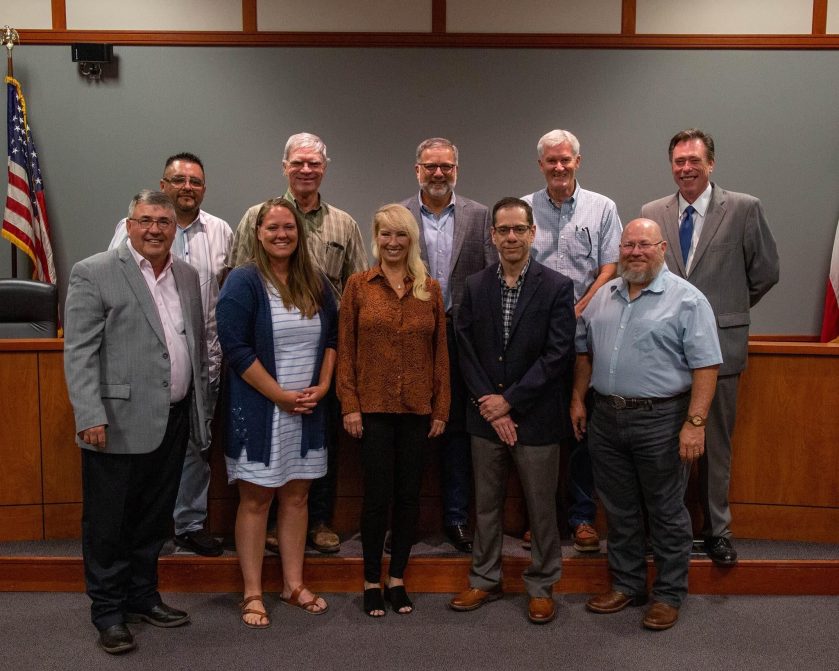
On August 23, 2021 the Texas Department of Agriculture Organic Industry Advisory Board met in Austin at the TDA building on Congress Avenue. This is the first time in over a year that the group has been able to meet in-person and discuss organics in Texas. I was privileged to have a chance to present information about my position as organic specialist with AgriLife Extension and talk about organic agriculture in Texas.
This picture shows front row left to right, Dr. Randy Harp – Higher Ed., Brandi Chandler – TDA Coordinator for Organic Certification, Victoria Velarde – Producer, Robert Morton – HEB, Scott Sroufe – TDA Marketing Specialist. Back row, Tony Sanchez – Rice Belt Warehouse, Cliff Bingham – Producer, Donald De Jong – Producer and Chairman, Bob Whitney – Extension Organic Specialist and Dan Hunter – Assistant Commissioner for TDA.
Not pictured: Juan Anciso – Extension Horticulture Specialist, Randy Brazil – Producer, Greg Devillier – Processor, Amy Griffith – Public, Jed Murray – Trade Associations, Russon Holbrook – Retail.