Blog Posts

Top Ten Strategies for Survival with Forage

Kleingrass Pasture

Dr. Larry Redmon was the featured speaker at a Livestock Forage Seminar a few years back when we were having another one of our periodic droughts!  Dr. Redmon is an Extension Forage Specialist and has been for many years.  Basically, he has lots of experience meaning he has about seen it all!!   Certainly Dr. Redmon has been through a number of droughts and even though this one now is severe, basically there is always one thing you can count on in a drought – forage is scarce.  Knowing this Dr. Redmon shared his Top Ten List with the group, and it works now…

Number one – Have a plan.  I visit with lots of livestock producers and still I am amazed at how few have any idea what to do.  Even if raising livestock is not a full-time occupation still it is important to know where you are going. 

Number two – soil test to know what you have.  With the very high cost of fertilizers (organic or conventional), it is important to know what you have in the soil and what you might need to buy.  A soil test costs $15 and will probably save you hundreds.

Number three – practice good weed and insect control.  I am a real believer in weed control since every pound of weeds controlled means at least one pound of extra grass and many times 3 or 4 pounds. Organic growers must use their cattle to mob graze weeds early and do it often.  The insects to control are grasshoppers and armyworms.  Both are not hard to control if caught early which means you should be walking your pastures often.  We have several organic sprays that work well.

Number four – consider alternative fertilizers.  It may not be feasible for all producers, but some may have access to poultry litter, cattle manure, even biosolids.  These can be less expensive but only if shipping and application doesn’t cost too much. (Organic growers understand this but also consider supplementing your manure with beneficial microbes to stimulate natural nitrogen cycling.)

Number five – consider forage legumes in grazing pastures.  This is a long shot since legumes do well here some years and others they don’t even come up.  Legumes can do well when we get fall rains but  in years like this, we never see them grow. 

Number six – evaluate your stocking rate!!  This is the most important part of drought management.  A livestock producers best friend is the stock trailer in a drought but unfortunately no one wants to sell a single animal believing instead that they can make it.  Ideally no range or pasture should be stocked above 70% of its capacity always leaving forage for years like this.  Instead, livestock producers think the good years are the ones that determine stocking rate when in fact we live in Texas where droughts are more common than rain.  What causes overstocking?  Larger cattle, weeds and brush taking over pastures, not fertilizing, not selling!

Number seven – purchase hay rather than produce it.  Unless you have lots of hay pastures you cannot justify owning hay equipment.

Number eight – analyze your hay for nutritive content.  Sometimes producers overestimate their hay quality and animal performance suffers but definitely you can save on supplements if your hay is higher in quality.

Number nine – consider stockpiling forage for winter feeding.  This is not a new concept, but I do believe one that has been forgotten.  Basically, you take a pasture that has been grazed short and close the gate by September 1st.   Fertilize it like you are growing hay and don’t turn the cattle in till you are ready to start feeding hay.  This standing forage is high in nutrition and certainly cheaper than baled hay.

Number ten – consider your forage base.  This last one has to do with considering native grasses versus bermudagrasses that need to be fertilized.  Dr. Redmon took the group through a few scenarios based on commonly accepted stocking rates for bermudagrass and native pastures.  It does take more acres per animal unit for native pastures, but you save on the cost of fertilizer.  For example, if you have 300 acres and it takes 12 acres per animal unit for native and 5 for bermudagrass then you have 25 cows on the native and 60 cows on the bermudagrass.  If both have an average weaning percentage of 90% then you have 23 calves produced on the native and 54 on the bermudagrass.  At $1,000 per calf that is $23,000 income on the native and $54,000 on the bermudagrass – quite a difference!    Now subtract $400 per cow per year for maintenance costs or $10,000 on the native and $24,000 on the bermudagrass leaving $13,000 for the native and $30,000 for the bermudagrass.  Now let’s subtract the $100 per acre for the fertilizer cost (organic or conventional are about the same this year).  $0 for the native and $30,000 for the bermudagrass pasture leaving $13,000 income for the native and, you guessed it, $0 for the bermudagrass!  If you don’t like these numbers just change them but it will be hard to beat the native grass.  Why? Natives are adapted to produce more on less and at a higher nutritional level.

Number eleven? Maybe this is just an addendum instead of an actual number 11! It applies to those who are trying to figure out what grasses to use and I thought it was appropriate to add it.  Dr. Redmon has said this at many of his forage programs and it is even more important with high input prices.  “A point could also be made regarding the use of other introduced forages that require little to no fertilizer under grazing. Examples are Bahiagrass east of IH 35/45; Kleingrass, WW-BDahl Old World bluestem, one of the lovegrasses (weeping, Wilman), others? Just a thought…” 

In Central Texas we have consistently seeded Kleingrass, Wilman, and WW-BDahl mixes with outstanding results. It takes a few years to establish but the cattle seem to love it and the fertilizer costs make it well worth it!

Fruit Tree Problems Now

I think we can blame the drought for causing another problem, terrible insect pressure especially on our fruit trees. Most if not all fruit trees have made it through the winter, and most have survived the drought, if you watered. They have made it through freezes, and most are in bloom or have very small fruit, no small miracle for Texas fruit production! Now after making it through all these weather problems we have to add insects to the list!


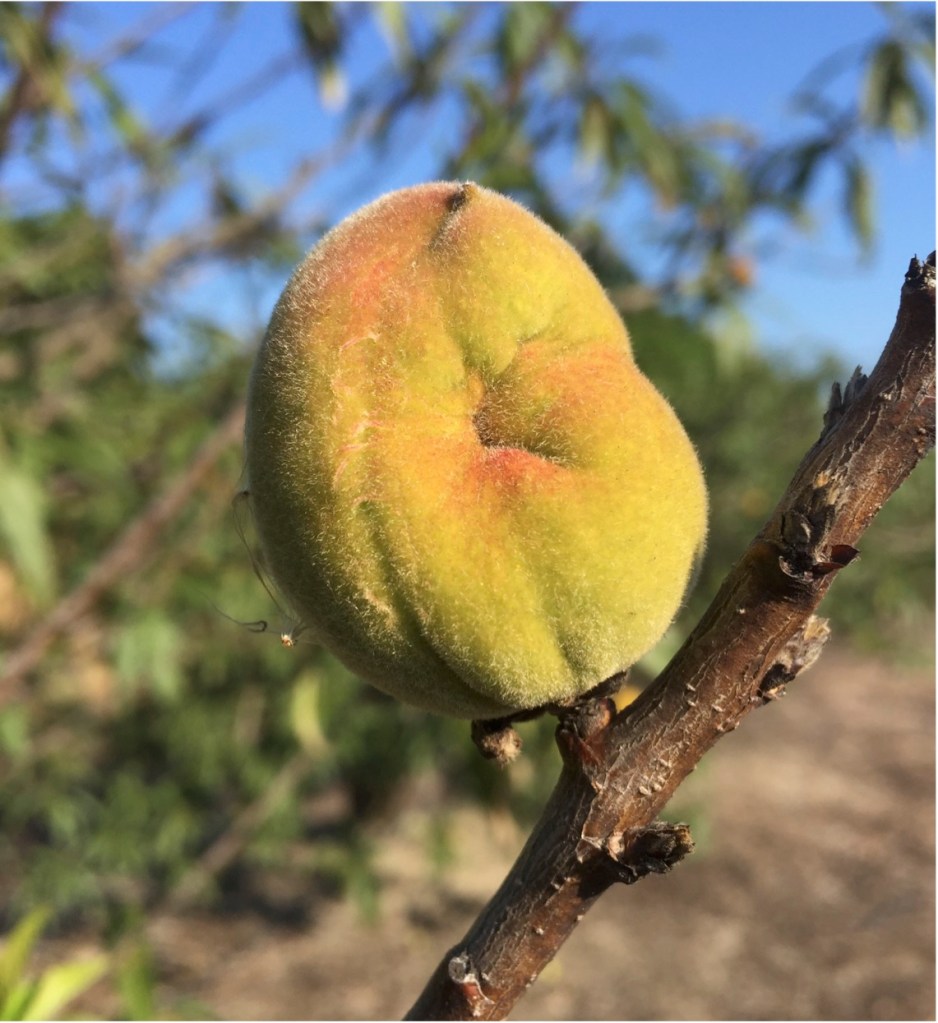
Both the brown stink bug and the green stink bug overwinter in grassy areas and under brush or wood. They wait for warm weather to come out and begin looking for energy sources to replace lost body reserves and the plant of choice is fruit. The brown stink bug causes the fruit to deform, and the green stink bug causes the fruit to exude a resin or gummy mess that can accumulate on the fruit especially on peaches. Both insects have long snouts that they use to pierce the skin and suck out juices. In the case of the green stink bug this resin attracts wasps and bees so that they get the blame instead of the stink bug. Stink bugs are hard to control especially since they have piercing/sucking mouthparts.

Organic growers have a few choices including some plant oils, but effectiveness is not good many times.  Grandevo and PFR-97 have plant bugs on the label, but I have never seen them in action and a product I know will take care of plant bugs (stink bugs) is Venerate.  Also, there is Pyganic, but it is a last resort even if it is organic!
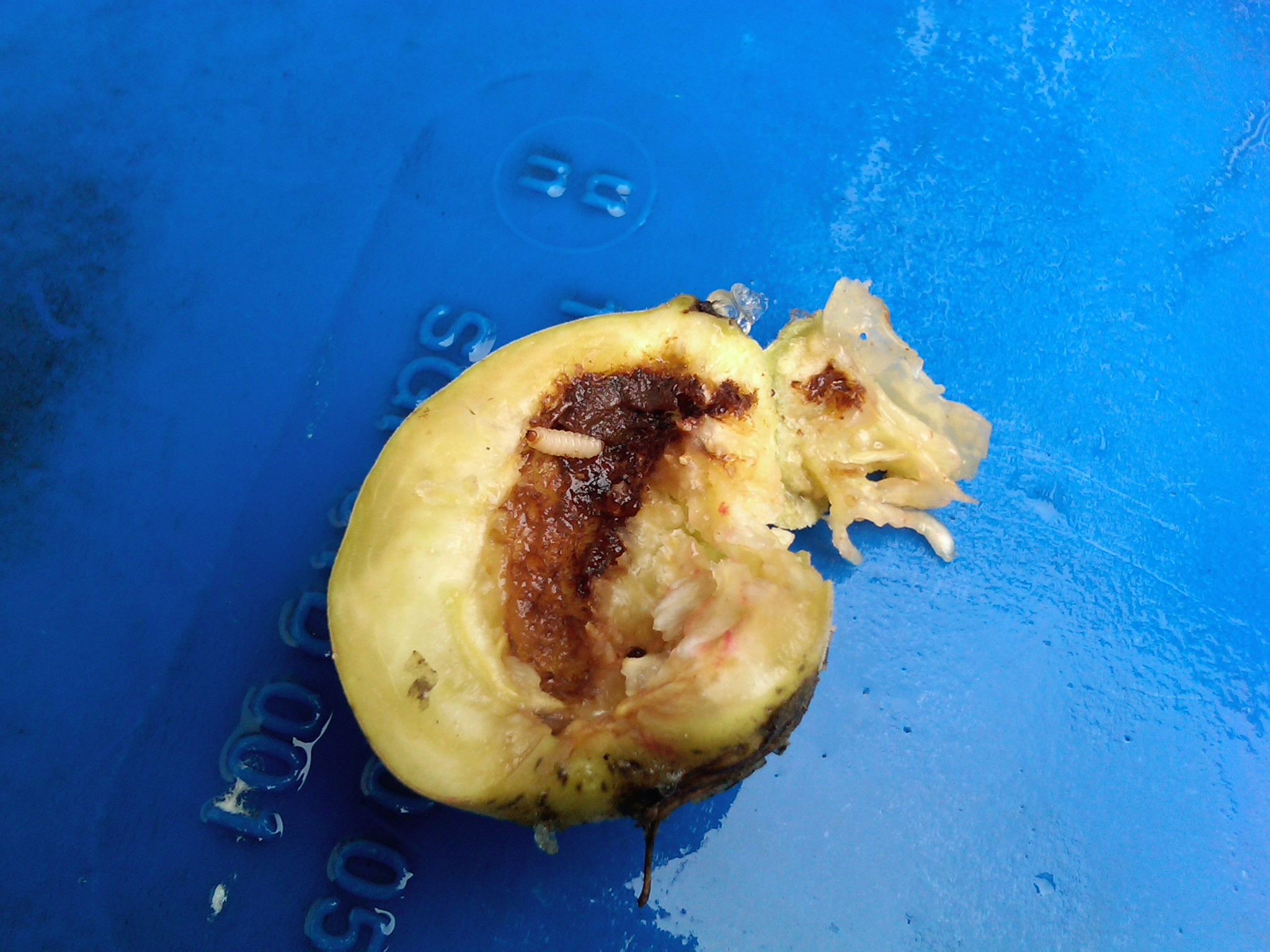
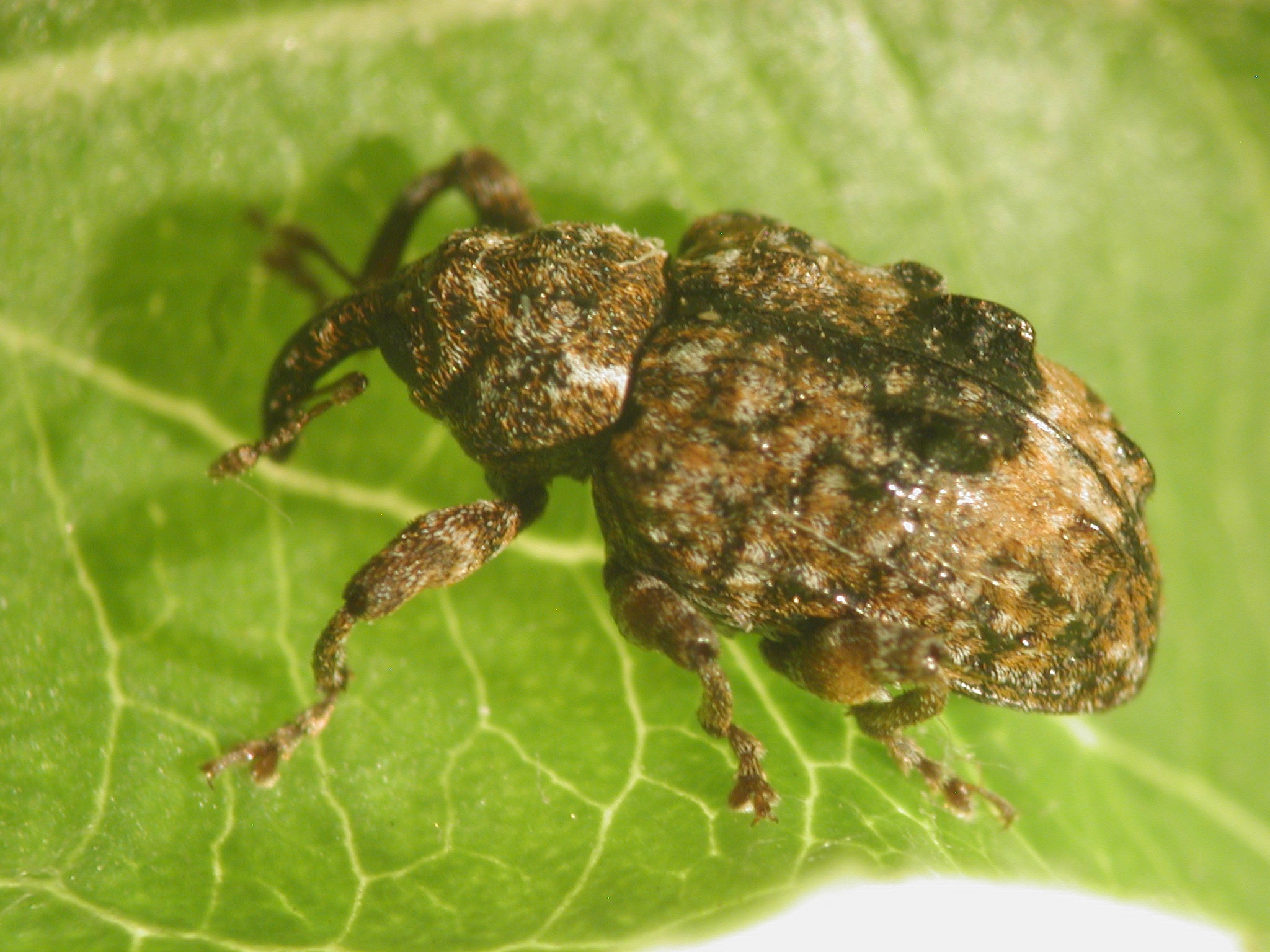
There is one major peach insect that everyone wants to get rid of, the Plum Curculio. This small worm or grub feeds inside the peach mostly near the seed and can cause anyone who has found one a real heartache. This worm or larva is laid by an adult snout beetle, similar in looks to the oak, pecan, or cotton weevil. This adult overwinters in the soil at the base of the fruit tree and comes out early with the plums and moves to peaches as plums mature early. The adult female will chew a small hole in the fruit skin and lay eggs just under the surface. The eggs hatch into small larva that feed in the fruit for 2 to 4 weeks and of course this is what causes the problems.


To control this insect spray must be made from shuck split (about the time the fruit is formed) and for two applications at two-week intervals and then 30 days before fruit harvest. This last spray is probably the most important since the eggs laid hatch out and the larva are still in the fruit at harvest. Recommended organic sprays include BoteGHA, Mycotrol or Botanigard MAXX all with Beauveria bassiana bacteria, Grandevo with Chromobacterum subtsugae, Venerate with the Burkholderia spp., Surround which is a kaolin clay product, and Pyganic. There is no insecticide to treat the soil with but keeping old fruit off the ground helps prevent next year’s problems. It might be interesting to see if a biological on the soil would help take out the overwintering adults, and if you do and it works let me know.
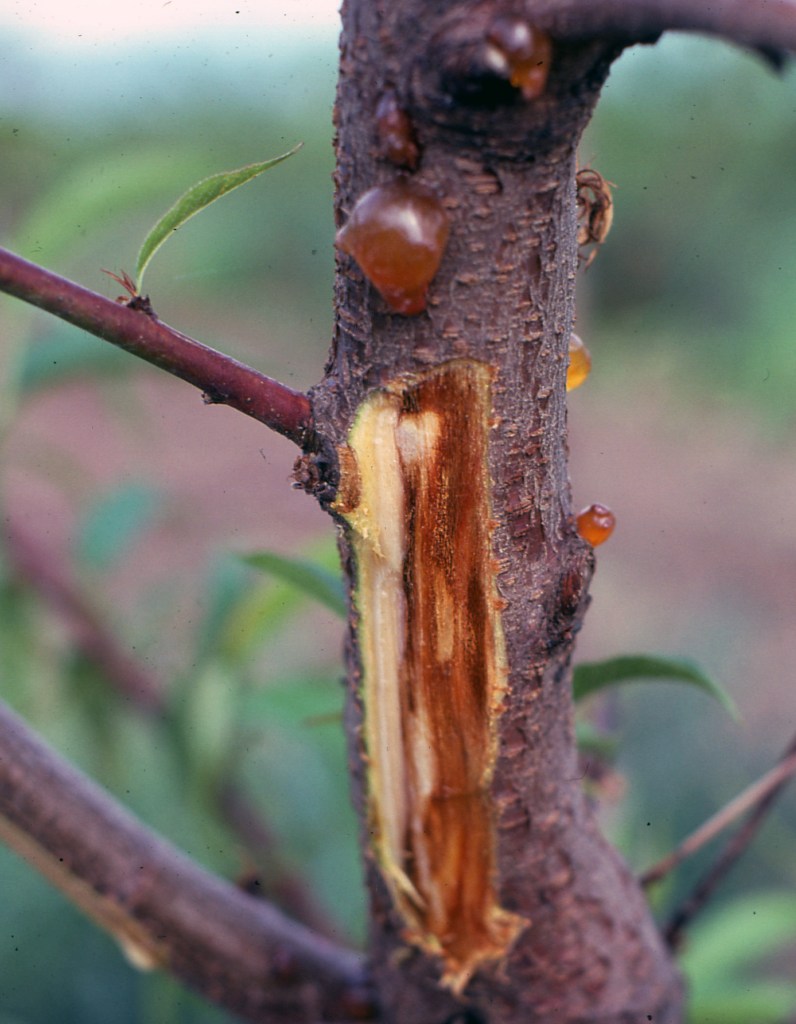
Another problem some homeowners have complained about is the gummy mess coming out of fruit tree limbs. This gum or resin is caused by a bacterial canker that has infected the limb. This canker develops in the fall and as the trees break dormancy in the spring, gum is formed by the infection and can break through the bark and flow down the tree limb. Stress in trees is the main culprit and treatments are not effective. Keep damaged wood trimmed out and supply water and nutrients to promote tree health.
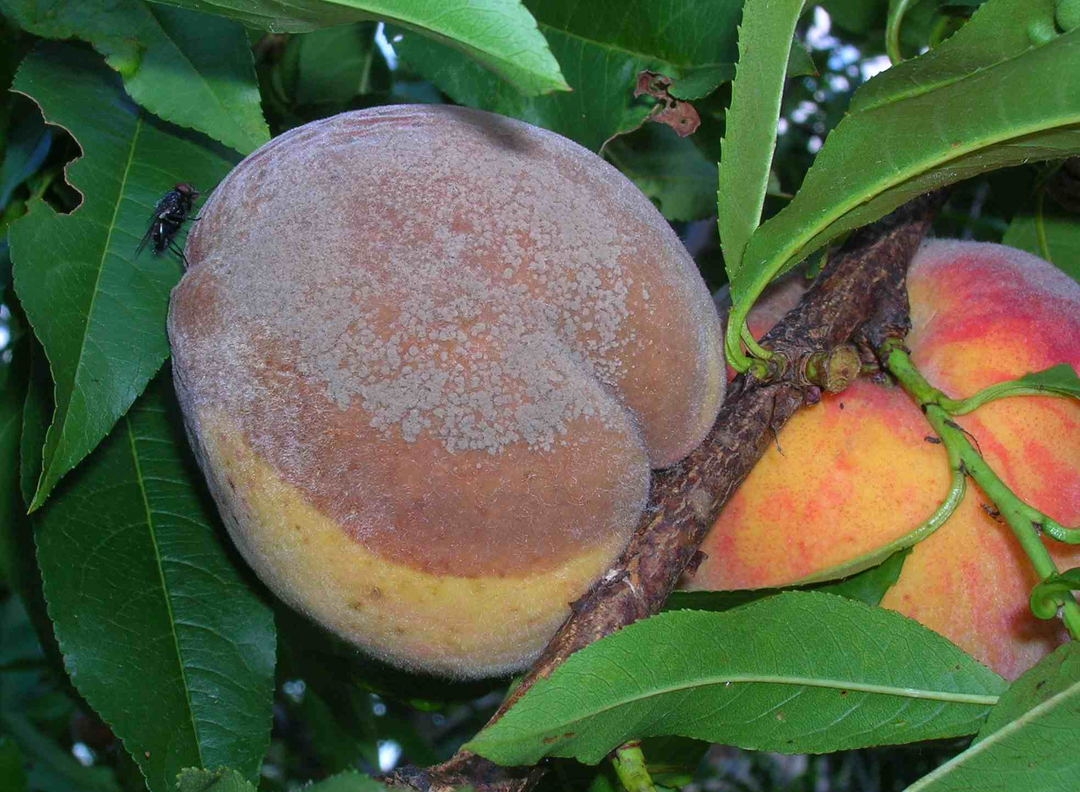
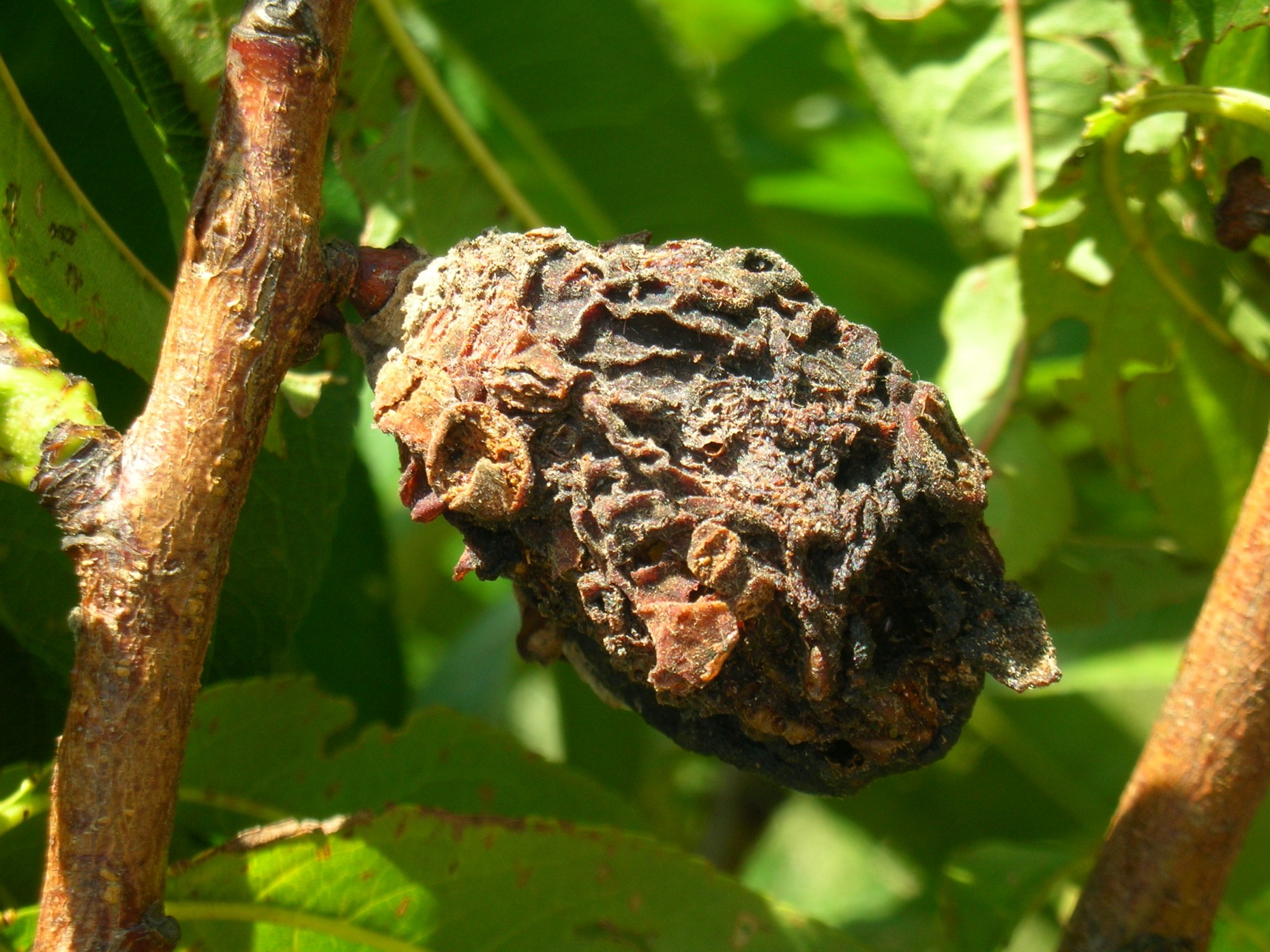
Last, there is the ever-present issue of Brown Rot.  This disease is caused by four species of Monilinia with the predominant species being M. fructicola and M. laxa. Brown rot fungus has the ability to attack blossoms, fruit, spurs (flower- and fruit-bearing twigs), and small branches under favorable conditions in the spring. Disease severity is dependent upon environmental conditions. Blossom blight can be expected in humid, rainy weather with mild daytime temperatures (68°F–77°F; 20°C–25°C) and cool nights. Mature fruit rot occurs at high temperatures in conjunction with high humidity. Under the right conditions, the entire tree’s crop can be completely rotted.

Organic controls include Bacillus amyloliquefaciens sold by several companies, Polyoxin D zinc salt (OSO, sold by Certis), Botector/Blossom Protect (SAN Agrow), several copper products and possibly others not I have not seen or tested.  Again, I am open to hearing about your organic control for this disease or any others in fruit crops!
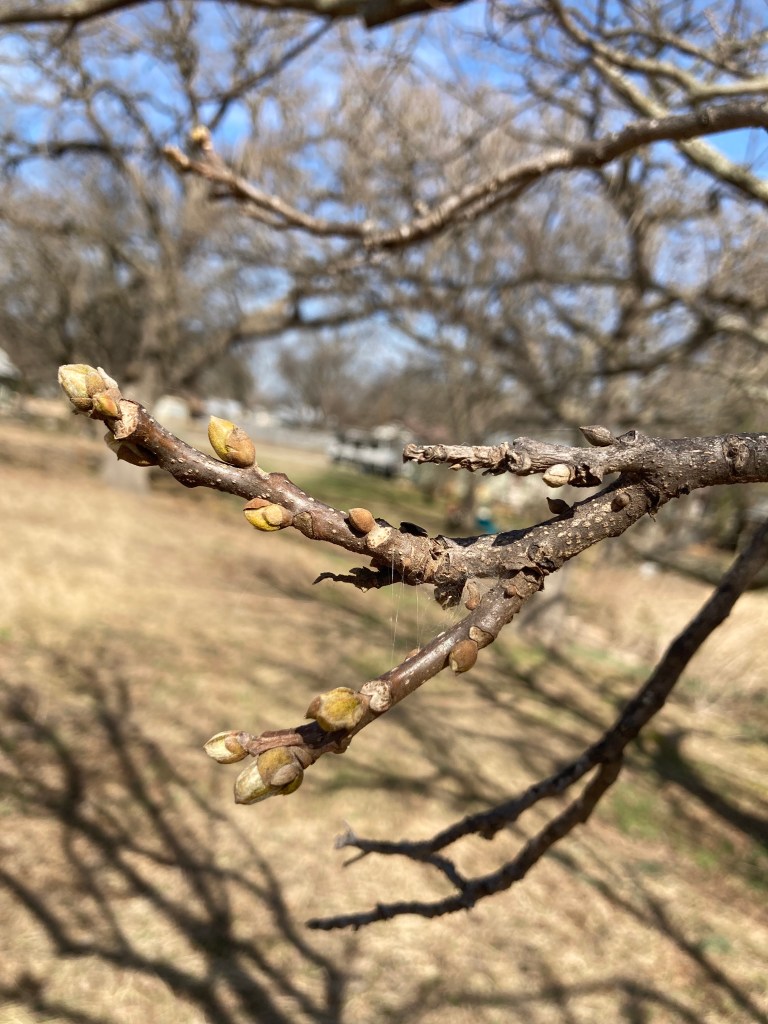
Pecan budbreak is here

I am fortunate to live in Central Texas pretty much in the middle of a huge pecan area containing both native and improved orchards. I don’t have to walk far to see pecan trees or keep an eye on their progress. I usually put out pecan nut casebearer traps and monitor them for growers and I also check regularly to make sure growers are producing the best quality pecan possible. In other words, I eat all the pecans I can!

As you can tell from the photo, we are about to enter pecan budbreak. You can see the old bud cap is breaking off as the bud swells and with the unseasonably warm weather the leaf buds are unfolding. It won’t be many days before we enter the “parachute stage” where the tiny leaves form a small looking parachute. Also, in this explosion of growth, there will be nutlets, catkins and more!

The reason for the post is to remind growers that budbreak is the beginning of the crop year and because of that it is also the beginning of crop problems. We have been extremely dry and so pecan scab is not on anybody’s mind, but it is not hard to find scab spores on the tree branches. Here is a picture from Dr. Bill Reid’s blog on Northern Pecans and you can see the lesions on this northern pecan variety called Hirschi. I did see lesions on branches in what I call orchard “hot spots” for pecan scab on Wichita and Kiowa varieties.

The question then becomes what can I spray in an organic or regenerative pecan program? Actually, the product list is longer than you might think. Some work done in 2018 points to organic fungicides with Reynoutria sachalinensis (Regalia, Marrone Bio) as having the best control of the tested products. The test in 2018 did not include organic fungicides with Bacillus mycoides isolate J (Lifegard, Certis Bio) which showed a good level of control in testing done in 2008.

The two products just mentioned had some research done specifically in pecans, but many other products can be mentioned because of their effectiveness with other diseases similar to pecan scab or their relationship to the two biologicals mentioned. They include Double Nickel, Cueva, Aviv, Taegro, Timorex Gold, Stargus, Serifel, Sil-MATRIX and probably more than I can find! Basically, there are products, they can be mixed if needed, but the main issue is getting a product out in a timely manner. Remember, always check with your organic certifier before making any applications!

Organic Project Grants

It has been a while since I wrote a blog post, but I have a good excuse – Maybe! I really try to post something every week or at most every other week so that I make myself stay up to date on organic topics and keep you up to date on organic topics. The first of March we got word from USDA that they had posted the “Request for Funds Application” for the Organic Research and Extension Initiative or OREI and they were due by March 31, 2022. This meant a hard month of coordination, collaboration and grant writing but it’s almost over!

These grants are from the National Institute of Food and Agriculture or NIFA and they can be substantial and if funded, can mean years of good organic agriculture work for both researchers, extension and our organic growers.

Texas A&M AgriLife Research and Extension has been fortunate to receive funds from these grants in the past and we certainly want to keep helping the organic producers and the organic program in Texas. These grants help researchers look at the important problems facing organic producers and then develop the tools producers need to overcome those problems and stay profitable. Currently, having high quality, disease and insect resistant, water and nutrient efficient, organic varieties to plant is the major issue facing organic producers. This means our grant applications are mainly focused on variety breeding and the issues that surround bringing organic varieties to the market.

There are a lot of researchers and extension specialists in the Texas A&M AgriLife system, and I don’t know them all, but I do know four teams that have been working hard over the last few weeks to develop these OREI proposals.

Dr. John Cason is a peanut breeder at the Texas A&M Center in Stephenville where I am privileged to be located as well. Dr. Cason has a great organic peanut project called, “Addressing the Challenges of Organic Peanut Production with Conservation Management Strategies and Breeding.” I am just one of several who are involved in this proposal which includes a team of 10 scientists and extension specialists working together.

Dr. Waltram Ravelombola is an organic crop breeder at the Texas A&M Center in Vernon and in a fairly new research position for organic growers. His project is working on cowpeas, a crop that we use for cover, soil health improvement, animal feed and as a great human food crop. His OREI project is, “Evaluation and breeding of short duration and stress resilient cowpea varieties suitable for organic cropping systems in the southern USA.” Cowpea (we call them blackeyed peas) reaches across all cultures in Texas and is harvest commercially while also being a farmers market favorite.

Dr. Shyamal Talukder is a rice breeder at the Texas A&M Beaumont Rice Research Center. He also is a new researcher but has a real passion for helping Texas improver overall rice breeding efforts with a special emphasis in organic rice. His project proposal is, “Development of effective phenotypic selection criteria, molecular markers, and varieties for organic rice systems.” I am privileged to be part of a 6-person organic rice team that will be working to develop and test rice varieties developed specifically for organic systems. We are especially concerned with fertility, weed control and ratooning potential.

Dr. Genhua Niu is a horticulture researcher at the Texas A&M Center in Dallas and is very interested in the organic vegetable industry in Texas. She has worked on transplant media for several years and has developed a proposal entitled, “Enhancing the transplant quality – a bottleneck in the sustainable production of organic vegetables.” This project has a great team of seven researchers and extension specialists and will have research projects scattered from West Texas to the Rio Grande Valley to Central Texas. Should be fun!

Now that they are all about to be submitted to USDA, the hard part starts – waiting to see if they get funded! Wouldn’t it be great for Texas organic producers and handlers if they were all funded? We sure hope so….

Do We Need Organic Variety Breeding Programs?

Texas A&M AgriLife Peanut Breeding

Yes!  That was easy.

Many plant breeders and seed companies are hesitant to grow and sell organic varieties – as you know there is a lot of paperwork!  Also, even if the organic variety is superior there is the concern that conventional growers won’t buy or even look at a great variety with an organic label.  But there is a growing body of evidence that we need to be looking at varieties from below the ground first before looking at the above ground yields.

            What am I talking about?  Well according to many sources but in particular an article in Trends in Plant Science, “Breeding crop varieties with the target of improving soil health and reducing soil degradation will produce better conditions for crop growth through more efficient resource use and stress tolerance, so a win-win is possible where both yield and soil are improved and could be the cornerstone of regenerative agriculture.”

            “By targeting soil structure building traits (in plant breeding), abiotic (environmental) stress resistance of both plants and soils could increase through microbial habitat formation to improve nutrient cycling, stabilization of soil against erosion, and a greater capacity of soil to absorb, store and drain water,  … but these processes are generally ignored in plant breeding, where the primary focus is yield.”

            In other words, the scientific ability to monitor and measure what roots are actually doing is teaching us how important they are to “naturally” living and interacting with soil and all the microbiome in soil.

            “Perhaps plant breeding exacerbated soil degradation by focusing on yield and resource capture in conventionally fertilized soils.  Fertilizers (conventional) decrease the benefit of root-soil interface plant traits such as exudates and root hairs to capture nutrients (the normal, natural process) making those exudates and root hairs expendable.”

            This article, like many others, gets very technical and in-depth, but the premise is we need to look at what a variety is doing below ground as well as above ground.  In organic systems, plants must be able to interact with the soil microbiome in the root rhizosphere to take in nutrients, protect itself, and be more water efficient.  So, YES, we need organic breeding programs producing highly efficient, high yielding organic varieties!

Planting Quality Seed

Photo by Southeast AgNet Radio

Dr. Justin Tuggle did a great job at the Organic Cotton/Peanut Seminar discussing peanut seed quality.  He showed some great pictures of peanut seed with the seed coat removed showing the damage underneath. His point, which is 100% right, is that this damage is causing the germination problems in peanut fields and this damage is mostly caused by harvest equipment.  

I was in a “webinar” recently and part of the discussion was damaged cotton seed as well.  Some observations have shown that upwards of 30% of the seed in a bag is damaged in some way.  In some cases, the damage was up to 50%.  The seed may germinate but it is evident that the vigor is diminished.  This was in a conventional seed bag with seed treatments!

Corn seed can have just as many problems but again seed treatments can make a difference and do.  I have seen lots of estimates but in cold soils damaged corn seed in the bag can lower overall germination 20% to as much as 50%.

This issue is difficult to solve but realizing some of the causes is a big first step.