Last Friday, September 30, I had an opportunity to speak at the Future of Urban Food Systems Summit held at the University of Houston Downtown campus. This was not my usual audience and really not my normal program topic, but it was really interesting, engaging and informative. What a wonderful group of people and many if not most, were young – much younger than me!
My topic was organic agriculture, but the title was Certified Organic: What is it and what is its value? I talked a lot about the Texas organic program including a lot of the information contained in the blogs you can read on this website. I think most of the audience were surprised at how easy it is to be certified and how many myths they had heard and believed about the organic program. The City of Houston has very few certified organic farmers and has the least organic handlers of all Texas major cities. Maybe they are about to turn that around!
On the program with me was Dr. Joe Novak, Faculty Lecturer at Rice University and before that of Texas A&M University. Joe is well known and well respected for his horticulture knowledge but more importantly for his use of gardening to improve human health. He did a fantastic job showing us all the important roles gardening and plants play in helping us all live and live better.
Also on the program was Dr. Patrick Stover, Professor of Biochemistry and Biophysics and Director of the Institute for Advancing Health through Agriculture. I have known Dr. Stover for several years and his passion for using agriculture to solve health issues in humans is fascinating. I believe he had the audience on the edge of their seats!
The day included breakout sessions and lots of discussions. To say the least it is just a start to what will be coming over the next few months and years in Houston!
This peanut seedling disease trial was established to simply evaluate organic seed/soil treatments at plant for any sign that they might prevent a complex of seedling diseases that affect peanut seed germination. Typically, a conventional grower has a chemical seed treatment to prevent disease, but organic growers have had very few options and so it is not unusual to be forced to replant. At $1.30 per lb. and most peanut farmers planting over 100#’s per acre, cost add up quickly!
This growing season has had strange weather and because of that the test was planted later than wanted. Both air and soil temperatures jumped significantly in May meaning we needed to irrigate before planting – which created its own set of problems. It was hoped we could put these seeds into cold, wet soils to simulate a West Texas April/early May planting but sometimes things don’t work even in the best planning. Even though it wasn’t ideal we saw a few differences that will help us to adjust what we do in the future for more testing. Listed below are the treatments and rates for the products tested. #7 and #10 serve as checks, #7 is bare seed and #10 is conventionally treated seed with Dynasty, Syngenta Co.
Plots were 2 rows X 25’ with 100 seed planted per row or 4 seed per 1’ of row. There were 4 replications of each plot, randomized. Planting date was May 20, 2022, into a previous irrigated site. 0.75 inches rain fell on May 23 and plots were sufficiently moist for good germination. Peanut seed ‘crack’ was observed on May 26.
Trt. #
Company
Product
Trt.
Per acre
1
Ecological Laboratories
Quantum-EXP 1
IF
64 oz/ac
2
Summit Agro
AVIV
Seed
10-30 oz/100-gallon water. Soak and dry
3
Summit Agro
AVIV
IF
10-30 oz/100-gallon water.
4
Certis Bio
Double Nickel
IF
Double Nickel LC @ 8 fl oz/acre
5
Certis Bio
Double Nickel
IF
Double Nickel LC @ 16 fl oz/acre
6
American Plant Food
Sigma 5-3-2 Bio
PPI
1000 lbs./ac
7
NA
Untreated Check
NA
NA
8
Corteva
Bexfond
IF
14 oz/ac
9
Valent
EndoPrime (EndoMaxx is organic of EndoPrime but not available at treatment)
IF
2oz/Ac
10
NA
Treated seed check
NA
NA
Looking at the results, there is no statistically significant difference in any of the treatments, but trends indicate some differences especially above the untreated check #7. Overall, we want to improve both germination percentage and stand establishment with organic product treatments. Seed germination counts were done on May 31 and no further germination occurred. Ratings of growth were done on June 3, 6, 9 and 13. Rating scale was 1 – 4 with a 1 being best. Organic treatments 1, 2, and 4 were all rated above the untreated check #7. This gives us a possibility of further testing to see if they continue to show an advantage.
Over the last few weeks, I have had the opportunity to be a part of conferences for “urban” audiences interested in urban agriculture in particular organic urban agriculture. There is a lot of interest in what agriculture really is, and terms like “natural,” “sustainable,” “regenerative,” and even “organic” can be confusing. Most consumers love labels but unfortunately labels begin to lose any meaning unless you define them and yes, enforce them!
Urban agriculture has many definitions and many parts. USDA defines it as,” cultivation, processing and distribution of agricultural products in urban and suburban areas.” Even this definition can be further defined because cultivation has many different aspects; agricultural products include a multitude of things from vegetables to dairy to fish to meat, and urban and suburban are rarely well defined and can mean the 2.5 million population of Houston, Texas or the urban center of DeLeon, Texas where 2.5 thousand live!
These problems with definitions still don’t deny that our population needs and wants local food and local food security no matter if it is small town or large city. And this desire is fueling a resurgence of everything from backyard gardening to large scale organic rooftop agriculture atop the newest Whole Foods retail store. All are woven together into a sense of “community supported agriculture” which has a history of being “urban agriculture” for decades.
According to Wikipedia’s definition, “Urban agriculture can reflect varying levels of economic and social development. It may be a social movement for sustainable communities, where organic growers, “foodies”, and “locavores” form social networks founded on a shared ethos of nature and community holism. These networks can evolve when receiving formal institutional support, becoming integrated into local town planning as a “transition town” movement for sustainable urban development. For others, food security, nutrition, and income generation are key motivations for the practice. In both scenarios, more direct access to fresh vegetables, fruits, and meat products through urban agriculture can improve food security and food safety.”
What does urban agriculture look like? Again, according to USDA, “Community gardens, rooftop farms, hydroponic, aeroponic, and aquaponic facilities, and vertical production are all examples of urban agriculture.” Certainly, there are backyard gardens, market gardens, and the small farm patches scattered around superhighways, streets, and buildings. Every open piece is real estate is being discovered, evaluated, rehabilitated, and put into production much like the English allotment system so popular in Great Britain.
Increasingly (maybe because of climate extremes), urban agriculture is now becoming Controlled Environmental Agriculture or CEA and these urban/suburban operations include low tunnels, high tunnels, shade houses, climate-controlled greenhouses, and indoor farming in warehouses, shipping containers, or even basements. Many are certifying organic, and some are not.
The demand by the urban/suburban consumer for both involvement in their own food production and knowledge about the food they purchase and consume, is driving the need for new and innovative research and education. Never before has there been such an interest in urban agriculture with an equally intense interest in the science of agriculture and food.
Even though a low percentage of the 30.93 million Texans consume very many fruits and vegetables there is still a considerable number who garden and a huge number that frequent farmers markets. The National Farmers Market Directory lists 282 local farmers markets in Texas and the Texas Department of Agriculture shows hundreds of registered farmers markets on their Go Texan website. Most of the Texas’ markets are located in the 5 largest urban areas and attendance at each is growing by double digits year over year.
Organic certification in Texas urban/suburban areas continues to increase with a significant increase in CEA (controlled environment agriculture) applications and organic certifications. Leading the way are operations involved in greens production including microgreens, lettuces, and spinach. Texas population is growing faster than the supply of local fruits and vegetable, faster than potential growers can be trained and faster than research can solve the production problems faced by both small- and large-scale urban growers.
Finally, here is the takeaway! The explosive population growth of Texas is creating a huge demand for Texas Food and for most of these consumers Organic is their preferred “label.” Certified organic growers or even growers contemplating organic certification – NOW is your opportunity….
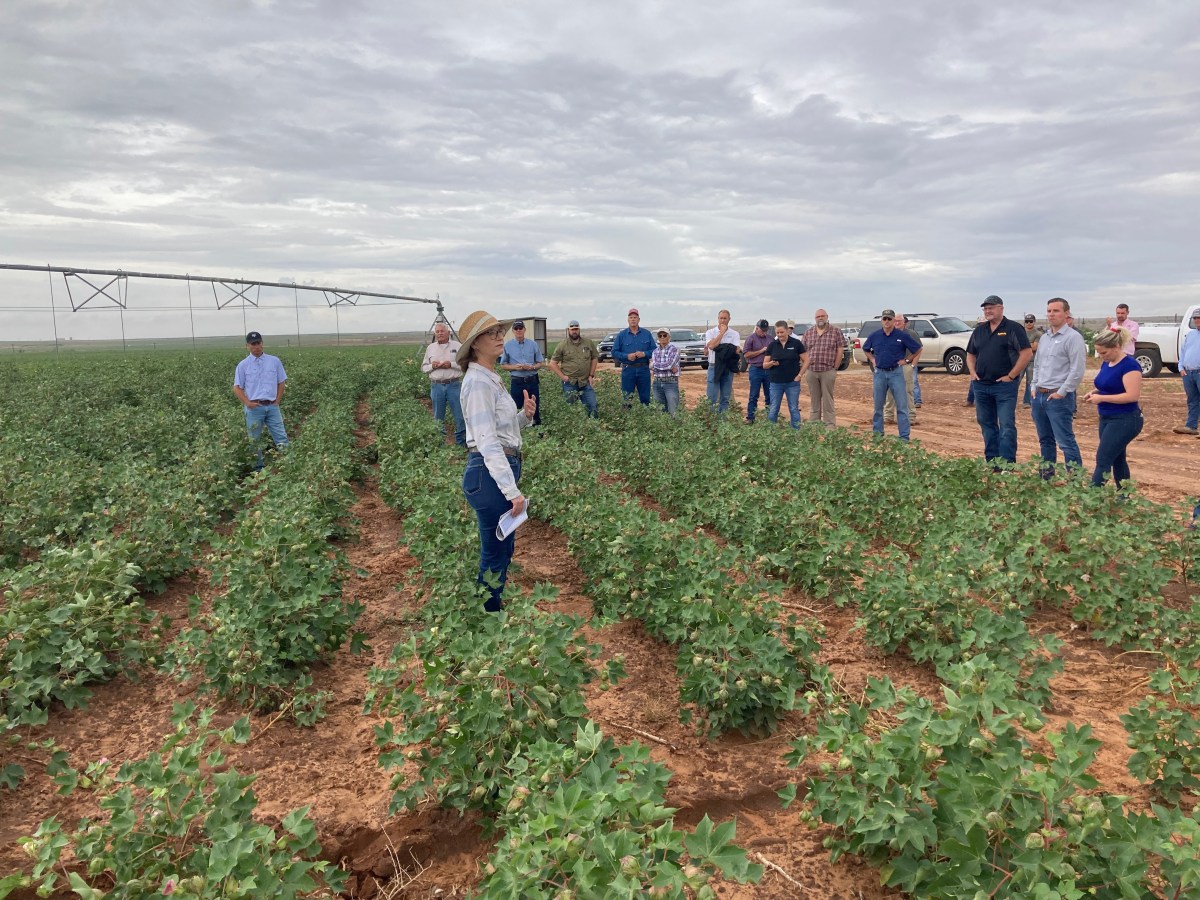
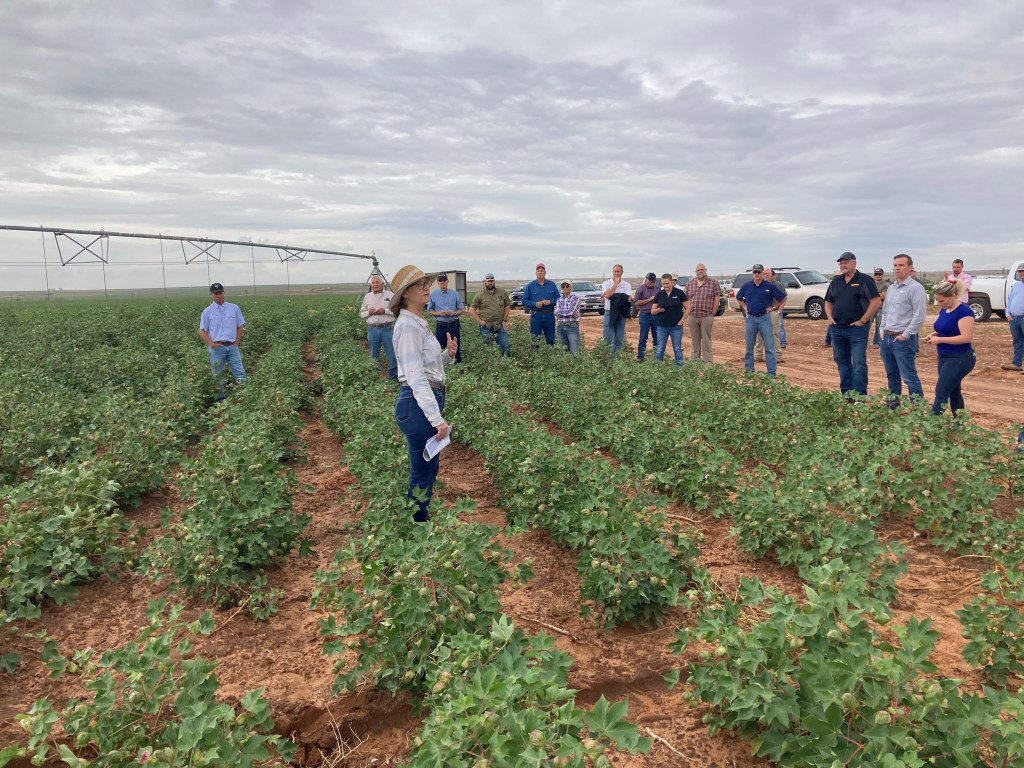
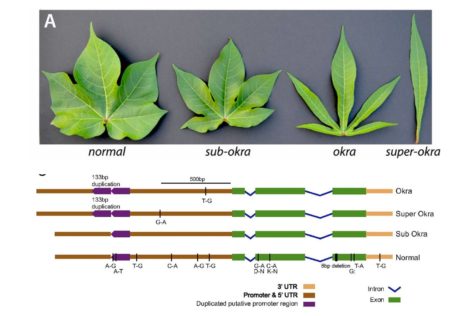
On the recent Organic Cotton and Peanut Tour in Seminole, Dr. Jane Dever presented an outstanding talk or “discussion” about developing cotton varieties for organic producers. Dr. Dever is the Cotton Breeder for Texas A&M AgriLife Research at Lubbock, and we depend on her work for new cotton varieties in this region. Dr. Dever talked about the challenges for developing cotton without genetically modified traits (GMO) since the South Plains is home to the largest “cotton patch” in the world. In order to prevent cross pollination, there must be plenty of separation from cotton with and without traits and that can be hard to do. She discussed how she is using the “okra leaf” characteristic, which is dominate in cotton, to distinguish non “GMO” cotton from GMO varieties. The picture below shows you how different the okra leaf characteristic is from normal cotton leaves. This characteristic will help breeders, seed companies and organic cotton growers know if a variety has GMO traits – it won’t have an Okra Shaped Leaf!!
Source: Plantae, American Society of Plant Biologists
Dr. Dever talked about her current cotton breeding work at the AG CARES facility, just north of Lamesa, with varieties that have potential to work well in organic systems. The poster below shows the variety test plot located at AG CARES. Just click on that image or photo and you can see a bigger picture with more of the details and a closer view of the QR code for directions. (If you know how to use your phone camera to scan QR codes!!)
On the back of the 2022 Demonstration Handout, Dr. Dever gave a great listing of previous cotton trials and all the data for each including yield, % turnout, and more. Click here to download that information!
I have opportunities to talk to lots of groups about organic agriculture and organic food. In the presentations I talk about organic handler certification and to be honest most folks have never even thought about what an “organic handler” is or does.
The vast majority of organic commodities pass through the hands of at least one middleman, also called a handler, on the way from the farmer to the consumer. Certified organic handlers are certified to handle organic products in accordance with National Organic Standards. Organic handlers perform numerous functions, including packing and shipping, manufacturing and processing, and brokering, wholesaling, or distributing. I basically say that once a farmer sells an organic product (meat, dairy, grain, vegetables, etc.) to anyone except a consumer the buyer must be a certified handler. I like to say that organic is from the farm to the grocery shopper and that is pretty much true. Once an organic product is packaged then anyone can sell that package with an organic label but until that time it must be “handled” by certified handlers.
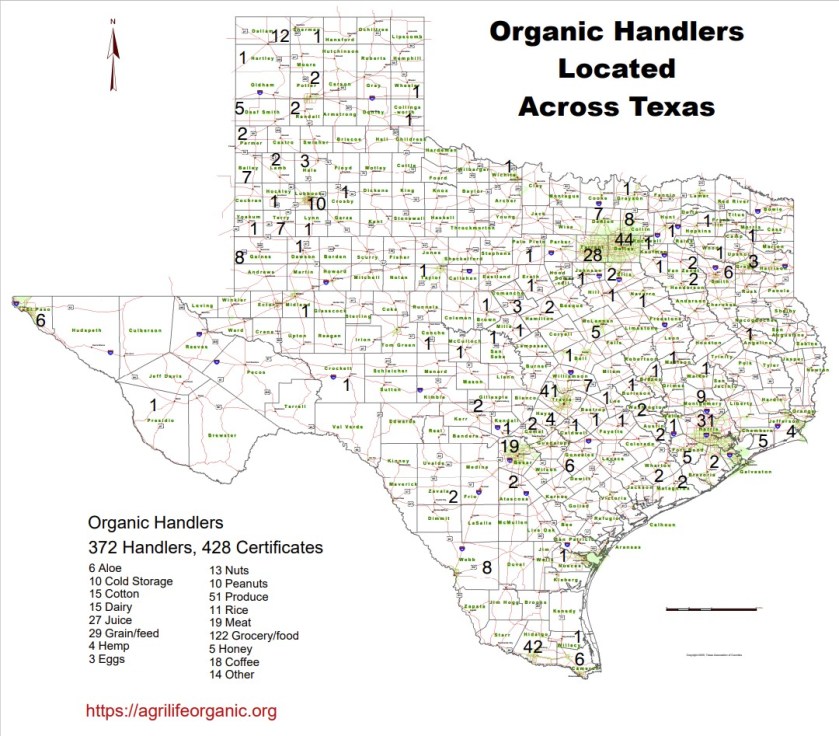
So, what does this mean in Texas? Currently we have 428 certifications issued to handler operations. Of this total there are about 372 different companies that operate as handlers. What I mean is that a company like HEB may have 20 stores with an organic handler certificate because they cut up organic produce and sell it in packages. Or Natural Grocers has 11 stores certified, all with different addresses but the same corporate company.
Of these 428 certifications in the hands of 372 companies, I have tried to put them into categories to better understand what is going on with Texas organics. If you look at the picture below you get a fairly good idea of the breakdown. Within these categories you have growers that also have a handler certificate. For instance, several organic rice growers also package their own rice and sell as organic rice to consumers. One citrus grower, South Tex Organics, the Holbrook family, also sells organic juices through their Earth Born branded products.
Why is this important? Good question and one I think is easily answered with the fact that we have over 383 organic Texas certificates in the hands of Texas farmers, and I hope that these 372 Texas organic handlers are buying Texas organic products to package and sell in Texas. The more we see Texas organic growers selling to Texas organic handlers who package and then sell to Texas consumers, the better it is for everybody in Texas!
I am adding this paragraph and picture after publishing this blog post because, well, I didn’t know about it!! I was looking at the Central Market website and down at the bottom in small print is the words potential suppliers! When I clicked on it I was taken to this web page. Interesting!
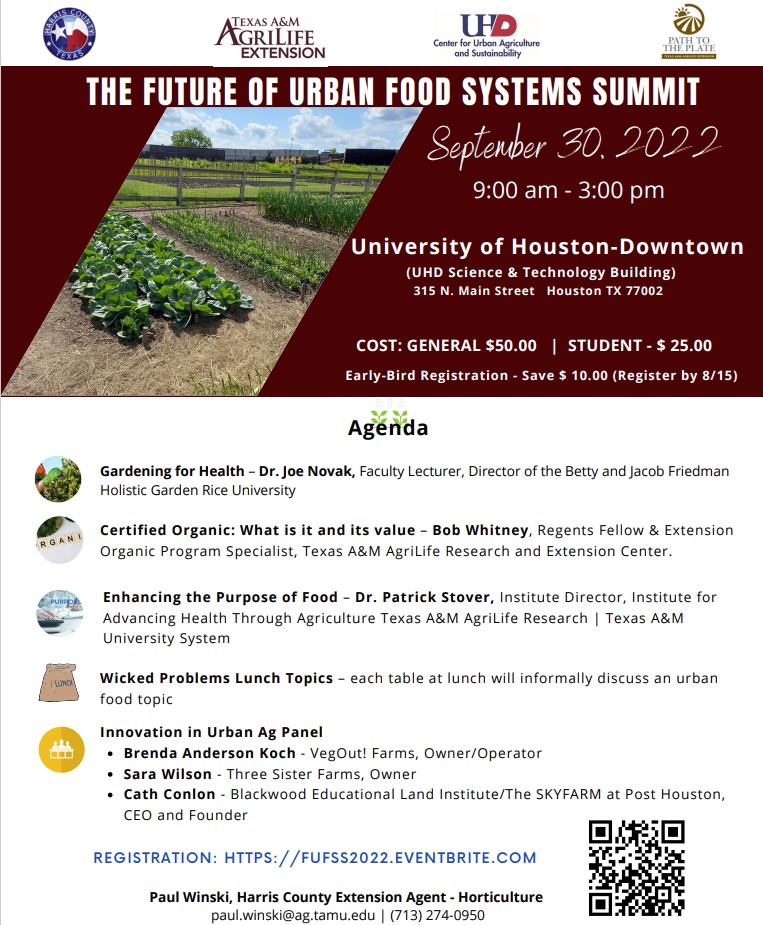
If you are in the Houston area, September 30 you might want to attend this food summit. I know at least two of the speakers are well worth hearing, not sure about the third one! Seriously, all of us are addressing issues related to having fresh, wholesome food available in the urban, inner city. Most cities have lots of wasted, open space suitable for growing fresh produce and lots of people to eat that produce. Our challenge is get the two together and there is no time better than now. The program flyer below gives plenty of information about the program and signup.







 Texas A&M AgriLife Organic