Recently I spoke with Josh Brooks the new Chairman and CEO of Guar Resources in Brownfield. Josh is pretty excited to announce the reopening of the facility after a long 15 months of work. They are now looking for growers to contract guar production in 2023.
Guar is an indeterminate legume that is perfect for rotation programs around cotton, sorghum, corn, etc. It is predominantly a dryland crop and is very drought tolerant. I have had the opportunity to be a part of growing guar in the 2012-2014 years and found it to be easy to grow. Seeding rates are generally around 8 lbs./ac. but can range from 6-12 lbs./ac.
I asked Josh about the need for organic guar, and he said YES! He is offering contracts for organic that are about 50% more than conventional price. For more information on guar go to https://guarresources.com
Utrisha N from Corteva Biologicals is an OMRI certified dry powder of Methylobacterium symbioticum, a bacterium that enters the plant and takes nitrogen from the atmosphere for the plant to use. It comes in 50 ounces packages that will treat 10 acres (5 oz. per acre). It is mixed with water and sprayed with a minimum of 10 gallons of water per acre.
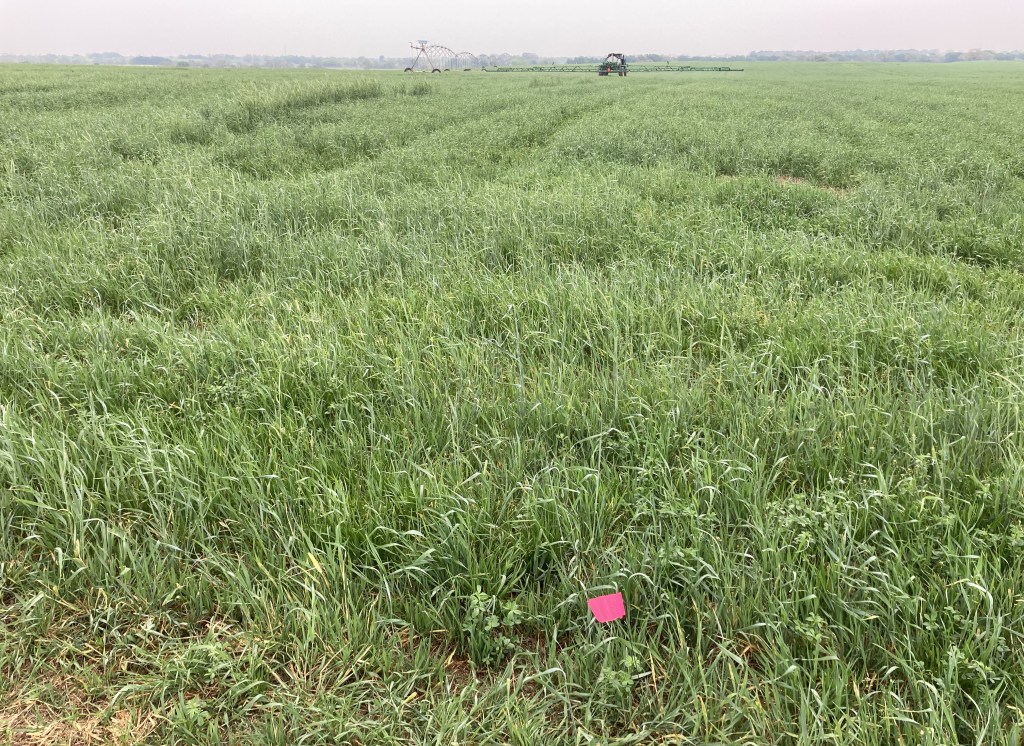
On April 4thI applied the Utrisha N on triticale being grown for silage (picture below). I wanted to see if Utrisha N would increase silage protein when applied late in the season (preboot to boot stage). The Utrisha N was being applied by a commercial rig as a liquid and I marked off a sizeable area that was not treated to be able to harvest as an untreated check.
I took two harvests from the plots (2 plots with 2 replications), one early harvest on April 18 and one late harvest on May 3rd. I did not take a yield from each plot since the Utrisha N was applied after vegetative growth had ceased and we were into grain production. The cost of organic protein sources can mean a lot of extra money spent on organic grain when there could be a cheaper source! Forages are always a cheaper option for both energy and protein and they help stimulate milk production. But they must be high quality to fit in a milking cow ration.
The longer the plants were in the field and continued to mature to grain, the overall crude protein % went down (typical, with maturity). It is amazing how quickly overall crude protein drops with maturity as seen by the untreated area. But the Utrisha protein reduction was less with time than the untreated area and more than paid for the Utrisha N treatment and application at $20 per acre!!
Are you a producer transitioning to organic or maybe you already grow a certified organic grain or feed crop? Are those crops covered with Federal crop insurance? If the answer is yes, you can now get premium assistance from the USDA for the 2023 reinsurance year through the Transitional and Organic Grower Assistance (TOGA) Program. It’s offered by the USDA’s Risk Management Agency, and it can reduce your overall crop insurance premium bills, and help you continue to use an organic agricultural system.
Eligible organic grain and feed crops under the TOGA program are: alfalfa seed, barley, buckwheat, canola, corn, cultivated wild rice, dry beans, dry peas, flax, forage production, forage seeding, fresh market sweet corn, grain sorghum, hybrid corn seed, hybrid popcorn seed, hybrid sorghum seed, hybrid sweet corn seed, millet, oats, crops insured under the Pasture, Rangeland, and Forage policy, peanuts, popcorn, rice, rye, safflower, sesame, silage sorghum, soybeans, sunflowers, sweet corn, triticale, and wheat.
You will automatically receive the premium assistance on your billing statements for the 2023 reinsurance year, which covers applicable policies with sales closing dates from July 1, 2022, to June 30, 2023.
Since there is no enrollment paperwork, the premium assistance will automatically apply to those eligible insurance policies with July or August sales closing dates that have passed.
More information is available on this website: TOGA
USDA to Provide Aid to Organic Dairy Producers for Marketing
Assistance to Help Organic Dairy Producers Cover Increased Costs Farm Service Agency (FSA) is making $104 million available to organic dairy operations to assist with projected marketing costs in 2023, calculated using their marketing costs in 2022.
FSA will begin accepting applications for ODMAP on May 24, 2023. Eligible producers include certified organic dairy operations that produce milk from cows, goats and sheep.
More information the dairy market program is available on this website: ODMPA
The Farm Service Agency (FSA) provides organic producers and handlers with financial assistance every year to reduce the cost of organic certification. The program reimburses producers and handlers for a portion of their paid certification costs. Once certified, organic producers and handlers are eligible to receive reimbursement for 75 percent ofcertification costs for program year 2023, up to a maximum of $750 per certification scope—crops, livestock, wild crops, handling, and State Organic Program fees. As you all know this is an increase from $500 in previ0us years to $750.
According to the 2021 USDA Organic Survey released this past December 2022, only about 20% of the organic farmers in Texas ever request this reimbursement of certification costs! That amounts to $240,000 never claimed by Texas producers for organic expenses – every year. I am trying to figure out a way for the Texas A&M AgriLife Organic program to apply for your “cost share” reimbursement if you don’t want it. Just think of all the organic research, educational programs and farm visits we could do!!!!
The date has been extended to August 8, 2023! Also go to the Grant Info page to get more information. I tried to put everything I can find on that page….
That’s right! I consider these mostly organic producer/handler grants and what is unique is that they pay for capital improvements. That rarely happens in grant programs. The program focuses on building and expanding capacity for certified organic production, aggregation, processing, manufacturing, storing, transporting, wholesaling, distribution, and development of consumer markets. There are 3 types of projects:
Market Development and Promotion – Developing or expanding commercial markets for generic (non-branded) organic commodities, producer and/or consumer education, and product development for underutilized organic commodities.
Processing Capacity Expansion – New or expanded aggregation, processing, storage, marketing, and distribution mechanisms for organic commodities to create a path to market for producers, including purchase and installation of equipment.
Simplified Equipment Only – purchase equipment to expand capacity for processing, aggregation, and distribution of organic products to create markets for producers.
Grants for Market Development or Processing Capacity are from $100,000 to $3 million and do require a 50% match. The Simplified Equipment Only grants are up to $100,000 and do not require a match. Grant matches can include your labor and materials and so don’t necessarily mean CASH! More information is found here: Organic Market Development Grant Page
Over the past few months, I have had a number of questions about pesticide drift onto organic fields, pesticide applicators who want to know where organic fields are located, organic growers who want pesticide applicators to know about organic fields, and conventional growers who want to know where organic fields are located. That is a lot of information to keep track of but there may be a system!
I reached out to FieldWatch and Curt Hadley who is Business Development Manager for Field Watch and is a great contact for what they do. In the process of visiting with Curt about Field Watch and how it might benefit organic growers in Texas he quickly said, “I need to write this down and make it available to your growers!” Here is his thoughts….
“How New Areas Can Approach the Need for FieldWatch Registries”
by Curt Hadley
We are often asked how new states / provinces / areas join FieldWatch and bring the registries to their areas. With 24 US states, Washington DC and 1 Canadian Province in Saskatchewan in the registry network we could tell you that they all joined the same – that would be far from the truth! The fact is that there are many ways that states / provinces / areas have joined and brought the registries to their respective areas, but there is one common thread……just click this link to go to the website and read Curt’s article (How New Areas Can Approach the Need for FieldWatch Registries – FieldWatch)
As the Extension Organic Specialist, I would like to know if this is something I need to help organize for Texas and Texas organic producers. I am willing, but I do need to hear from you to make it happen. Bob






 Texas A&M AgriLife Organic