Currently the Texas organic program has several producers farming in Far West Texas working with soils that have a high pH and some salt and sodium concerns. Their irrigation water also carries moderate levels of salts and sodium. These are not unusual conditions in Far West Texas, but they complicate crop selection. Over time, sodium can weaken soil aggregation, reduce water infiltration, and make it more difficult for roots to explore the soil. Salinity adds another stress because plants must use more energy to extract water from the soil. The goal is to continue to find and grow crops that can not only help the bottom line but add to soil fertility and overall soil health. That is a lot to ask of any crop but especially a sweetclover crop!
Hubam Sweetclover is a Surprise Crop
Hubam is an annual white sweetclover. It is a legume, which means it can form a relationship with nitrogen-fixing bacteria and obtain much of its nitrogen from the atmosphere rather than from purchased fertilizer. That is valuable in an organic farming system, but nitrogen fixation is only part of the story.
Sweetclover develops a strong taproot that can explore deeper portions of the soil profile. Those roots create channels, add organic matter below the soil surface, and help move carbon deeper into the soil. When the roots eventually die, the channels remain available for water movement, air exchange, soil organisms, and the roots of future crops. This “biological tillage” provides a living root that opens the soil while also feeding microbes, adding carbon, and protecting the surface. Also, Hubam has a history of performing on alkaline soils and even doing so with some salt and sodium problems.
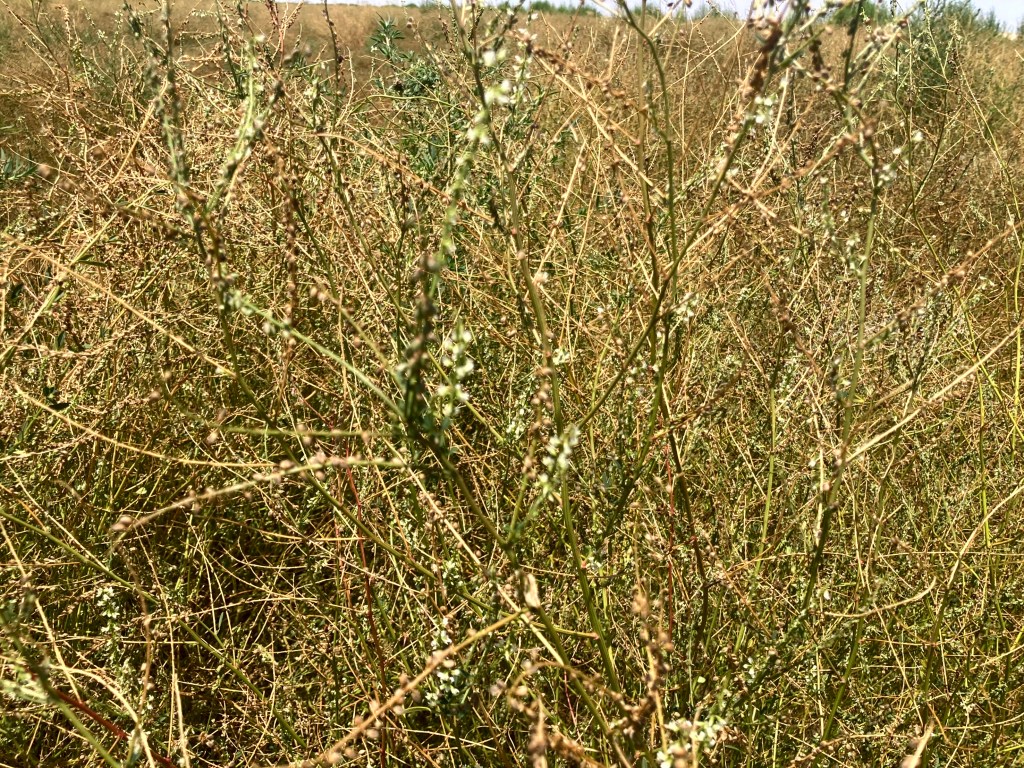
Recently, I was out in Far West Texas and got a chance to see my first field of Hubam Sweetclover and was surprised by the 5 to even 6 feet tall plants, heavily branched, and still productive even though it was the end of July and the crop was seeded out and going down. This is normal for a cool season clover, still the crop was demonstrating that an annual white sweetclover could survive and produce substantial forage and root mass even under some tough soil and water conditions. It is known to be about the most heat tolerant of all the clovers and as you can see will be growing and blooming late into summer. One source said it can get 10′ tall!
Can all that Hubam Sweetclover seed be harvested??
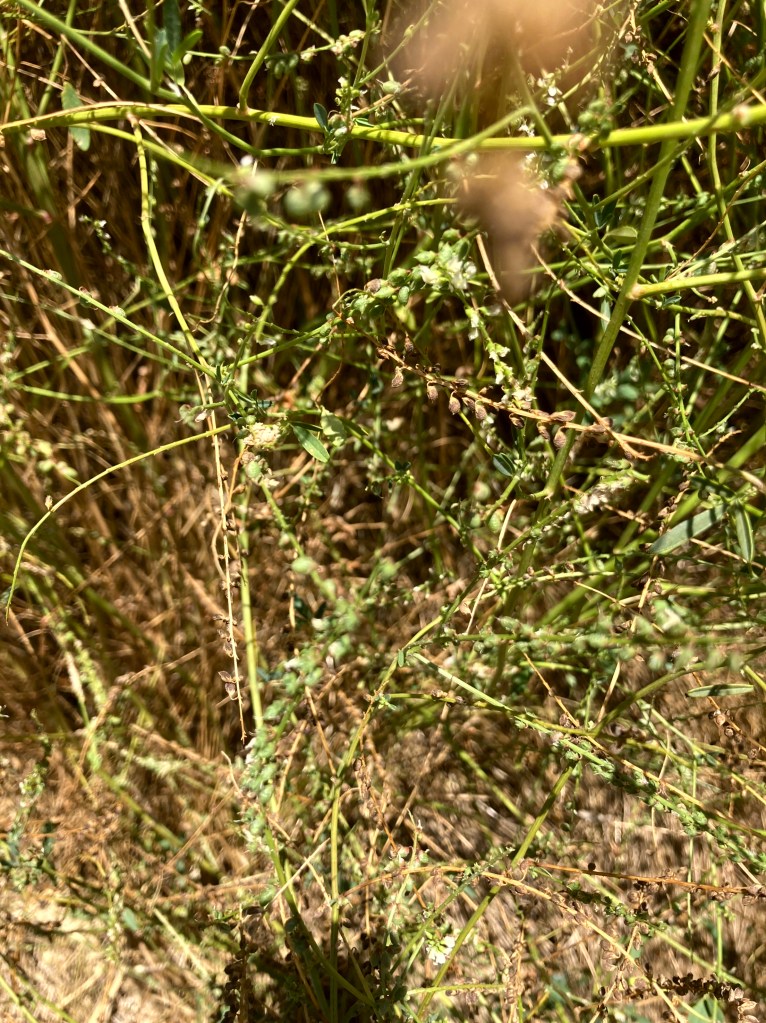
You can easily see from the picture that Hubam Sweetclover produces a lot of seed and is known for reseeding itself because of its good viable seed production. Unfortunately harvesting that seed for future use in other fields may be a real challenge. First, all sweetclover plants are indeterminate. That means the plant does not flower, mature, and dry down all at once. On the same plant you can see white flowers, green pods, mature brown pods, green stems, and drying stems which creates a harvest problem, when do you start? When the oldest seed is mature enough to harvest, the newest seed may still be immature. Waiting for the entire plant to mature increases the risk that the earliest, most mature seed will shatter and fall to the ground. Cutting earlier protects some of the mature seed but potentially leaves more immature seed in the windrow.
The crop is also tall and tangled. The large stems can remain green longer than the fine branches and seed pods. A combine may thresh dry seed but stall out processing heavy, moist stems. Swathing was recommended by most of the seedsmen I contacted. Darcy Turner at Turner Seed has decades of experience and he recommended swathing at about 50% dark brown to black seed. You can run a conventional swather, but the crimpers need to be open as wide as possible to minimize crushing and pod disturbance. We sure don’t want to strip off the seed with a crimper. Your combine needs a pickup attachment, but they are not too hard to find especially around any silage crop growers.
Lastly, you may be wondering if there is any problem with harvesting the seed to use either on your own farm or to sell to your neighbor – don’t worry it is not a protected variety and has been around for decades.
If You’re not into Seed Harvest, then What?
Talking with the Far West Texas farmers they like the Hubam Sweetclover but the seed is very hard to find – probably because it is so hard to harvest! That said we did discuss another variety developed because it was similar to Hubam but had some different or even better plant characteristics.
Silver River1 was developed and released through Texas A&M AgriLife Research. and is described in the Journal of Plant Registrations, Volume 11, Issue 2, pages 112–115.2 It is closely related in function and growth habit to Hubam and was selected primarily for resistance to sweetclover rust, a disease that can severely damage susceptible sweetclover plants. Published evaluations found Silver River to be similar to Hubam in maturity and forage production while having much greater rust resistance.
Rust may not be the first concern that comes to mind in the dry environment around Pecos. However, irrigation and a dense crop canopy can create humid conditions within the stand. Disease resistance is rarely a disadvantage, even when disease pressure is inconsistent. More importantly, Silver River may provide many of the same soil-building and forage functions as Hubam while being more available through several commercial seed sources. We haven’t tried it in Far West Texas yet but overall it has the potential and genetics to do really well – try a test plot and see.
Sweetclover as Hay
Both Hubam and Silver River can produce substantial forage, but sweetclover should not be managed exactly like alfalfa. As sweetclover matures, the main stems become large and woody. For hay, cutting time is critical and like other legumes earlier cutting generally provides better forage quality and finer stems, but it sacrifices some total tonnage and even root development. Later cutting produces more biomass but also increases stem size, slows drying, and reduces forage quality.
Sweetclover also requires special attention during curing since moldy sweetclover hay can develop dicoumarol, an anticoagulant associated with sweetclover bleeding disease in livestock. This risk comes from improperly cured or mold-damaged hay rather than from healthy plants standing in the field. Grazing is their strong suit, but they can be cut for hay and cattle love it!

Discover more from Texas A&M AgriLife Organic
Subscribe to get the latest posts sent to your email.


