Recently, I received an anonymous handwritten letter concerning alleged violations of USDA organic regulations. The letter had been mailed to a Texas A&M office and forwarded to me because of my work with organic agriculture.
I am not going to identify the operation involved or repeat the specific allegations because I have not verified them. However, the letter raised several issues that I believe are worth discussing with organic producers and consumers.
One statement caught my attention:
“This is unfair to the consumer and other farmers.”
The writer was concerned that someone might be misrepresenting agricultural products as organic. Whether or not that concern is justified in this particular case, the statement identifies something fundamental about organic certification.
Organic integrity matters to everyone involved, including consumers, farmers, handlers, and businesses that depend on the credibility of the USDA organic label.
Organic Farmers Need to Remember That People Are Watching

Observing agricultural practices does not always tell us whether an organic regulation has been violated.
Certified organic agriculture is different from many other agricultural production systems because organic is not simply a way of farming. It is also a federally regulated marketing claim.
When a product is sold as certified organic, the producer or handler is making a claim that the product was produced and handled according to USDA organic regulations.
That means people have a legitimate interest in whether those requirements are being followed.
Neighbors, employees, buyers, other farmers, and consumers may observe agricultural activities and wonder whether something they see is allowed under organic regulations.
Sometimes their concerns may be justified. Sometimes they may misunderstand what they are observing.
Consider a simple example.
Someone drives past a certified organic farm and sees a tractor pulling a sprayer across a field.
Does that mean the farmer is violating organic regulations?
Of course not!
Organic farmers routinely use sprayers to apply permitted pest control materials, fertilizers, and other crop production inputs. Whether an application complies with organic regulations depends on the material, its intended use, the circumstances of the application, and the operation’s approved Organic System Plan.
The same is true for fertilizers. Seeing a farmer applying fertilizer tells us very little about whether that material is permitted in organic production.
There is another important consideration. Some agricultural operations produce both conventional and certified organic crops. That is permitted under USDA organic regulations, provided the operation maintains the required separation, records, and safeguards against contamination and commingling.
A person observing a conventional production practice may not know which fields are certified organic and which are not.
What someone sees happening on a farm is not always enough to determine whether a violation has occurred.
A Complaint Is Not Proof of a Violation
The anonymous letter included another statement:
“I believe this deserves investigating and testing.”
I understand that concern.
When someone believes organic products are being misrepresented, they may want the situation investigated. That is one reason USDA has established procedures for receiving and evaluating complaints.
But there is an important distinction between suspecting a violation and establishing that one has occurred.
A complaint may come from someone with firsthand knowledge of an operation. It may include documents, photographs, dates, locations, or other supporting information.
It may also result from a misunderstanding, incomplete information, or something someone heard from another person.
That does not mean the complaint should be ignored. It means the information needs to be evaluated.
The USDA National Organic Program and accredited organic certifying agents have responsibilities for investigating suspected violations and taking appropriate enforcement actions.
An investigation may substantiate an allegation, identify a different compliance concern, or find insufficient evidence of a violation.
Every organic producer deserves a fair process, just as every consumer deserves confidence in the organic products they purchase.
Who Should Someone Contact About a Suspected Organic Violation?
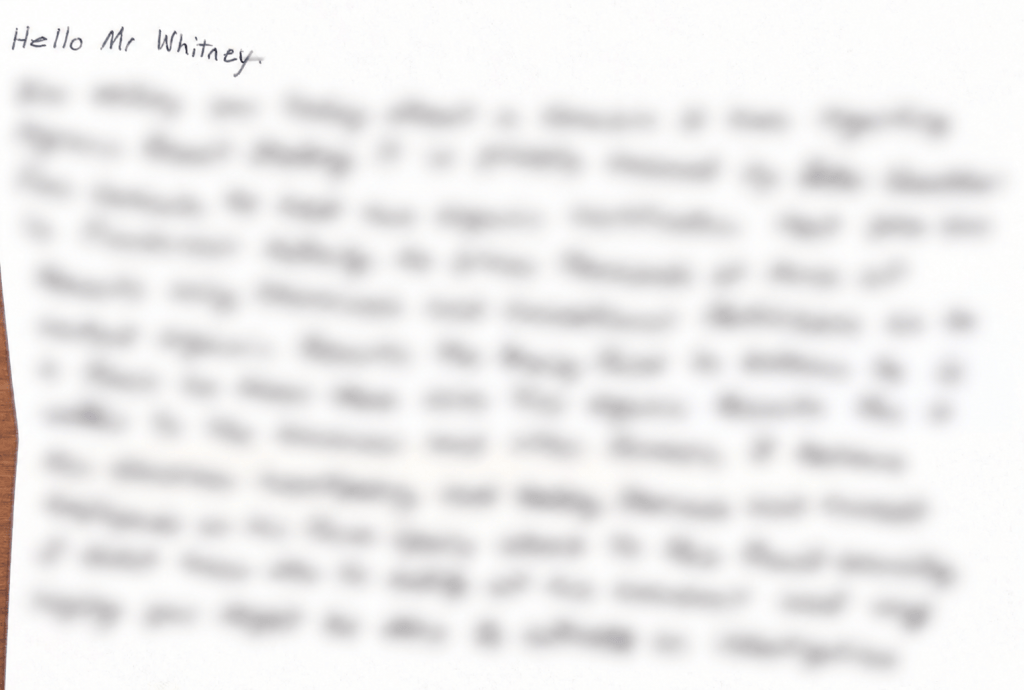
An anonymous letter received concerning alleged organic violations. The contents have been obscured to protect the identities of those involved.
One of the final statements in the letter illustrates an important problem: many people who suspect an organic violation simply don’t know where to report it.
“I didn’t know who to notify of his conduct and was hoping you might be able to activate an investigation.”
This may be one of the most important reasons for writing this article.
People frequently contact me through Texas A&M AgriLife Extension Service with questions or concerns about organic production and certification. Sometimes those concerns involve suspected violations of USDA organic regulations.
However, my role as an Extension Organic Specialist is educational, not regulatory. I do not conduct investigations or determine whether an organic violation has occurred.
I have also learned from experience that simply forwarding someone’s complaint to USDA does not necessarily initiate an investigation. When I have contacted USDA’s Agricultural Marketing Service about complaints received from others, I have been told that the original complainant needs to submit the information directly.
This is particularly important when someone sends an anonymous letter. I may receive the information, but without knowing who submitted it, I cannot ask questions, obtain supporting evidence, or direct that individual to the appropriate reporting process.
For that reason, I encourage anyone who suspects an organic violation to submit the complaint directly to the USDA National Organic Program. The complainant may request anonymity, and USDA protects complainant identities to the greatest extent permitted by law.
The responsibility for reviewing the information, determining whether sufficient evidence exists, and deciding whether to investigate belongs to USDA and the appropriate regulatory authorities.
How to File an Organic Complaint with USDA
Anyone who suspects a violation of USDA organic regulations may submit a complaint.
USDA National Organic Program — Compliance and Enforcement
- Online: https://www.ams.usda.gov/services/enforcement/organic/file-complaint
- Email: NOPCompliance@usda.gov
- Telephone: 202-720-3252
USDA asks complainants to provide as much specific information as possible. Useful details may include the operation or product involved, the location, dates of suspected activities, a description of what was observed, and any supporting documents or photographs.
The more specific the information, the better USDA can evaluate the allegation.
A complaint may be submitted without providing the complainant’s name. USDA states that complainant identities are protected to the greatest extent permitted by law. However, providing contact information allows USDA to request clarification or additional evidence if needed.
USDA reviews complaints and determines how to proceed. In cases involving certified operations, the National Organic Program may coordinate with the operation’s accredited certifying agent.
What Should Organic Producers Learn From This?
I think there are several lessons worth remembering.
First, maintain good records. Organic production and handling records are not simply paperwork required for an annual inspection. They document what was done, when it was done, and how the operation complied with USDA organic regulations.
Second, understand your Organic System Plan. Farmers should know which practices and materials are permitted, what conditions apply to their use, and when changes need to be reported to their certifier.
Third, be especially careful when operating both conventional and organic production systems. Clear field identification, equipment management, product segregation, and accurate records are essential to maintaining organic integrity.
Fourth, recognize that not everyone understands organic production. A person may see something that looks suspicious simply because they are unfamiliar with the regulations.
Sometimes an explanation can resolve a misunderstanding. Other times, an independent regulatory review may be necessary.

Organic Integrity Is Everyone’s Responsibility
I have worked with organic farmers long enough to know that most take their certification responsibilities seriously. They invest considerable time, money, and effort in complying with the regulations.
I also know that organic fraud is a legitimate concern. When products are falsely represented as organic, honest producers face unfair competition, consumers may be misled, and confidence in the organic marketplace suffers.
That is why we have certification, inspections, recordkeeping requirements, and enforcement procedures.
I cannot determine whether the allegations in the anonymous letter are accurate, and I do not know whether they will result in a regulatory investigation. Making those determinations is not my responsibility as an Extension specialist.
But the experience offers a useful reminder.
Organic producers should expect accountability. People who suspect violations should know where to report them. And everyone involved should remember that an allegation is not the same as proof.
That is how we protect both organic integrity and the people who work hard to maintain it.
References
USDA Agricultural Marketing Service. How to File a Complaint on Organic Regulations.
https://www.ams.usda.gov/services/enforcement/organic/file-complaint
USDA Agricultural Marketing Service. Organic Enforcement.
https://www.ams.usda.gov/services/enforcement/organic
USDA National Organic Program. 7 CFR § 205.661 — Investigation.
https://www.ecfr.gov/current/title-7/section-205.661
USDA National Organic Program. 7 CFR § 205.662 — Noncompliance Procedure for Certified Operations.
https://www.ecfr.gov/current/title-7/section-205.662
Discover more from Texas A&M AgriLife Organic
Subscribe to get the latest posts sent to your email.


