
Wrapping parts of field bindweed plants from the nursery infected with Gall Mites around field bindweed plants in the South Plains. Introducing the beneficial Gall Mite to help control this noxious weed.
Some time back I wrote a blog post about using some biological methods for controlling field bindweed (click here to read). I liked the idea of introducing the Field Bindweed Gall Mite (Aceria malherbae) to areas of field bindweed and hoping they would help to keep this weed from taking over fields. Sounds easy till you try finding the mites!
Most of the information pointed me to the State of Colorado and Nina Louden Biocontrol Specialist with the Colorado Department of Agriculture. The first thing Nina asked me, “Do you have a USDA permit to allow us to ship “biological control agents” across state lines?” At that time, I didn’t even know there was a need for a permit, but I soon found out you can apply for one online. There was much in the application process I didn’t understand but overall, it was simple and easy. I got my “permit” as you can see below
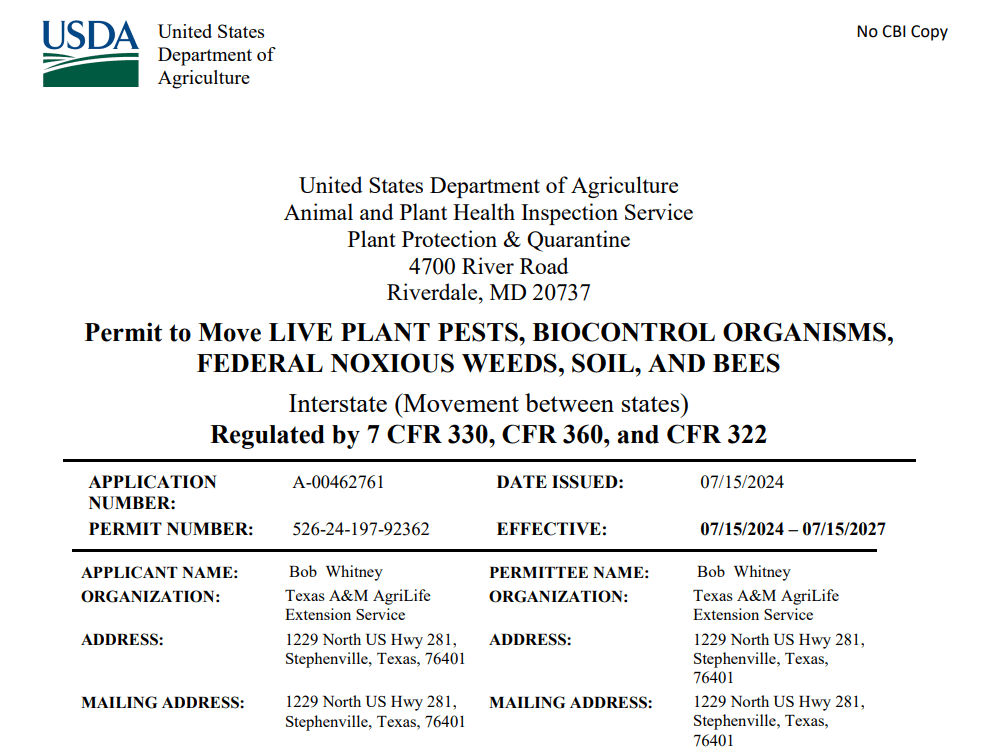
USDA Permit to ship and apply Field Bindweed Gall Mites
I sent Nina the USDA permit by email and her response back was we will ship you the Gall Mites on Monday of the next week to arrive by noon on Tuesday. The mites are harvested in Colorado from growing field bindweed by simply cutting off pieces of field bindweed that are infected with the mites and shipping them in a cooler with cold packs. My next call was to Carl Pepper, South Plains Organic Cotton Farmer to see if he was able to help me put out the mites on one of his fields.

Field bindweed with the Gall Mites on the plant are harvested and sent to us for distribution.
Carl and his family had a perfect location next to an organic cotton field. The area between the county road and the field was infested with field bindweed and the weed was growing out in the cotton rows where Carl could not plow it out. We put the gall mites into two 10′ X 10′ squares well marked and will monitor their “survivability” and ultimately measure their spread out from the 10′ X 10′ area to the field.

Carl Pepper is applying the field bindweed pieces to the existing field bindweed plants in his field. We did this by wrapping the pieces around the existing plants. The mites will move from the old plants to the new looking for fresh food sources.
Will it work? I don’t think any of us know for sure, but we have to try! The field bindweed gall mite is not going to eradicate field bindweed on the South Plains. But our hope is that as the field bindweed comes out each spring the gall mite is also out and feeding on the field bindweed. This will significantly slow the growth of the bindweed and hopefully keep it in check. Something we don’t have now!

Click on the picture above to read this publication about the Gall Mite and how Colorado State Department of Agriculture ships them out. This service was free of charge and very easy to do. I hope to get more to release in other places soon.

Discover more from Texas A&M AgriLife Organic
Subscribe to get the latest posts sent to your email.

 Texas A&M AgriLife Organic
Regarding “Eradication” of Bind Weed in Urban gardens, both Landscape & Vegetable gardens?
My concern is first: safe eatables and second not introducing something that will continue to kill other Landscape plants!
Russ Allen
LikeLike
Russ. This mite only survives on field bindweed and does not move to vegetables. We don’t intend for the mite to eradicate field bindweed since the mite will die off long before its food source dies. Lastly, this mite is native to North America but has not been introduced to the South Plains of Texas. Bob
LikeLike