The maps below are an attempt to help you see and know what and where organic in Texas is located. There is a lot going on in this well over $1 Billion dollar a year industry! You can click on the individual maps to see a larger picture.

This map of the 418 organic farms/certificates across the state of Texas gives you an up-close look at where organic farms are located. As you can see there are 278 farms or 66.5% of all organic farms located from the South Plains to the High Plains. These farms are mostly cotton and peanuts with a huge concentration of dairies located in an area west and north of Amarillo. The rice belt includes farms on either side of Houston and these farms do other organic crops in rotation with rice. Vegetable/fruit farms can be found in many places in the state but there is a concentration in the Rio Grande Valley.
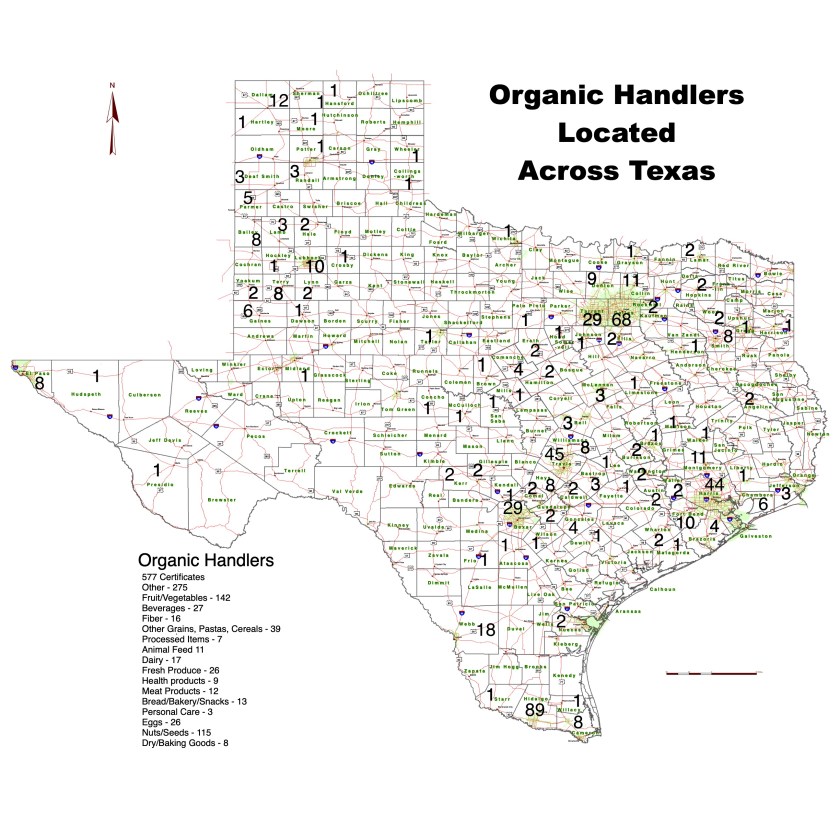
This handler group buys farm products from organic producers or perhaps they manufacture an organic product for use on an organic farm. Basically, they are in the organic business and are regulated like an organic farm. Organic begins on the farm in the soil and stays organic till it is packaged!
Most folks don’t even think about organic handlers or what their business might be. I will call your attention to a blog post I wrote about organic handlers a few years ago. Organic Handlers The majority of these handler companies are located in or around cities but notice the 117 at the Rio Grande Valley. The majority of those companies bring in organic imports from Mexico and either store them or package them for delivery into the United States.
Currently (August 2024) there are 577 Organic Handlers up from 428 just last year. Why the jump? Well, we now have Strengthening Organic Enforcement (SOE) in place and those rules are demanding that the organic value chain be certified, completely certified! That has meant that brokers and even truckers have had to get an organic certification to ensure that they were held accountable for the organic products they “touched.” The consumer likes to be able to trace the products they buy and now certified organic is traced from the farm to the consumer.
Other Organic Program Information
- Being Certified Organic is not a Form of Virtue Signaling
- USDA Organic: You are automatically part of a huge family!
- Award-Winning Growth: Texas Organic Entities Will Flourish with USDA Organic Grants
- What? We Got a Notice of Noncompliance?
- Collaboration – defined as a willingness to give!
- Who Needs to be Certified Organic?
- Have you considered lifestyle as a reason for organic consumption?
- Organic Handler, What Does That Mean?
- Organic Food: A Study of Consumer Perception and Preferences in Greece
- Study Shows People Who Buy and Eat Organic Are Perceived as “Better!”
- Why Organic Means Something?

Discover more from Texas A&M AgriLife Organic
Subscribe to get the latest posts sent to your email.

 Texas A&M AgriLife Organic