
This well written post on the Green Corn Project website details a problem we are having with compost throughout Texas. I have been getting plenty of questioning emails and calls about this and so I am trying to give some context on what is happening. I have tried to be fair but when it happens to you and your crops it is very frustrating and difficult not to lash out.
Topics Covered in This Article
- Herbicides involved
- How it happens
- Perfect storm!
- Update! New Study that may Help This Issue
- Key Findings:
- Other Resources
Herbicides involved
Dow AgroSciences now known as Corteva Agriscience makes the Grazon Next herbicide with aminopyralid and 2,4-D in a premix. It has been on the market for years but was generally more expensive than a common pasture and hay field weed control herbicide known as Weedmaster or its generics which is a premix of Banvel (dicamba) and 2,4-D. Grazon Next is a popular herbicide but until the last few years the extra expense did slow its use somewhat.
Corteva Agriscience also has a fairly new pasture weed control product called Duracor which is a mix to aminopyralid and florpyrauxifen. This product is popular because it does not require a Texas Department of Agriculture pesticide license to purchase which helps a lot of landowners who want to spray pastures and hay fields with their own equipment.
How it happens
Grazon Next and Duracor have on their label (below) that it is only to be used on forage intended to be used on the farm and manure is not to be composted and used on vegetables. When a producer buys Grazon Next or Duracor, they are required to be warned about this restriction. I really do believe that most producers who use the product know the danger, whether they abide by it or not.
As a chemical used on hay or pasture crops and then fed to cattle it is really interesting because it does not break down in the animal but instead stays intact as aminopyralid. This is one reason why EPA has less trouble labeling it for animal feed, it is safe for animals and does what it says it will do in a pasture. I am not justifying its use, only trying to understand why it is used.
The older Weedmaster product is not persistent in the environment for more than a couple of weeks and certainly not persistent in manure used for compost. Aminopyralid, on the other hand, can last up to 18 months in the environment. Animals that eat treated grass will then excrete (poop!) manure with aminopyralid and that composted manure will have aminopyralid for about 6-18 months. The label says 18 months which is a chemical treatment at the highest rate of aminopyralid. There are all kinds of conditions that will speed up this breakdown process.
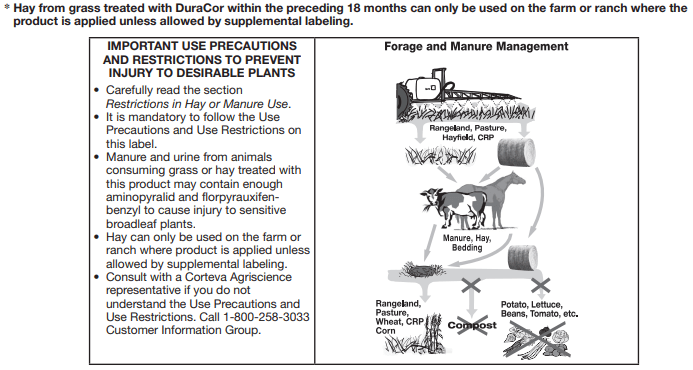
Duracor Label
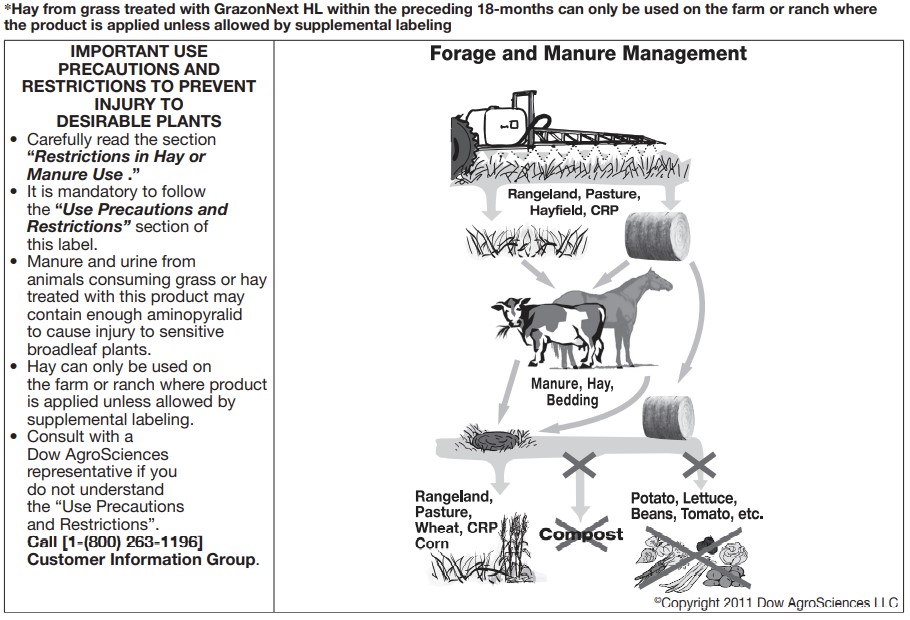
GrazonNext HL Label
The past several years has been a perfect storm for this problem to get hugely worse. The Weedmaster (or generics like it) has Banvel, and Banvel is now a common herbicide used in cotton because of GMO cotton with Banvel herbicide resistance. This has significantly increased the use of Banvel and caused a shortage which caused the prices to go up. This caused Weedmaster to be in short supply and more expensive than herbicides with aminopyralid in many cases.
So, the cheaper aminopyralid products and lack of supply of Weedmaster or Banvel caused many hay producers to switch and save money. Hay has been in short supply and dairies have been getting it from anyone and anywhere they could, no questions asked. Dairies, and to a smaller extent, feedlots are a big supplier of manure for compost operations all over the state and this perfect storm has opened up the potential for compost or manure to have aminopyralid in it.
Perfect storm!
One last thing that also makes this an issue, the compost industry has had a perfect storm itself. Higher synthetic fertilizer prices have caused all producers to search out cheaper sources of nutrients. Compost suppliers usually have more compost than they can handle on their operations and want to sell it. Along comes field crop producers who are hit with higher fertilizer prices, compost has what they need, and the price is low compared to synthetic fertilizer. Compost yards will push their composting process so that they are sending out compost/manure very fast after receiving it from the farm. I have seen some compost that I think was just really mixed-up manure with no composting time or mixed with some small amount of compost. Usually, the compost process and the time it takes, breaks down aminopyralid somewhat, but many years compost can move fast because of high fertilizer prices. That has left very little time for the compost process to break down the chemical like there had been in years past.
Update! New Study that may Help This Issue
This study titled “Composting Dairy Manure with Biochar: Compost Characteristics, Aminopyralid Residual Concentrations, and Phytotoxicity Effects” examines how biochar affects the composting process of dairy manure contaminated with aminopyralid, a herbicide commonly used to control broadleaf weeds.
Key Findings:
- Aminopyralid Contamination:
- Aminopyralid, absorbed into forage, can contaminate compost feedstocks like hay, grass bedding material, and manure. Residual aminopyralid in compost can cause injury to sensitive crops such as tomatoes.
- Even low concentrations (<10 ppb) of aminopyralid in compost can negatively affect broadleaf crops. (I know you have had complaints about this!)
- Effectiveness of Biochar:
- Adding biochar (BC) to composting dairy manure reduces aminopyralid residues and enhances the compost’s safety for plants.
- Different levels of biochar (0%, 2%, 4%, and 10%) were tested. Higher biochar levels resulted in greater reductions in aminopyralid concentration.
- Biochar addition decreased organic matter degradation but increased nutrient concentration (N, P, K) in the compost.
- Phytotoxicity and Plant Health:
- Composting with biochar reduced the phytotoxic effects of aminopyralid, leading to milder injuries in test plants (tomatoes) compared to compost without biochar.
- Higher levels of biochar (10%) led to the least plant injury and increased plant biomass.
Recommendations for Composters:
- To mitigate aminopyralid contamination, incorporate biochar into the composting process. This approach helps immobilize the herbicide, making the compost safer for plant use.
- Regularly test compost for aminopyralid residues, especially if sourcing manure from farms using aminopyralid-treated forage.
- Educate suppliers about the impact of aminopyralid and encourage practices that reduce herbicide contamination in manure.
Conclusion: Incorporating biochar into dairy manure composting is a practical solution for Texas composters facing aminopyralid-related plant injuries. This method not only reduces residual herbicide levels but also enhances the compost’s nutrient profile, promoting healthier plant growth.
Other Resources
- Building Soils for Better Crops
- Soil Balancing Basics for Organic Farming
- Biostimulants – The Next New Frontier for Ag
- Best Cover Crops for Weed Control and Fertility
- What is the True Cost of Compost (or Manure) in 2024
- Composts and Herbicides Don’t Mix
- Managing Soil Biology for Organic Farming
- The Economics of Transitioning to Certified Organic Farming
- Farming with Soil Life
- Managing Soil Biology for Organic Farming
- Soil Balancing Basics for Organic Farming
- The Economics of Transitioning to Certified Organic Farming

Discover more from Texas A&M AgriLife Organic
Subscribe to get the latest posts sent to your email.

 Texas A&M AgriLife Organic
4 thoughts on “Composts and Herbicides Don’t Mix”