My office is at the Texas A&M AgriLife Research and Extension Center in Stephenville which provides me lots of opportunities for research and demonstrations in crop and horticulture production. We also have a super staff of AgriLife Researchers that are constantly working on new projects. A big thanks to them for allowing me to participate in their projects and helping me conduct my own organic research.
That said 2022 was a very difficult year in the state of Texas and certainly in Central Texas at the Center. There were all kinds of experiments installed and unfortunately the drought and high temperatures prevented much of an evaluation or harvest. We use hand move pipe for irrigation and keeping up with irrigated plots was almost just enough to keep plants growing and yields did suffer.
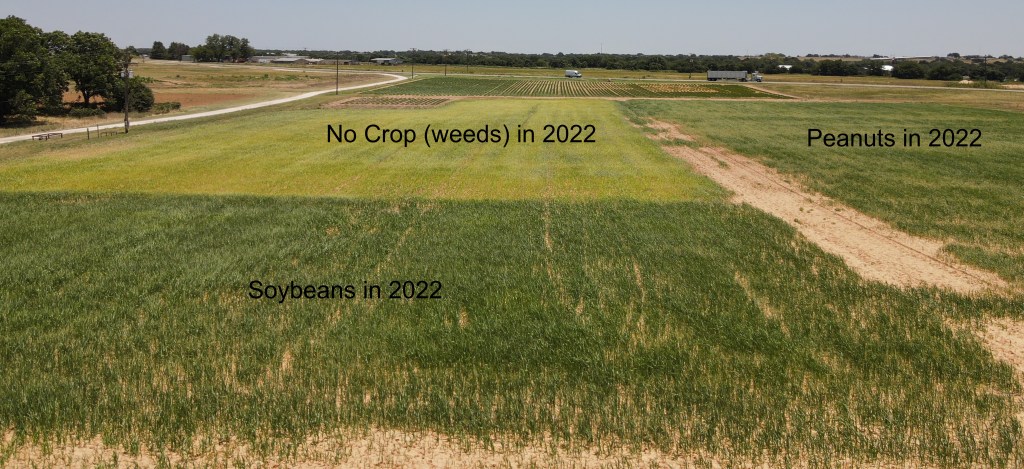
In the picture above you see a field that was not irrigated in 2022. The section of soybeans was planted very early in the spring in hopes of testing a few different treatments on the same variety. The section of peanuts was planted dryland to evaluate the variety as a dryland peanut. No crop was planted on a large section in the middle but it did grow up in weeds – sort of!
Dr. Johnny Cason is one of our Research Scientists with a specialty in peanut breeding. He and his staff put in these two test areas of legumes in 2022 and to say the least they were a disaster. The soybeans came up and did try to grow but the deer kept them eaten down till the drought took over. The peanuts were also eaten by deer, but the drought basically kept them from ever growing more than teacup size. We considered both areas a disaster and just plowed them under later in 2022.
Now, in 2023, this whole field was planted to Haygrazer as a cover crop as you can see in the picture. Now that I have explained what was done in 2022 maybe you can see (thanks to Johnny for the drone picture) and understand what is going on in 2023. The field has had no fertilizer of any kind this year or last year. What you see is strictly the residual soil fertility left by the attempt at growing two kinds of legume crops in 2022. What’s the takeaway here? Pretty obvious that even when you don’t think your legume crop is making a difference it is probably making a huge difference. If you want to know how much, just leave a planter width of legumes out when you plant the field. I bet you see that strip all of next year!
Discover more from Texas A&M AgriLife Organic
Subscribe to get the latest posts sent to your email.

 Texas A&M AgriLife Organic