1. Overall Flow: From Breeding to Market
The seed development and commercialization pathway at Texas A&M AgriLife follows a multi-phase process that moves from breeding and evaluation through administrative approval, licensing, and commercialization.
Breeder → Department Head / Program Coordinator → Plant Review Committee (PRC) → Texas A&M Foundation Seed (TAFS/TFSS) → Texas A&M Innovation → Commercial Partner (Seed Company) → Farmer
Each entity plays a defined role to ensure both scientific integrity and legal compliance for intellectual property and commercialization.1

2. Breeding and Variety Development Phase
Purpose and Process
- The breeder begins by conducting multi-year selection and evaluation to ensure genetic stability, yield performance, and commercial merit.
- Development cycles typically span 10–12 years before a variety is considered for release.
- Example timelines for wheat and peanuts are given in the Varietal Development and Release Overview…. (Item 2 in Resources below)
- Development cycles typically span 10–12 years before a variety is considered for release.
- During this phase, breeders conduct seed purification and prepare data for release documentation. (Plant Variety/Germplasm Disclosure)2
Why it matters
This step ensures the seed has proven performance and genetic purity before release, protecting both the reputation of AgriLife and the interests of farmers.
3. Internal Review and Board Approval
A. Plant Review Committee (PRC)
- The PRC is the internal gatekeeper for varietal releases.
- Composed of scientists and administrators, it reviews breeder proposals and ensures adequate testing and justification for release.
- Proposals go through department heads and program coordinators before PRC consideration.
- PRC reviews occur quarterly; breeders must submit at least eight weeks in advance.
- Breeders must submit to PRC:
- Release Proposal (with variety data, traits, yield, etc.)
- Registration Article (for journal submission)
- Texas AgriLife Leaflet (public release summary)
B. Texas State Seed and Plant Board
- Once AgriLife internally approves, the Texas State Seed and Plant Board must also approve the variety for legal recognition and seed certification.
- Applications are due April 1 (summer crops) or September 1 (fall crops); late applications will not be fast-tracked.
4. Foundation Seed Production
Texas A&M Agrilife Foundation Seed (AFS)3
- Texas A&M AgriLife Foundation Seed is responsible for producing foundation seed once a variety is approved.
- The breeder provides Breeder Seed, which Foundation Seed increases under strict purity conditions.
- Texas A&M AgriLife Foundation Seed works closely with:
- The Texas A&M Innovation (TI) for licensing agreements.
- Texas Department of Agriculture (TDA) for certification inspections.
- AgriLife Foundation Seed manages the executed license agreements and monitors compliance and infringement issues. Coupled with handling its own related fees and royalties on licensed plant materials, it also provides royalty collection services for several other land-grant institutions that market plant materials in the southwestern U.S.
Why it matters
This step ensures farmers receive genetically pure seed with documented origin and quality control.
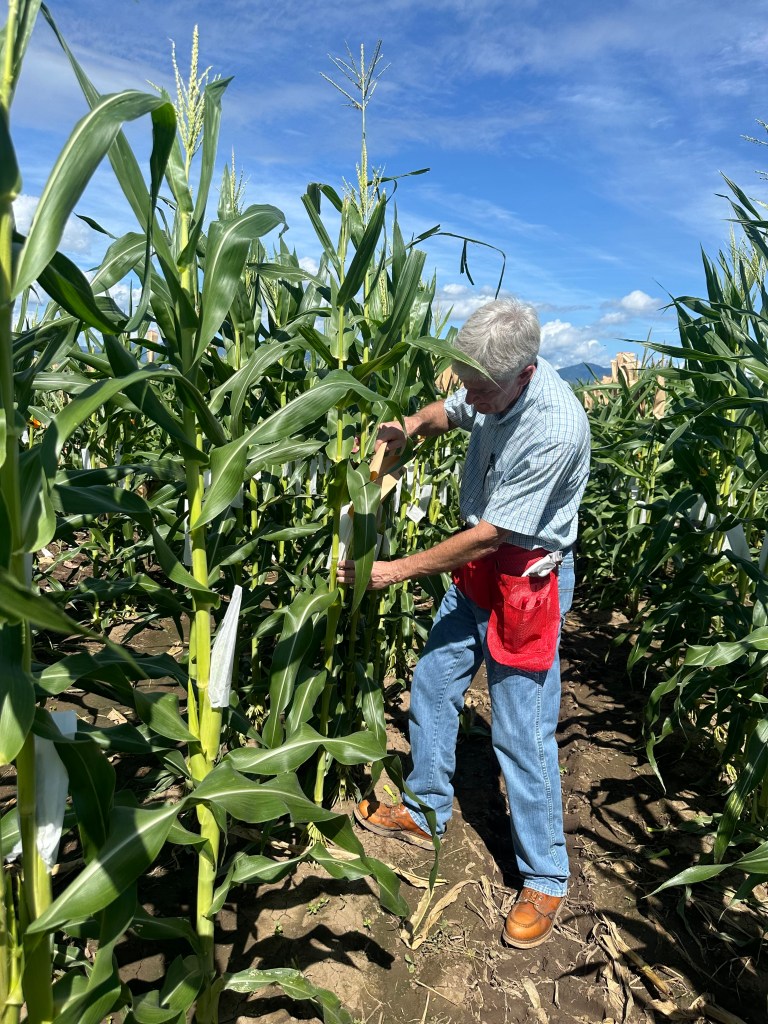
AgriLife corn breeding at the Winter Nursery in Puerto Rico
5. Commercialization and Licensing
Texas A&M Innovation (“TI” formerly “OTC”)4
- Once AgriLife Foundation Seed produces foundation seed, TAM Innovation handles intellectual property protection and licensing.
- Prepares Plant Variety Protection (PVP) applications.
- Negotiates license agreements with seed companies.
- Collects royalties and manages revenue distribution (per TAMU System Policy 17.02).
- They work with the Breeder and Marketing & Communications (MarComm) to create Requests for Proposals (RFPs) for companies interested in marketing the seed.
- Example: Texas A&M Innovation completed an exclusive license agreement with Adaptive Genetics for commercialization of a new wheat variety developed by the Texas A&M Wheat Improvement Program at Texas A&M AgriLife.5
AgriLife GermPlasm Commercialization Advisory Board6
- This Board is advisory, not decision-making.
- It provides strategic guidance on commercialization opportunities and helps align research with market needs.
- Membership includes representatives from AgriLife leadership, Foundation Seed, Texas Seed Trade Association, and Texas A&M Innovation.
6. Licensing to Seed Companies
Once TAM Innovation and AgriLife Foundation Seed have prepared the foundation seed and protection documents:
- A Request for Proposals (RFP) is issued for qualified seed companies.
- Companies submit proposals outlining marketing, production, and distribution capacity.
- A license agreement is executed with the chosen company, defining:
- Rights to produce, market, and sell the seed.
- Royalty terms.
- Quality control and reporting obligations.
- Foundation seed is sold or transferred from AFS to the licensed company for commercial production and marketing to farmers.
This is the point at which a company would enter the process — by responding to an RFP and entering a license agreement with TAM Innovation and AgriLife Foundation Seed, not directly with the breeder.
7. Summary: The Step-by-Step Path
| Stage | Lead Entity | Key Deliverables | Comments |
|---|---|---|---|
| 1. Breeding & Evaluation | Breeder | Data, purified lines | Multi-year trials |
| 2. Internal Review | PRC | Release proposal approval | Technical validation |
| 3. State Approval | TX State Seed & Plant Board | Legal release | Required for certification |
| 4. Foundation Seed | AFS | Breeder → Foundation seed | Managed increase |
| 5. Protection & Licensing | TAM Innovation | PVP, license, RFP | IP and royalties |
| 6. Commercial Partner | Licensed seed company | Market and sell seed | E.g., New Deal Grain |
| 7. Farmer Distribution | Dealer / Co-op | Certified seed to growers | Certified by TDA |
8. Interpretation of Direction and Intent
The intent of these documents is to:
- Centralize control of all plant material ownership and commercialization within Texas A&M AgriLife Research, not with individual breeders.
- Ensure legal protection and accountability through TAM Innovation.
- Maintain genetic integrity and traceability through AFS and the State Seed Board.
- Support public benefit and cost recovery through licensing and royalties.7
Resources List
- Standard Procedure Management and Release of New Plant Materials https://agrilifeorganic.org/wp-content/uploads/2025/10/tfss05-for-breeders1variety-release-procedures.pdf ↩︎
- Texas A&M Innovation Plant Variety/Germplasm Disclosure Form https://agrilifeorganic.org/wp-content/uploads/2025/10/plant-variety-germplasm-disclosure-2023.pdf ↩︎
- Varietal Development and Release Overview Texas A&M AgriLife
https://agrilifeorganic.org/wp-content/uploads/2025/10/varietal-development-and-release-final_smc.pdf ↩︎ - Texas A&M Innovation (TI) uses a comprehensive process to manage Intellectual Property (IP) from across The Texas A&M University System; including engaging with the creators of IP, forming IP protection strategies, conducting market research, and implementing commercialization plans. Every year many projects are successfully commercialized, with significant societal and financial impacts. https://innovation.tamus.edu/inventors/process/ ↩︎
- Adaptive Genetics to produce new Texas A&M wheat variety https://innovation.tamus.edu/adaptive-genetics-to-produce-new-texas-am-wheat-variety/ ↩︎
- A Charter for the Texas A&M AgriLife Germ Plasm Commercialization Advisory Board https://agrilifeorganic.org/wp-content/uploads/2025/10/agrilife-germ-plasm-commercialization-board_charter-final-1.pdf ↩︎
- Certified Seed and the Laws on “Brown Bagging” https://agrilifeorganic.org/wp-content/uploads/2025/11/agrilifebrownbaggingbrochure.pdf ↩︎
 Texas A&M AgriLife Organic